The Pillars
Five hollow rings in star-point formation. Not towers — buttresses, expressed as habitable mass.
The Pillars exist for one structural reason: to keep the Spire from buckling. Their habitability is a consequence of their mass — not the other way around.
Each Pillar is a hollow ring: 618 ft outer diameter, 250 ft inner courtyard, 250,800 sq ft floor plate per floor. Every floor has light from both sides — outer skin and inner atrium.
P-N, P-NE, P-SE, P-SW, P-NW
The five Pillars are placeholder-named by cardinal direction until a permanent naming framework is locked. Three frameworks remain in candidacy: Virtues (Memory, Vigil, Identity, Service, Future), Cardinal (their current labels, made permanent), or Celestial (named for stars or constellations that orbit a center).
Pending Naming framework decision.
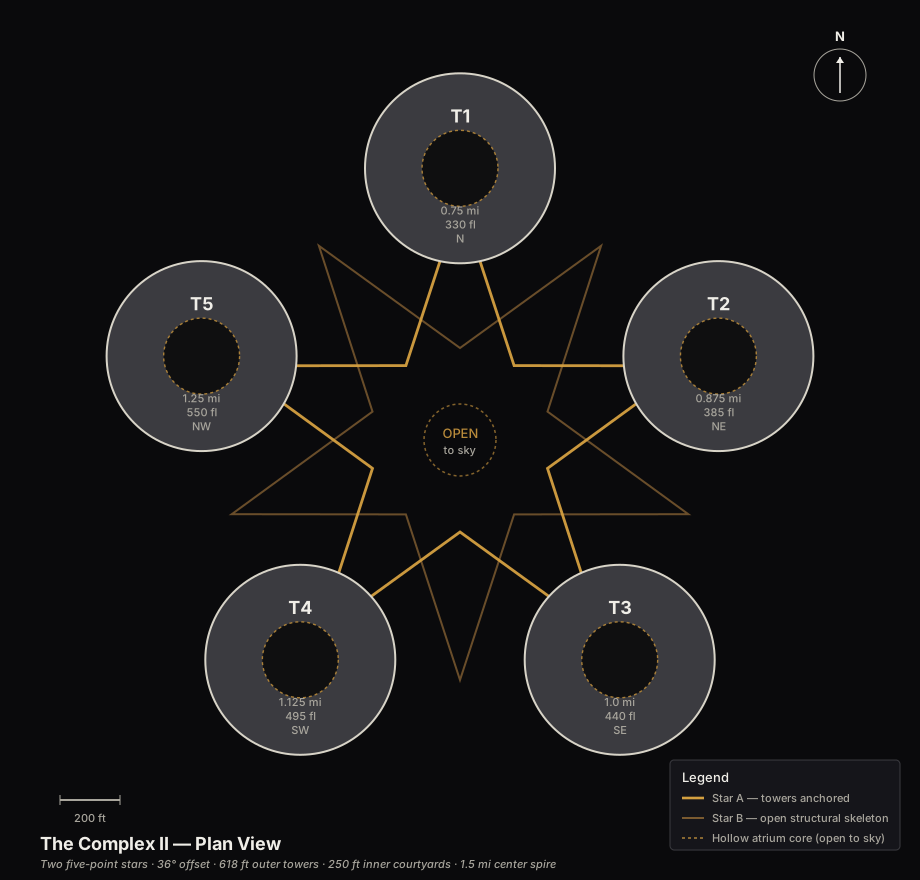
Heights stagger by design
| Pillar | Height | Floors | Total sf |
|---|---|---|---|
| P-N | 0.75 mi | 330 | 82.8M |
| P-NE | 0.875 mi | 385 | 96.6M |
| P-SE | 1.0 mi | 440 | 110.4M |
| P-SW | 1.125 mi | 495 | 124.1M |
| P-NW | 1.25 mi | 550 | 137.9M |
The asymmetric heights are not aesthetic — they are anti-resonant. Five identical Pillars would oscillate together in wind and reinforce each other. Five different heights have five different natural frequencies; their motions damp each other out through the skybridge tendons.
The hollow heart of every Pillar
Each Pillar's 250-ft inner courtyard runs the full height — vertical gardens, multi-story tree wells at sky lobby tiers, real soil and real ecosystems. Stack ventilation rises through these atriums naturally; hot air evacuates to sky for free. They are climate, life support, and lung.
Buttresses, not buildings
The Pillars are the Spire's distributed structural mass. Each is in compression along its own axis and tied laterally to the Spire via the skybridges. Lose a Pillar, the formation does not stand. Lose a Pillar's skybridge connections, the Pillar can survive but the Spire's restraint is degraded.