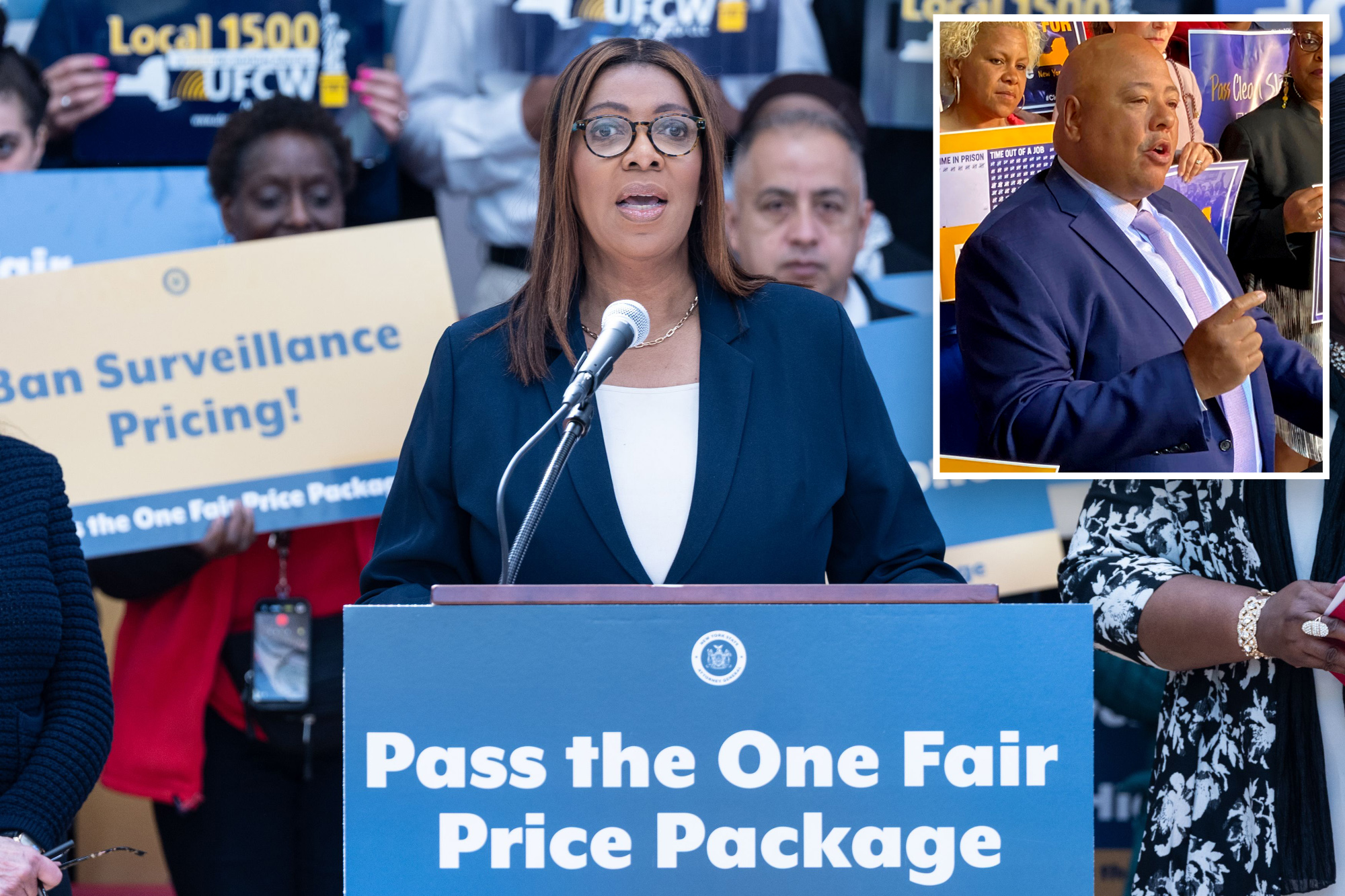
Add The New York Post on Google New York’s leading business advocacy group is launching a $1 million effort to defeat legislation championed by State Attorney General Letitia James that would ban “surveillance pricing” — claiming it could actually hurt consumers.
The “One Fair Price Package” consists of two bills that outlaw surveillance or algorithmic pricing, in which companies use shoppers’ personal data to set individualized prices for consumers.
A similar bill was just introduced in the New York City Council to prohibit algorithm-fueled predatory pricing schemes that charge customers different rates for the same product or service.
But the Business Council of New York State argues the well-intentional proposal to prevent price hikes goes too far.
The legislation could also prohibit tailoring discounts to individual customers based on tracking data or their shopping history, the corporate advocacy group claimed.
“It’s kind of crazy that while basically every New Yorker is demanding affordability, lawmakers in Albany are proposing a bill that would ban discounts for all New Yorkers and force people to cross the GW [George Washington Bridge] to buy things because it would be cheaper. It makes less than zero sense,” Paulo Zuber, executive vice president of the Business Council, told The Post.
The Business Council slams the legislation on its advocacy website, New Yorkers for Affordability, and plans to run ads against it on digital TV and social media.
“Why is Albany taking our discounts and coupons away?” one ad asks.
But James said discounts for shoppers will be protected — not outlawed — and cited a new survey showing New Yorkers overwhelmingly supported stopping companies from using their personal data to set pricing.
“The One Fair Price Package protects shoppers by stopping big companies from using their personal data to manipulate the prices they pay while preserving the discounts, coupons, loyalty programs and promotions for veterans and seniors that consumers count on,” a spokesperson for the attorney general said.
“Our legislation is supported by a broad coalition of unions, small businesses and leaders statewide who are committed to protecting New Yorkers’ personal data and their wallets.”
The coalition backing the legislation includes the Small Business Majority, AARP, NAACP and unions representing grocery store workers.
James’ office said the legislation protects legitimate custom discounts, including individualized discounts based on a customer’s purchase history.
Promotions such as 15% off from a restaurant a customer ordered from before are allowed under the proposal, according to the AG’s office.
Discounts based on milestones or life events, such as a birthday or the anniversary of a membership in a rewards program, are also allowed.
Start your day with all you need to know Morning Report delivers the latest news, videos, photos and more.
But a retailer or app cannot use an extensive number of data points to set a particular price for a particular consumer — regardless of what it is called, James’ office said.
Zuber, of the Business Council, disputed the AG’s claim that all discounts are protected.
He acknowledged the current draft of the proposed law exempts some discounts that apply uniformly to all consumers, like sales events such as “25% off this weekend” coupons distributed publicly or store-wide promotions, including “buy one get one” free.
But Zuber insisted discounts that stores provide to individuals are at risk — such as “Just for You” personalized coupons provided by grocery stores.
“We Miss You” Win-Back Offers, Hotel Loyalty Personalized Rate Discounts, “Browse” Offers and Rewards Programs are also imperiled under the legislation, he said.
“Under the bill, the only permissible loyalty rate would be a flat discount offered identically to every single member of the program, regardless of any behavioral data,” the business group said.
Major New York retailers also use surveillance data to send personalized price-change alerts, such as: “The item you left in your cart last week just dropped in price — here’s an additional 10% off if you complete your purchase today,” the Business Council said.