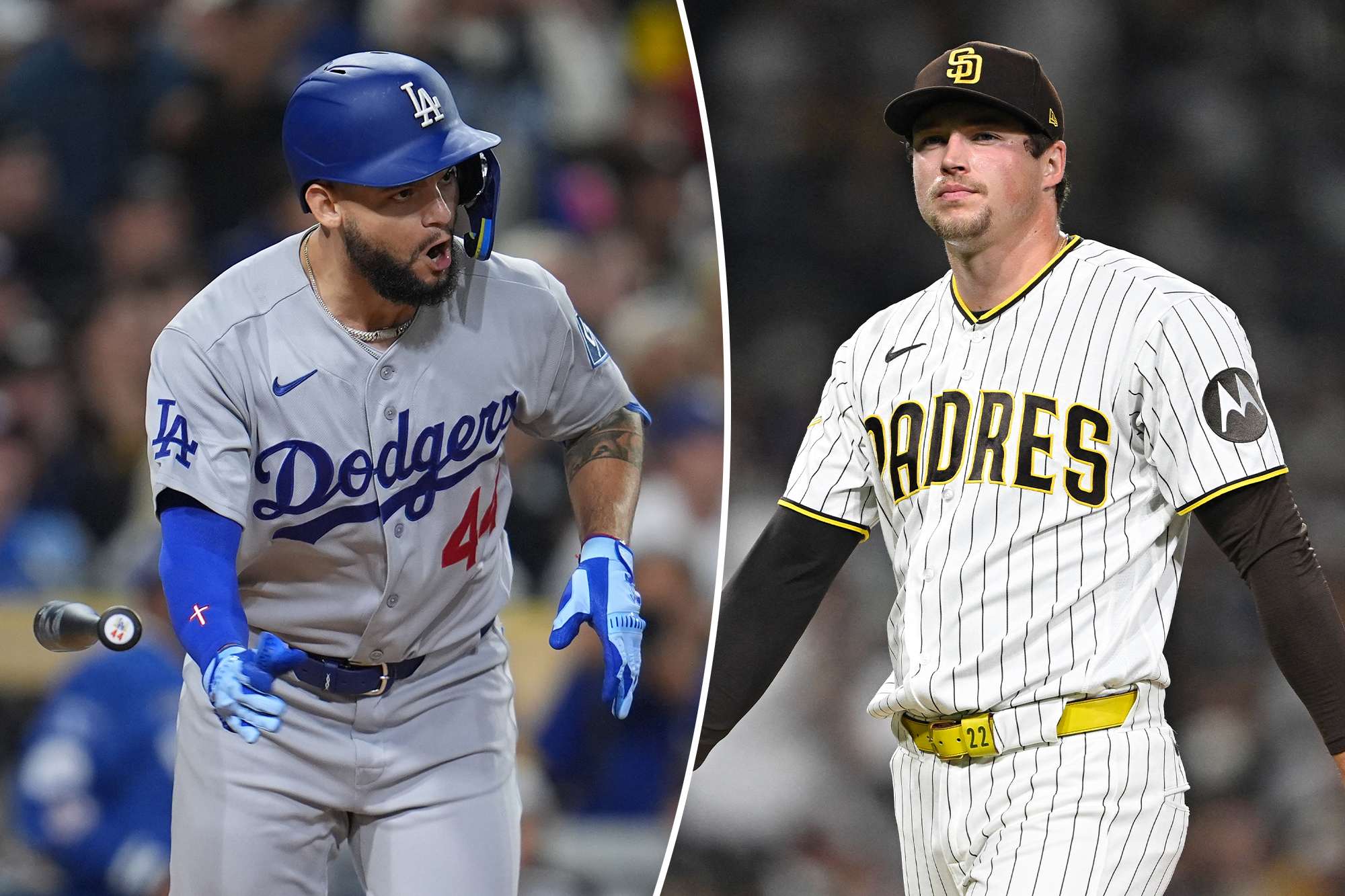
Add The New York Post on Google SAN DIEGO –– Freddie Freeman sat at his locker Tuesday night, shook his head in amazement, and kept repeating the same word at least a half-dozen times.
In the Dodgers’ 5-4 win over the Padres, Freeman himself had hit two home runs. The bullpen combined for five scoreless innings. And the Dodgers secured a come-from-behind victory that put them back in first place in the National League West.
It was a different moment, however, that had the 17-year veteran so mesmerized.
Andy Pages, he declared, had just taken “one of the greatest at-bats I’ve ever seen in person.”
“We were all just like, ‘Wow,’” Freeman added.
In the ninth inning Tuesday, Pages came to the plate at the game’s most critical juncture.
Tie score. Go-ahead run on first. The sport’s best closer on the mound. The Dodgers’ best chance to break through hanging in the balance.
“In my mind, I never thought he was gonna strike me out or dominate me,” Pages said in Spanish. “I was 100% certain I was gonna move the ball forward.”
No pitcher in baseball this year has been as dominant as Mason Miller. Of his first 21 appearances, 20 were scoreless. He’d struck out 45 of 84 batters he’d faced, and gone 15-for-15 in saves, and not suffered a losing decision in more than a calendar year.
On Tuesday, however, Miller put himself in trouble. In the at-bat before Pages’, he walked Max Muncy on a full-count slider initially called a strike but overturned to a ball on an ABS challenge. Then, after catching pinch-runner Alex Call hung out to dry, he misfired on a pickoff throw that allowed Call to race to third.
In Monday’s series-opener, Pages had made the last out of the game against Miller, chasing a low slider in an 0-2 count that he rolled over to third base with the tying and go-ahead runs on base.
It was a matchup, teammate and mentor Teoscar Hernández sensed, that Pages had internalized and learned from.
“He knew the next time he faced him, he was going to do a better job,” Hernández said.
Indeed, with Miller trying to settle back in after his error, Pages dug into the box feeling nothing but belief.
“He’s a good pitcher, but to me, he’s simply a pitcher who throws hard,” Pages said. “And if you’re able to get on time against him, you can do damage against him.”
Thus, after fighting off Miller’s fastball for the first time, Pages seemed to stare back out toward the mound at the 6-foot-5 flame-thrower. The message was sent: He wasn’t backing down.
For as good as Miller has been this year, Pages has had his own breakout start to the campaign.
He entered Tuesday leading the team in batting average (.299), trailing only Max Muncy in OPS (.865) and one off the MLB lead for RBIs (41).
Over the offseason, he spent hours upon hours in the team’s batting cages, working not only on his swing but also his ability to differentiate pitches and control the strike zone. He didn’t just use the club’s augmented-reality Trajekt machine, but dialed up stars like Paul Skenes to craft his approach against.
To people around the team, it has led to renewed confidence from the 25-year-old outfielder, who has completely washed away the historic slump he endured in last year’s playoffs.
“Andy is a tough kid,” manager Dave Roberts said. “He’s hungry.”
And on Tuesday, Roberts proudly noted, he could tell Pages felt “that at-bat is the important thing in your life at that moment.”
“It was just will, determination,” Roberts added. “It was him versus Mason Miller. And he wasn’t gonna lose that battle, man.”
With a slightly shortened swing and perfectly timed leg kick, Pages knew early on he had Miller’s fastball timed up –– even though the pitch’s average 101.3 mph velocity is the hardest in the majors by more than a full tick.
“I was on time and I’m sure he noticed that,” Pages said. “There were some pitches he threw 102 and I fouled them off, and I saw them well. In that moment, that’s when I had the confidence to tell myself that he didn’t have a chance.”
At least, in a situation where a fly ball would give the Dodgers the lead, not a chance to strike Pages out.
What makes Miller almost impossible is that he has not only an almost unhittable fastball (opponents had gone 5-for-27 against it previously, all singles with 12 strikeouts) but also a change-of-pace, upper-80s mph slider that can usually get any hitter trying to cheat to to his four-seamer helplessly out in front.
Pages, however, possesses rare contact ability, co-hitting coach Aaron Bates said. It’s not just that he gets the bat to the ball. It’s how his natural athleticism allows him to adjust mid-swing, something Bates added “not many people” have.
“When he’s super locked-in and focused in those situations, that’s what he can do,” Bates said. “He’s gonna make contact in certain ways.”
Staying locked in and sticking to an approach is where Pages has faltered in the past. But this season, coaches have raved about the third-year big-leaguer’s maturity, with Roberts noting multiple times how the slugger has been able to limit cold spells and sustain hot streaks; never getting too low while letting himself ride the highs.
“(He was) not worrying about mechanics and this and that,” Roberts said, adding: “That was his only focus. That at-bat.”
Pages felt momentum changing over the course of the battle.
“Obviously, at the start of my at-bat, it’s a little harder because he has a little bit more confidence,” Pages said. “But hitting so many pitches foul, I think his confidence dropped a little, mine went up.”
Miller didn’t go quite that far in his postgame address with reporters. But he did highlight the “outstanding job” Pages did in fighting away his typical putaway weapon.
“Good approach from him,” Miller said, “staying on the slider enough to foul it off and get to the heater.”
For reference: Miller had previously generated an absurd 68% whiff rate with his slider (aka, an empty swing in almost 7 of 10 hacks), and used it for 32 of his punchouts.
On Tuesday, Pages fouled it off three times and laid off another.
Now, Miller had tried almost everything. Fastballs up-and-in. Sliders at the top and bottom of the zone. A chase pitch in the dirt.
So, with his 22nd pitch of the inning, and ninth of the at-bat, he kicked, fired and went back to Plan A.
With an 85 mph line drive that sailed just deep enough to right field, Pages delivered the game-winning sacrifice fly in the Dodgers’ eventual 5-4 win. He chucked his bat. Call came sprinting home. A relay throw from Fernando Tatis Jr. was cut off. Catcher Freddy Fermin’s tag came a split-second after Call’s foot tapped the plate.
“To hit 102 is probably the hardest thing to do,” Freeman said. “And to foul off 102s back-to-back, sliders at 87, 88 –– one of the best at-bats I’ve ever seen.”
Back in the dugout, the celebration was delayed by a Padres’ challenge. But once the call was confirmed, there was a round of high-fives while Call shook his shoulders.
“The most important thing is winning,” Pages said. “When you have confidence and you feel good against a pitcher, you can do the job, and that’s what happened today.”
Thus, it was back to business. Pages popped in one sugar-free bubblegum, then another. He returned to center field, and watched Will Klein collect the final three outs. Then, he returned to a clubhouse still marveling at the moment.
“Mason is the best in the game right now,” Roberts said, “and Andy willed himself to do something productive in that at-bat.”
“That at-bat,” Freeman reiterated, “was incredible.”