WASHINGTON — The CIA used a futuristic new tool called “Ghost Murmur” to find and rescue the second American airman who was shot down in southern Iran, The Post has learned.
The secret technology uses long-range quantum magnetometry to find the electromagnetic fingerprint of a human heartbeat and pairs the data with artificial intelligence software to isolate the signature from background noise, two sources close to the breakthrough said.
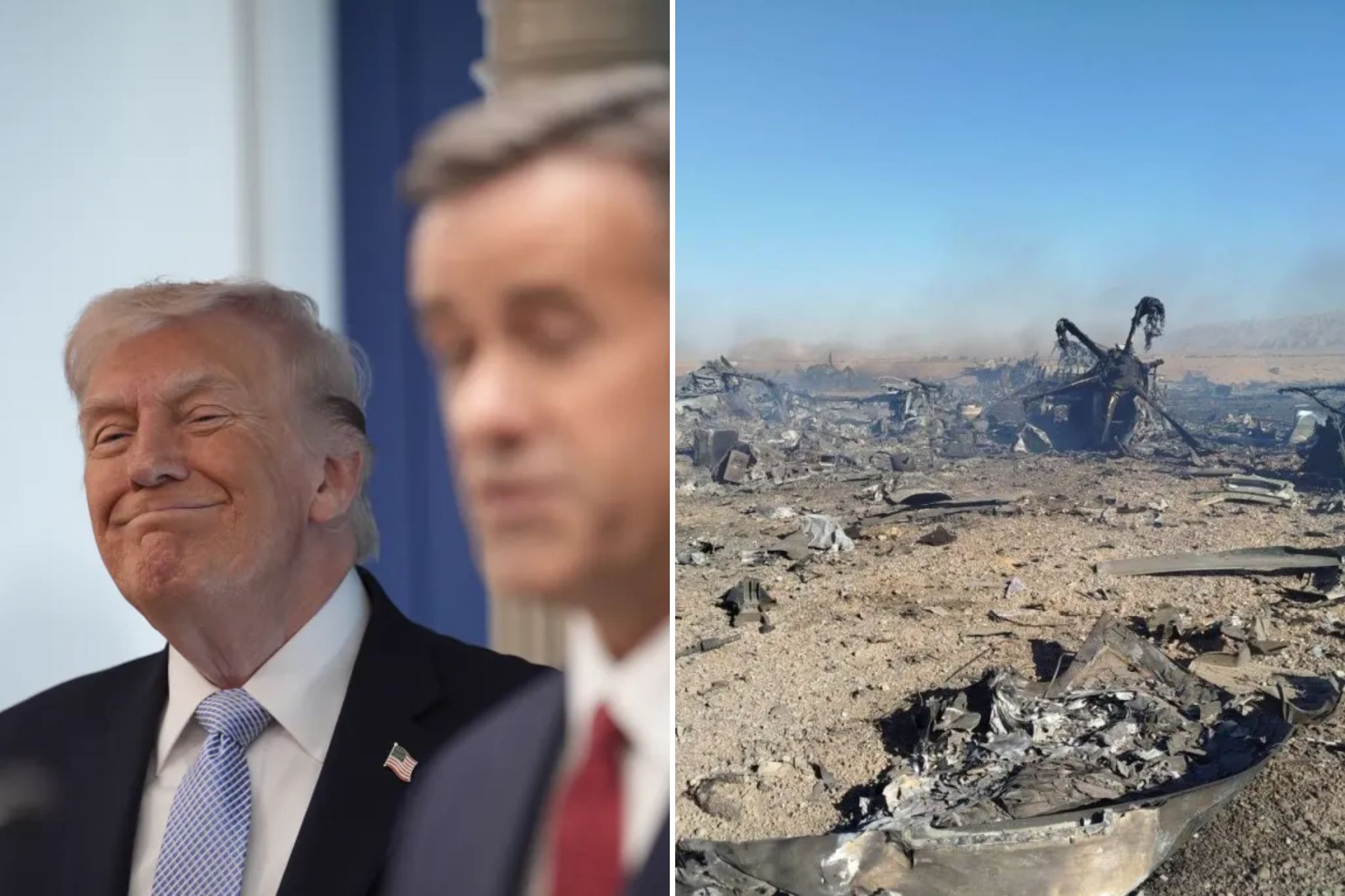
It was the tool’s first use in the field by the spy agency — and was alluded to Monday afternoon by President Trump and CIA Director John Ratcliffe at a White House briefing.
“It’s like hearing a voice in a stadium, except the stadium is a thousand square miles of desert,” a source briefed on the program told The Post. “In the right conditions, if your heart is beating, we will find you.”
This source and another with knowledge of Lockheed Martin intelligence collection tools told The Post that “Ghost Murmur” was developed by Skunk Works, the aerospace giant’s secretive advanced development division. The company’s press office did not immediately respond to a request for comment.
The technology has been successfully tested on Black Hawk helicopters for future potential use on F-35 fighter jets, the second source said.
The missing and wounded weapons systems officer — known publicly only as “Dude 44 Bravo” — was hiding in a mountain crevice after his F-15 jet was shot down late last week, surviving two days in desolate terrain as Iranian troops scoured the area for the American with a bounty on his head.
The relatively barren landscape made for “an ideal first operational use” of Ghost Murmur, the first source said.”
“The name is deliberate. ‘Murmur’ is a clinical term for a heart rhythm. ‘Ghost’ refers to finding someone who, for all practical purposes, has disappeared,” the first source said.
It was “about as clean an environment as you could ask for” because of low electromagnetic interference, “almost no competing human signatures, and at night the thermal contrast between a living body and the desert floor,” which “gave operators a secondary confirmation layer.”
“Normally this signal is so weak that it can only be measured in a hospital setting with sensors pressed nearly against the chest,” the source said.
“But advances in a field known as quantum magnetometry — specifically sensors built around microscopic defects in synthetic diamonds — have apparently made it possible to detect these signals at dramatically greater distances.”
“The capability is not omniscient. It works best in remote, low-clutter environments and requires significant processing time,” this person said.
It was unclear to The Post’s sources how long the processing time was in this use. It’s also unclear if the technology may have additional wartime offensive uses.
Although the missing airman had activated a Boeing-made Combat Survivor Evader Locator beacon, officials said his precise whereabouts remained uncertain to search and rescue teams.
The pivotal moment in the frantic two-day search and a dramatic rescue mission came when the “Ghost Murmur” pinpointed the aviator’s location — with the first source describing the two technologies as both being useful in ball-parking and then confirming the location.
“He had to come out [of the crevice] to send the beacon,” the first source said. “It was less important the signal they sent and more important that he had to come out to send [it].”
Trump and Ratcliffe hinted at the new technology while briefing the press on the successive yet dramatic mission, which included hundreds of US troops and two rescue planes getting stuck in a field, requiring more planes and the destruction of the stranded jets — with no American casualties.
Ratcliffe, who took no reporter questions at the briefing, said that on Saturday morning the spy agency “achieved our primary objective by finding and providing confirmation that one of America’s best and bravest was alive and concealed in a mountain crevice — still invisible to the enemy, but not to the CIA.”
“That confirmation was relayed by Secretary [of War Pete] Hegseth to the president, and the operation quickly moved to the execution phase,” the CIA director said.
Trump told the press that the CIA spotted the missing American from “40 miles away.”
“It’s like finding a needle in a haystack, finding this pilot, and the CIA was unbelievable,” Trump said Monday. “The CIA was very responsible for finding this little speck.”
The president said that Ratcliffe “did a phenomenal job that night — he did something that I don’t know if you want to talk about it. If you want, you can. I’m not sure he’s supposed to.”
The president joked that the technology “might be classified, in which case I’d have to put him in jail if he talks about it and I don’t want to put him in jail. He doesn’t deserve that.”
Trump has himself revealed the contours of secretive new technologies — including telling The Post in January that he had deployed a weapon called “The Discombobulator” to disable Venezuelan defenses during the Jan. 3 raid that captured the country’s dictator Nicolas Maduro to face US drug and weapons charges.
The secret nature of Ghost Murmur was “basically why everyone’s been so cagey about how [the airman] was actually found,” the first source said.
“I don’t think people even know this technology is possible from this distance.”