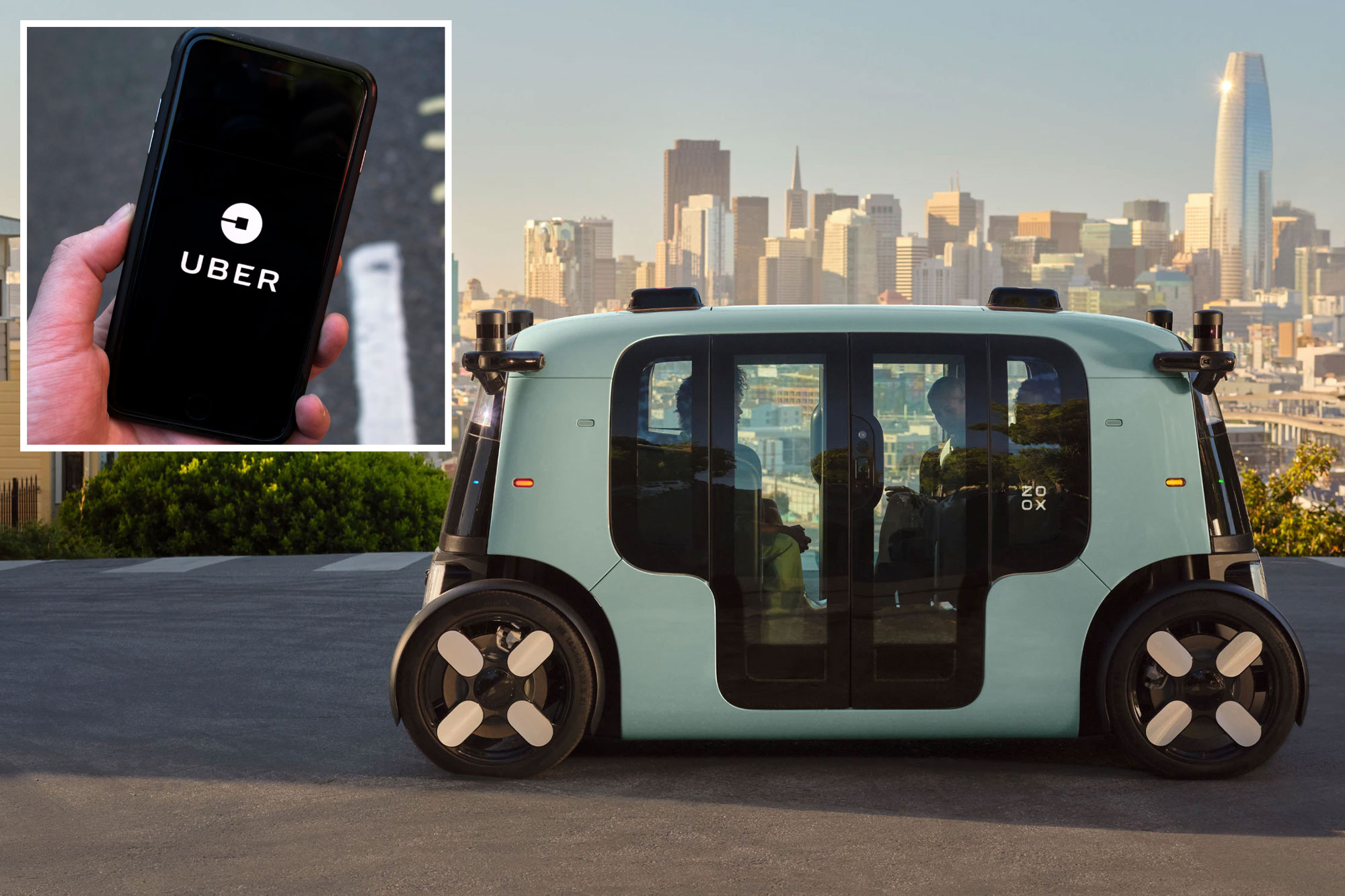
Los Angeles ride-share customers can soon be picked up in a vehicle that looks more like a spaceship than a car — no steering wheel, no gear shift, no gas pedal.
Zoox Inc., the Northern California-based autonomous vehicle company, revealed it’s teaming up with Uber Technologies Inc. to bring its self-driving cars to the Uber app next year, with LA the launchpad, the Los Angeles Business Journal reported.
“The Zoox robotaxi is unlike any other vehicle on the planet,” Dara Khosrowshahi, Uber’s CEO, said in a statement. “It was purpose-built from the ground up to deliver an extraordinary experience.”
The company, an Amazon.com Inc. subsidiary, has quietly been driving through LA for about a year, mapping streets with retrofitted Toyota Highlanders and human drivers, in a similar way Waymo was first introduced.
These test vehicles are just a stopgap, prepping the city for the fully autonomous, bidirectional Zoox shuttles that allow passengers to face each other rather than sit in traditional rows.
In other words, it’s like a miniature boardroom on wheels.
While Waymo’s fleet of modified Jaguar electric vehicles already navigates LA, Zoox’s futuristic robotaxis are designed to stand out.
“Los Angeles has much to teach us,” Zoox said in a statement. “It is a vibrant city where people use ride-hailing and [using] various modes of transportation to get around. Los Angeles is also well-known for its traffic congestion and car reliance.”
Zoox has used the same approach in other cities — Las Vegas, San Francisco, Seattle, Miami and Austin— mapping the streets before releasing its autonomous cars.
In Las Vegas, its service runs from 11 a.m. to 1 a.m. along the Las Vegas Strip and nearby areas, with limited rides to attractions like the Sphere and T-Mobile Arena.
In San Francisco, the company plans to launch operations across a significant portion of the city this spring.
After mapping Austin’s streets starting mid-2024, Zoox is set to deploy vehicles there later this year.
Launching in smaller zones makes sense, says Rahul Jain, a professor at the Viterbi School of Engineering at the University of Southern California.
Autonomous vehicles must understand unique road conditions — pavement, bike lanes and bus-only routes.
“Some of the technology relies on what is called high-definition maps. The roads and the streets need to be remapped over and over again,” Jain told the LA Business Journal about autonomous vehicles generally.
“If you have high-definition maps, then you can expect that it will be more reliable, and it will be safer.” Zoox has been approached for further comment.
In May 2024, the National Highway Traffic Safety Administration opened a probe after two rear-end collisions in broad daylight involving Zoox vehicles equipped with the company’s Automated Driving System.
Both crashes resulted in minor injuries to motorcyclists, prompting a preliminary evaluation of 500 vehicles.
“Transparency and collaboration with regulators is of the utmost importance, and we remain committed to working closely with NHTSA to answer their questions,” a company spokesperson said back then.
The crashes came amid Zoox’s expansion of vehicle testing in California and Nevada, including higher speeds and nighttime operations, as the company competes with Waymo.
Problems continued into 2025, when a voluntary software recall followed a collision in San Francisco involving an e-scooter rider.
The recall addressed flaws in the vehicle’s perception tracking system, which could misread the movements of other road users.
Regulators have also been investigating Zoox’s earlier self-certification of a robotaxi without traditional driving controls, raising questions about whether the unique vehicle design met safety standards.
California Post News: Facebook, Instagram, TikTok, X, YouTube, WhatsApp, LinkedInCalifornia Post Sports Facebook, Instagram, TikTok, YouTube, XCalifornia Post Opinion California Post Newsletters: Sign up here!California Post App: Download here!Home delivery: Sign up here!Page Six Hollywood: Sign up here!