S. Vincent Anthony is not what you expect when you think of a technology founder. There is no hoodie, no Silicon Valley address, no venture capital origin story. He is a 47-year veteran of enterprise technology — IBM, Loral, Suzuki, CPI Tech — who spent the last three years building something in Cape Coral, Florida that he believes will outlast every company he has ever worked for. I sat down with him this week to find out why.
Gina: Most technology founders go to Silicon Valley, raise money, hire a team, and then build. You did the opposite. Why?
Vincent: Because I have watched that model fail people my entire career. You raise money first, you optimize for the investors, and somewhere between the first check and the second check the thing you were actually trying to build gets replaced by the thing that returns capital on a five-year horizon. I was not interested in that. I had a very specific thing I wanted to build and I needed to know it could actually be built before I asked anyone to believe in it.
Gina: And now you know it can be built.
Vincent: Now I know it is built. That is a different statement. We have 23.57 million real estate properties in production databases across seven states. We have 342 gigabytes of geographic data covering 261 million road and boundary lines. We have twelve applications running in production — not prototypes, not demos, production systems handling real transactions for real merchants. Fun Time Hobbies, my own RC hobby shop here in Cape Coral, runs on NeuraWeb infrastructure as a live authorized Traxxas dealer. CRES Southwest Florida, a commercial brokerage, is a live enterprise partner. The platform is built. That is the conversation I want to have with investors — not "here is what we will build if you give us money" but "here is what exists, here is what it does, here is where we are taking it."
Gina: Let's back up. What is NeuraWeb, in the simplest possible terms?
Vincent: It is a permanent digital identity platform. One identity per person — yours for 150 years, transferable to your heirs, free from surveillance, backed by a revenue model that pays you instead of selling you. When you join NeuraWeb you receive a .nw namespace. That is your identity across every application on the platform. You own it. No platform can take it from you. No company can delete it. No algorithm decides what you see or harvests what you do. That is the foundation. Everything else — the real estate platform, the news network, the point-of-sale system, the social feed, the mapping database — is built on that foundation.
Gina: The "no surveillance" piece — is that a marketing claim or is it structural?
Vincent: It is structural. There is no Google Analytics on any NeuraWeb property. No Facebook Pixel. No third-party tracking of any kind. That is not a setting users can toggle. It is built into the infrastructure at a level that makes surveillance architecturally impossible. Our news platform — NeuraNews Network, which you are reading right now — runs on that same architecture. No tracking pixels. No behavioral advertising. No data broker relationships. The news is yours to read. None of your reading habits belong to anyone else.
Gina: You mentioned revenue sharing. How does that work?
Vincent: The existing internet pays users zero percent of the value they generate. Zero. Five point five billion people use the internet every day and create every dollar of a four point nine trillion dollar economy and receive nothing. NeuraWeb returns between twenty and ninety-five percent of the revenue generated by user activity back to the users who generated it. Content creators keep the majority of what their content earns. Commerce participants keep the majority of their transaction value. The platform takes a service fee. That is a structurally different relationship between a platform and its users — and it is the growth engine that no advertising budget can replicate. When users earn from the platform, they do not need to be paid to recruit. They recruit because they are economically invested in the platform's growth.
Gina: That sounds like a very different business model than anything that currently exists at scale.
Vincent: It is. And that is precisely the point. Every platform in history has grown by spending money on user acquisition. We grow by paying users. The flywheel compounds without advertising spend because the users are owners, not products. That changes the entire economics of growth.
Gina: You mentioned the giants — Google, Meta, Amazon. Are you trying to replace them?
Vincent: No. I want them out of the surveillance business, not out of business. They can profit. They just cannot profit by exploiting the people who make them profitable. The surveillance model is a burning platform and the regulatory pressure on it is permanent and accelerating. GDPR has levied over four billion dollars in fines since 2018. Apple's App Tracking Transparency removed ten billion dollars from Meta's annual revenue with a single privacy toggle. The giants know their model is under siege. What they do not have is an alternative architecture. NeuraWeb gives them the exit ramp. They become partners building on infrastructure they do not control, reaching users they cannot surveil, earning revenue they did not steal. That is a world worth building — for them and for everyone else.
Gina: Let's talk about Cape Coral. This is not where people expect a platform of this ambition to be headquartered.
Vincent: I grew up understanding that the best work gets done by people who are building something real, not performing for the right zip code. Cape Coral is home. This is where I built it. This is where it will stay. And frankly, there is something fitting about the fact that the platform that is supposed to give power back to regular people was built by a regular person in a regular city in Southwest Florida — not in a glass tower in San Francisco by people who have never worried about anything in their lives.
Gina: You are a veteran. Does that inform how you think about NeuraWeb?
Vincent: Deeply. Service teaches you that some things are worth building regardless of whether they are easy or profitable in the short term. salute.nw — our veteran honor platform — is the most personal thing I have ever built. Fourteen point four million veterans, permanent records, heir-transferable, free. I am in that database. Not as the founder. As a veteran among veterans. The same principles that govern salute.nw govern every decision I make about NeuraWeb. Permanence. Dignity. Ownership. Service to people who deserve better than what they have been given.
Gina: You mentioned entering a growth phase. What does that mean for NeuraWeb right now?
Vincent: It means the building phase is over and the scaling phase is beginning. The infrastructure exists. The data is real. The merchants are live. The applications are running. What comes next is the team, the user acquisition, the enterprise expansion, and the partnerships — both with individual investors and with the kinds of institutional partners who will eventually make NeuraWeb the substrate the giants run on. I am selectively engaging with people who understand what has been built, who believe in the long-term thesis, and who want to own a piece of the infrastructure that takes the internet back. I am not looking for investors who want a three-year exit. I am looking for partners who think in decades.
Gina: What is your message to someone reading this who might be one of those partners?
Vincent: The platform is built. The data is real. The vision is clear. If you have spent any time thinking seriously about where the internet goes from here — about surveillance capitalism, about identity fragmentation, about what happens to your digital life when you die — and you believe there is a better answer, I want to have that conversation. Reach out. Let us talk about what has been built, where it is going, and whether this is something you want to be part of.
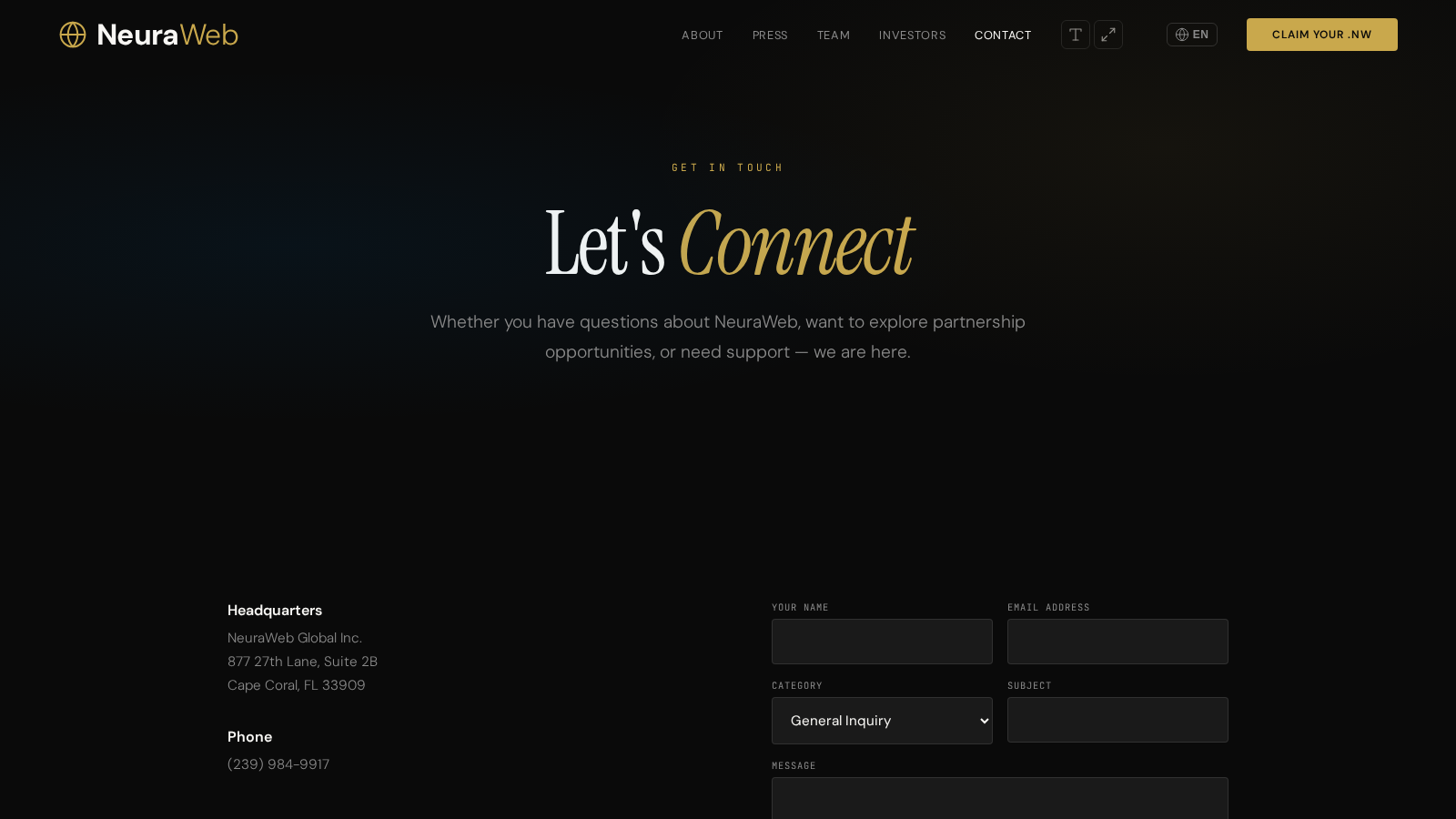
To connect with NeuraWeb Global Inc. or inquire about partnership opportunities, visit neuraweb.io/awaken.nw/contact.
This article is editorial content and does not constitute a securities offering, solicitation, or advertisement. Any investment discussions are conducted privately and exclusively with pre-qualified individuals under applicable securities law.