play Live Sign upShow navigation menuplay Live Click here to searchsearchSign upOPINIONOPINION, Opinion|The Far RightAfD is rising, but it can still be stoppedThe German mainstream still has a window of opportunity to act and reverse a dangerous trend to the far right.
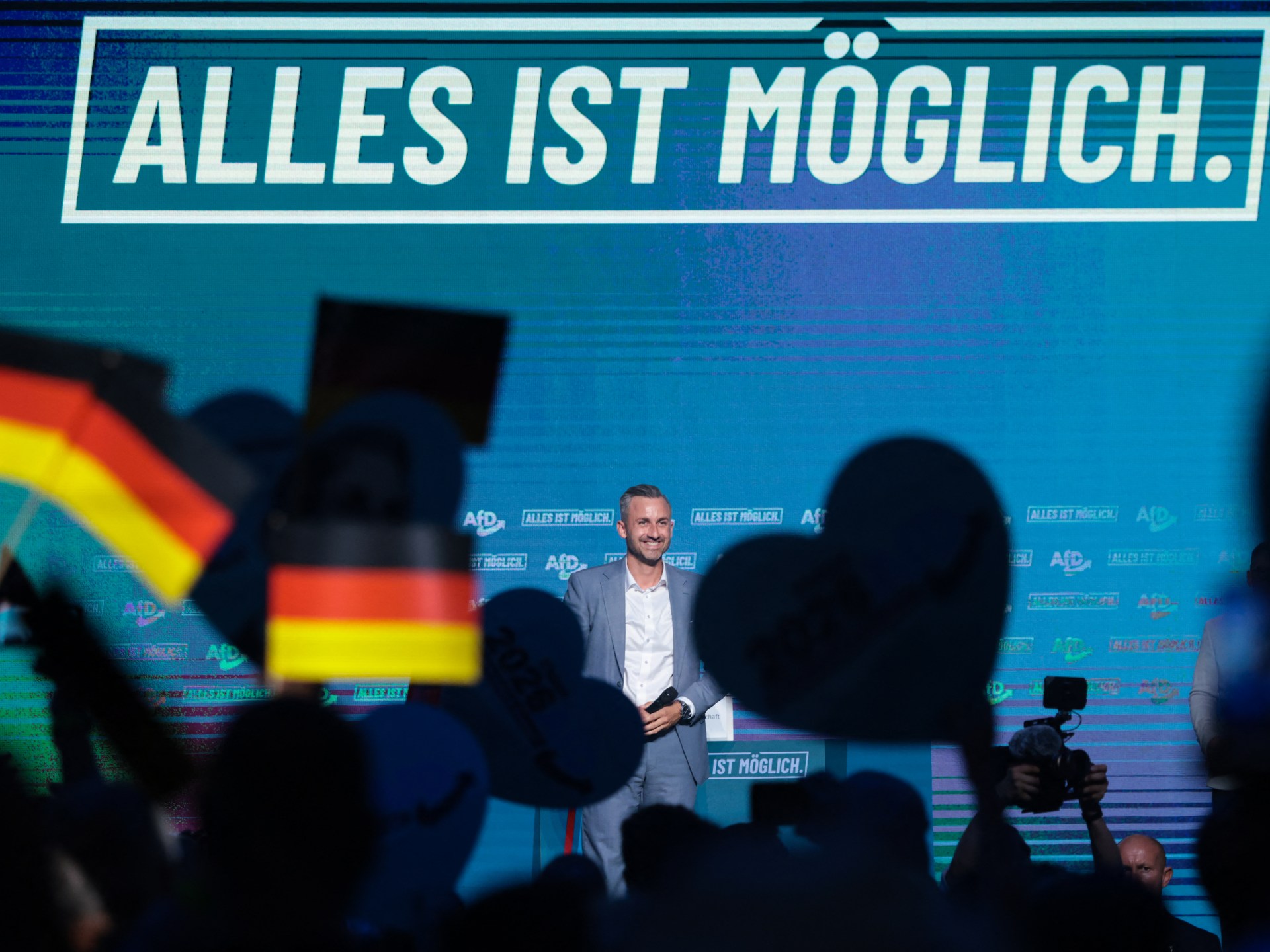
xwhatsapp-strokecopylinkgoogleAdd Al Jazeera on GoogleinfoUlrich Siegmund, top candidate in the Saxony-Anhalt state election for the far-right Alternative for Germany (AfD) party, addresses a campaign event in Magdeburg, eastern Germany, on September 5, 2026 [AFP]The victory of far-right Alternative for Germany (AfD) in the elections of the East German state Saxony-Anhalt is a dramatic moment for Germany. The party won 44 percent of the vote, securing 39 seats in the 83-seat local legislature.
Although this result falls short of a majority, it is close enough. The small, populist BSW party has indicated that it may enable the election of an AfD head of government in the state. This would give executive power to an extreme-right party in a German state for the first time since World War 2.
The election has already deeply disturbed Germany. It is the culmination of a decade-long process that saw the AfD move from a marginal protest party to a major political power.
Although this election has been a tough blow for the other mainstream German parties, they still have an opportunity to reverse this dangerous trend. That would depend on whether those in power are prepared to take decisive action.
When considering what strategy must be adopted in response to AfD’s surge, it is important to explore the attitudes of its electorate and the socioeconomic conditions affecting them.
In recent surveys, conducted by the think thank I co-lead, d|part, people in Saxony-Anhalt were much more likely than the national average to report job prospects, education, health care and the social environment worsening where they live.
The mismatch between public demands for better economic opportunities and social services and what the government has delivered has resulted in the anger that the AfD has been able to exploit.
While AfD’s proposed policies in Saxony-Anhalt could worsen socioeconomic problems, many voters do not see an alternative. Their trust in the parties in power has eroded too much.
According to our surveys, roughly three quarters of AfD voters do not consider any other party as a viable option at all. Among supporters of other parties, more than half could name at least one other political option they would also consider. In short, most AfD voters are firmly and distinctively committed to the party.
Among those committed AfD voters, there are many who firmly agree with the extreme right and racist positions of the party. Over the last 10 years, the support base of the AfD has shifted from a majority, saying they vote for the party despite their positions to saying they vote for it because of them.
In the short term, those hardline voters of the AfD are not reachable. But the quarter of current AfD supporters who are open to other parties could be swayed. Most of them do not think the AfD is the best on areas like the economy or cost of living.
In the immediate aftermath of the Saxony-Anhalt election, this group should be the focus of mainstream parties. How they approach these voters could make a difference in the upcoming elections in Berlin and Mecklenburg-Vorpommern state later this month.
In the longer term, there should be a major overhaul of political strategies across the mainstream.
Our surveys show that across the country and the political spectrum, voters are deeply discontent with the status quo. Germans have a very low opinion of the current government. Chancellor Friedrich Merz has the worst approval rating of any German government head since polling began – currently at 13 percent. The disapproval of the work his government is doing is near unanimous across German society.
But dissatisfaction in the government does not mean people do not want strong state action. To the contrary, across the political spectrum decisive and transformative action is desired.
Our research shows that most people, including AfD voters open to other parties, fundamentally trust state institutions and want a government that takes actions to improve people’s living conditions. They do not just care about the money in their own pocket but rather want to see the areas they live in improve in terms of economic and job opportunities but also in terms of social, educational and cultural services.
There are many reasons why the current government – like its predecessors – is failing to deliver. But a major one is that the traditionally large parties, the Christian- and Social-Democrats, have made a huge mistake in recent years of letting the AfD set the agenda.
Hoping to gain more votes, they have picked up AfD’s focus on immigration, placing it at the centre of their agendas and rhetoric. While that has fed anti-immigrant sentiments in the country, it has not made immigration the German people’s main priority.
Our surveys show that the overwhelming majority – 80 percent – of the public think that economic policy should be prioritised over immigration policy.
This means that the German mainstream should stop trying to “steal” AfD’s votes by adopting its agenda and rhetoric. It should not accommodate AfD because accommodation leads to normalisation, and that would only fuel its ascendance.
Instead, mainstream parties should regain the initiative by setting the political agenda, pursing a credible shift in policies, and demonstrating a capacity for decisive action.
The mainstream has to offer a clear plan of action to significantly improve people’s lives. The emphasis of policy making must shift from abstract macroeconomic indicators to tangible changes that affect directly ordinary Germans. Local authorities must be empowered and financially enabled to improve the socio-economic conditions at the local level.
Most Germans want a government that takes strong action and cooperates with businesses to improve life in urban and rural places. If the AfD is to be stopped from progressing, the confidence in the government at all levels must be restored.
In the 20th century, Germany saw the dangers of underestimating a rising extreme-right party during times of economic upheaval. The consequences of that mistake devastated Europe. We must learn from history and do better now.
The views expressed in this article are the author’s own and do not necessarily reflect Al Jazeera’s editorial stance.