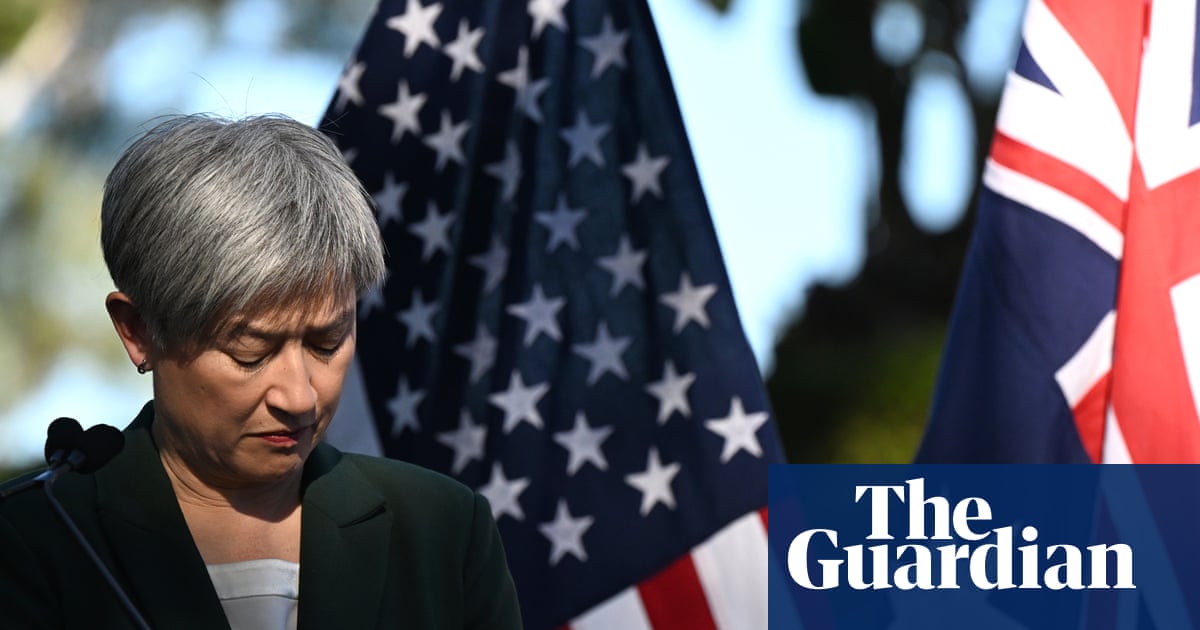
The foreign affairs minister, Penny Wong, told the Senate on Monday the US military presence in the country is ‘at Australia’s invitation’, and that the defence sites were ‘Australian bases under Australian command’. Photograph: Darren England/AAPView image in fullscreenThe foreign affairs minister, Penny Wong, told the Senate on Monday the US military presence in the country is ‘at Australia’s invitation’, and that the defence sites were ‘Australian bases under Australian command’. Photograph: Darren England/AAPGrassroots Labor group urges Albanese government to chart course away from ‘American war machine’Pressure follows revelations US military and weapons manufacturers control or have access to more than 100 bases across Australian continent
Why can the US access so many Australian military bases? – podcast
Get our breaking news email, free app or daily news podcast
The US has “led Australia into wars of aggression” for 50 years, internal party campaign group Labor Against War has argued, urging the government to chart a foreign policy independent “from the American war machine”.
The Australian government has defended the growing presence of the US military on the Australian continent, insisting the defence sites “are Australian bases under Australian control”, despite evidence the US military controls more than a dozen bases on Australian territory.
On Monday, the Guardian published data showing the US military, and US weapons manufacturers, control or have access to more than 100 bases across the Australian continent.
Read moreThe Guardian has detailed 17 military facilities on Australian soil which are controlled by the United States military. The military has access to 75 more Australian-run bases, and US defence corporations access to 18 more.
In total, the US military and American defence corporations have control of or access to 110 facilities on Australian territory, well over half of all the military installations in Australia. That analysis has not been contradicted. The data was compiled by Dr Richard Tanter, senior research associate with the US-based Nautilus Institute.
The publication of the database has exposed disquiet within the Labor party over growing US military presence across the continent.
Marcus Strom, the national convener of the grassroots Labor Against War group, said “the latticework of US bases and facilities across our continent should alarm anyone that values Australia’s independence from the American war machine”.
“For more than 50 years the US has led Australia into wars of aggression,” Strom said.
“Labor Against War calls on the Albanese government to chart a new course for Australia’s foreign and defence policy that is suited to the future, not clinging to the fading guarantees of the past.”
Strom said the government should abandon the Aukus nuclear submarine agreement as a first step.
In question time in the Senate, Greens senator David Shoebridge asked the foreign affairs minister, Penny Wong, why the government had chosen to “sign us up to the next US war”.
Wong said the government would resolutely defend the US alliance, and that “everything the government is doing is working to deter and avert conflict”.
7:00US military presence in Australia, mapped – video“We are of the view that the US alliance contributes to Australian sovereignty. It enables us to have access to a range of capability that Australia would not have access to,” she said.
Wong told the Senate the US military presence in the country is “at Australia’s invitation”.
“These are Australian bases under Australian command.”
Shoebridge said Australians living near US military facilities in Australia feared they could be targets in the event of conflict in the region, citing attacks on US bases in the Middle East in the current war with Iran.
“These bases obviously make Australia a target when the US decides to start its next forever war, don’t they?”
Shoebridge asked Wong to specify one instance where Australia had said no to the US having access to an Australian military base.
“Access to and use of Australian facilities … is on a rotational basis, mutually determined and at Australia’s invitation,” Wong said.
Read morePine Gap, the best known of the US-Australia “joint defence facilities” on Australian territory, was established by the CIA in the 1960s near Alice Springs. US National Security Agency documents, leaked by whistleblower Edward Snowden, show the “chief of facility” at Pine Gap is always an American, who reports directly the US National Reconnaissance Office. The deputy is a senior Australian Signals Directorate official.
Former defence minister Christopher Pyne described Pine Gap in a public hearing as “more American than Australian”. There are numerous other bases on the Australian mainland that are controlled by the US rather than Australia, including the GPS monitoring station at RAAF Edinburgh base in South Australia, and the Learmonth solar observatory in Western Australia.
The defence minister, Richard Marles, travelled to the US last week, agreeing with the US secretary of defense, Pete Hegseth, “to accelerate force posture initiatives at Australian bases, bolster cooperation in combined logistics, and build greater interoperability through joint exercises”.
Marles said: “American force posture is growing in Australia, and that’s across all the domains”.
“We think that’s really important in terms of providing deterrence in the Indo-Pacific, providing for stability and peace in the Indo-Pacific, and that’s very much in Australia’s national interest.”