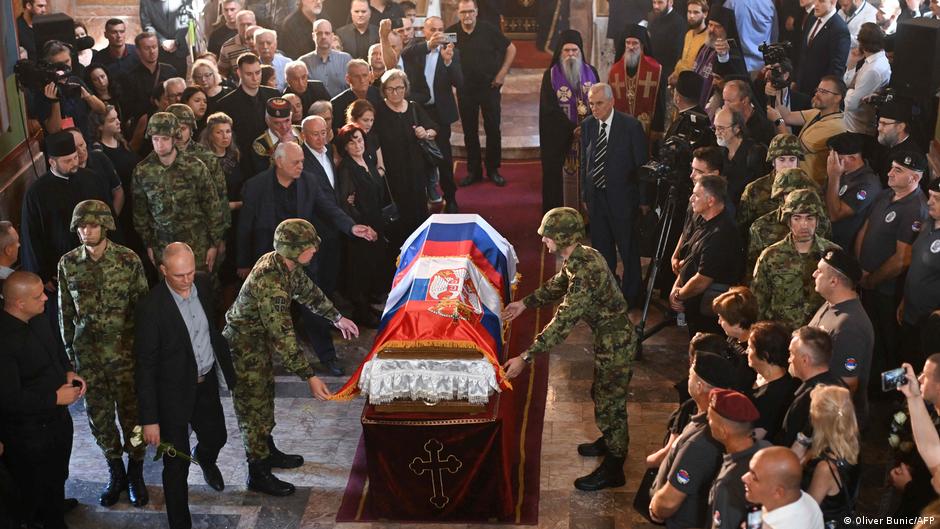
Ratko Mladic, the former Bosnian Serb commander convicted of genocide in Srebrenica, has been buried in Belgrade. The funeral, broadcast live on TV, comes just days before President Vucic is expected to call an election.
https://p.dw.com/p/5M6BaFormer Bosnian Serb army commander and convicted war criminal Ratko Mladic was buried in Belgrade on MondayImage: Oliver Bunic/AFPAdvertisementSeveral thousand people lined the streets of Belgrade on Monday to follow the funeral service and burial of former Bosnian Serb army commander Ratko Mladic.
Earlier in the day, Serbian Patriarch Porfirije personally officiated at the funeral service for the former general, who died while serving a life sentence in The Hague for genocide in Srebrenica and other war crimes committed during the violent breakup of Yugoslavia in the 1990s.
In accordance with his wishes, Mladic was laid to rest at Topcider Cemetery beside his daughter, who died by suicide in 1994.
Informer TV, a staunchly pro-government broadcaster, carried live coverage of what it described as a "magnificent farewell," without mentioning the roughly 8,000 Bosniak civilians and prisoners massacred by Mladic's Bosnian Serb forces in Srebrenica in July 1995.
President Aleksandar Vucic did not attend the funeral, citing a previously scheduled visit by his counterpart from Uzbekistan.
Observers say that the president has tried to chart a middle course on the issue of Mladic's funeral.
Mladic was not buried with state honors, but with military honors, with Vucic insisting that the state was merely respecting the wishes of the family and ensuring a dignified burial.
"Were we supposed to forbid people from attending, forbid the funeral itself and create dog cemeteries?" he said in response to criticism from the EU.
The phrase "dog cemeteries" refers in Serbia to the unmarked graves of so-called "enemies of the people" who were executed by Yugoslav partisans during and immediately after World War II.
Vucic was equally dismissive of the decision by EU Enlargement Commissioner Marta Kos to cancel a planned visit to Belgrade, calling her reaction "stupid." He has brushed aside other criticism of the public glorification of Mladic in much the same way.
An EU spokesman said in a statement that "Any glorification of war criminals, genocide denial and revisionism contradict the most fundamental European values and have no place in the EU or in EU candidate countries."
For Vucic, who has long sought to balance Serbia between the European Union and Russia, the situation is politically delicate.
He is expected to call a snap parliamentary election as early as this week. The poll is likely to take place on October 25.
For the first time in years, there is a credible possibility that his ruling bloc could be defeated by the student movement, which has led anti-government protests in Serbia for nearly two years now.
Vucic is expected to head the list of his Serbian Progressive Party as its candidate for prime minister.
According to Dejan Bursac, a political scientist at the Institute for Philosophy and Social Theory in Belgrade, all signs point to a president increasingly anxious about the upcoming vote.
"Vucic is grasping at every available lifeline," Bursac told DW. "One of those lifelines is Mladic's funeral and the nationalism it can help generate, allowing Vucic to present himself as a patriot while portraying his political opponents as traitors."
Many Serbs, Bursac said, still feel deep resentment over the outcome of the Yugoslav wars and claim that crimes committed against Serbs during these wars largely went unpunished. "That sentiment is now being deliberately inflamed and politically exploited," said Bursac.
Tanja Topic, a political analyst from Banja Luka in the predominantly Serb entity of Republika Srpska in Bosnia and Herzegovina, where Srebrenica is located, sees a similar dynamic.
"Politics here rests heavily on emotion," she told DW. "This is an issue around which citizens are mobilized. They forget how difficult their lives are because patriotic fervor takes over."
Bosnia and Herzegovina will go to the polls before Serbia, with elections there scheduled for October 4.
In Serbia, the student movement — a coalition of faculty assemblies and protest groups operating without formal leaders or public representatives — has largely avoided commenting on Mladic, the funeral or wartime crimes on its social media channels.
Analysts note that both Vucic's party and the student-backed electoral list, which is expected to include respected professors, activists and other public figures, are attempting to function as broad "catch-all" political platforms.
In Serbia, that means neither side can afford to alienate nationalistically minded voters. "Especially because the election will most likely be decided by a very narrow margin," said Dejan Bursac.
The students, he argued, have recognized that for many citizens, it is enough to campaign for the rule of law, democracy and against systemic corruption.
The protest movement began with university blockades after the collapse of a canopy at the newly renovated railway station in Novi Sad, Serbia's second-largest city, in November 2024. Sixteen people were killed.
Although prosecutors have opened several investigations, including into possible corruption linked to construction contracts, no trial has yet begun.
Few people in Serbia place much faith in opinion polls. Nevertheless, it is widely assumed that both the ruling party and the student movement command roughly 40% support each.
The government directly or indirectly controls most television stations and major news outlets, many of which frequently publish identical content.
In recent days, pro-Vucic tabloid Informer has targeted anyone who describes Mladic as a war criminal, branding such critics as "professional haters of Serbs" and "traitors."
Yet political narratives in Serbia shift quickly. Vucic alone appeared on television roughly 400 times last year. By the time voters head to the polls in late October, he will almost certainly need a new issue to rally supporters around.
Mladic's funeral is unlikely to carry him all the way to election day.