Add The New York Post on Google Two air traffic controllers left work early the night an Air Canada regional jet smashed into a fire truck at LaGuardia Airport, killing two people in March, according to reports.
The Federal Aviation Administration is moving to fire the two controllers who left work about an hour before their shifts ended on March 22 — leaving two remaining controllers to handle more than twice the usual volume of traffic on the night of the deadly collision, the Wall Street Journal first reported.
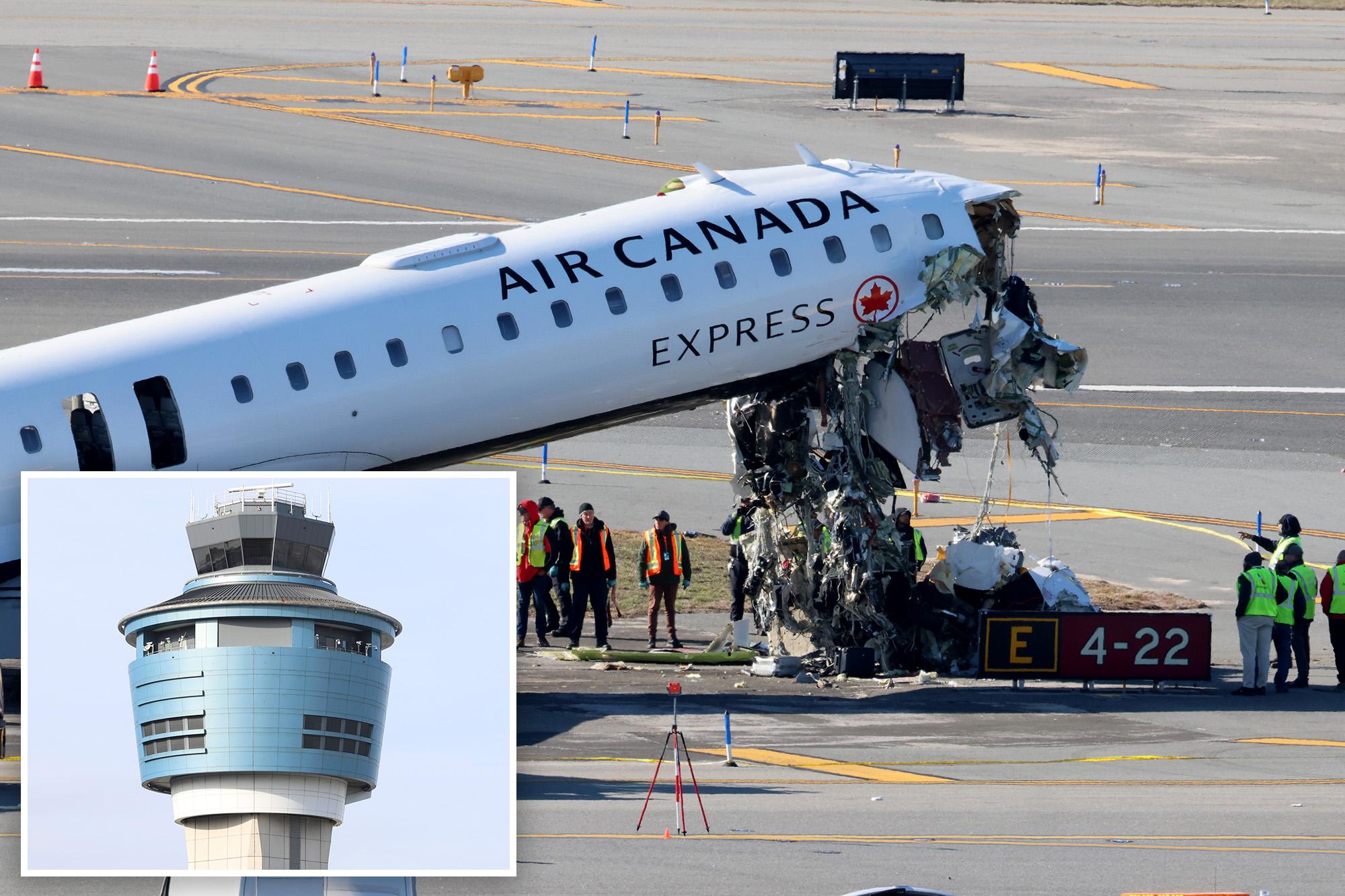
That evening, the Air Canada regional jet barreled into the Port Authority fire truck while it was crossing the runway in a fiery collision that killed the two pilots in the cockpit and injured 39 others on board.
The two firefighters inside the fire truck were also injured, but ultimately survived and have been placed on leave.
Leaving early is referred to as an “early shove” and is a longstanding practice in the industry, according to current and former controllers, the Journal reported.
Managers have at times allowed controllers to cut loose before their shift ends, for example, when they have only a break left.
The FAA, however, views the practice as a form of timecard fraud. Current and former officials with the federal agency argue that controllers may still be needed for emergencies, even if they are on break.
The agency has axed more than 10 controllers for alleged timecard fraud or abuse of leave policies, signaling a more aggressive approach under the Trump administration, people familiar with the matter told the outlet.
“The vast majority of air-traffic controllers are great patriots—they show up for work, complete their full shift, and come back and do it all again,” Transportation Secretary Sean Duffy said in a statement to the paper.
“But when a small percentage of individuals take advantage of the American taxpayer, unfairly add additional work to their fellow controllers, and impact the airspace—we have no choice but to act. We will not tolerate fraud.”
The National Transportation Safety Board is still investigating the cause of the March crash and determining the role tower staffing may have played in the fatal collision.
Start your day with all you need to know Morning Report delivers the latest news, videos, photos and more.
A firefighter aboard the truck that collided with Air Canada Express Flight 8646 said he heard an air traffic controller warn, “stop, stop, stop,” but didn’t know who it was for, according to the NTSB’s preliminary report.
A crash-prevention system also didn’t generate an audio or visual alert in the control tower, and the runway entrance lights, which act as stoplights for crossing traffic, remained on for roughly three seconds before the truck and jet collided, the report revealed.
The system is designed to turn the lights off two or three seconds before a plane reaches an intersection.
The preliminary report also singled out the fire truck’s lack of a transponder but did not say if including the device could’ve prevented the collision.
Without the device, LaGuardia’s automatic warning system could not “correlate the track” of the descending Air Canada Express with the fire truck’s path, the report said.
Emergency vehicles at the New York City area’s three major airports — LaGuardia, JFK, and Newark — will be outfitted with new tracking devices in response to the crash, a Port Authority spokesperson previously said.
The FAA did not immediately respond to The Post’s request for comment.