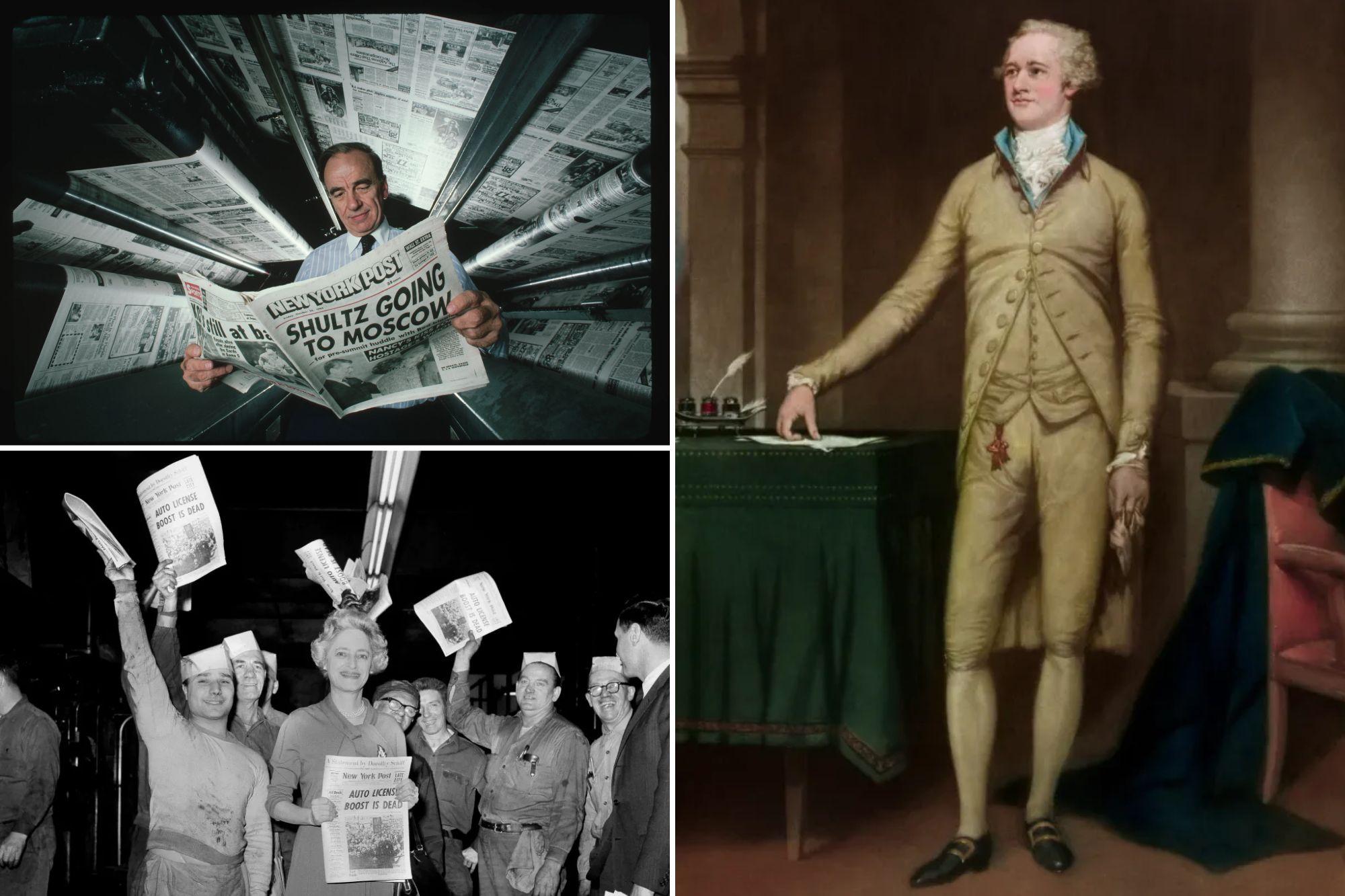
Make New York Post a Preferred Source It’s an extra! extra! special milestone. The New York Post, the nation’s oldest continuously published daily newspaper, turns 225 years old today.
Our stories are read by millions around the country and around the world. But even as we cover the nation, The Post’s history and influence have been inextricably tied to the city we call home.
“The New York Post is so baked into the fabric of New York and has the voice of the city in a way no other publication has,” said Aileen Gallagher, professor of magazine, news and digital journalism at Syracuse’s Newhouse School, adding the paper “has always been a power read.”
The Post, which published its first issue on Nov. 16, 1801, has played an integral part in shaping the city as it grew from the cramped streets of lower Manhattan into a bustling metropolis.
And eventually into the greatest city in the world.
The Post championed innovation, civic reforms and was the first to propose the creation of Central Park. We were also the place where the name “Knickerbocker” first appeared, leading to our champion NBA team.
Knicks in five, but Alexander Hamilton for 225 and counting.
If you’ve seen the musical, you know the story. Hamilton, creator of the Treasury Department and co-writer of the Federalist Papers, had a spectacular fall from grace. He had an affair, and was living in political exile in Harlem. He was a deciding voice in the election of 1800 — choosing Thomas Jefferson over Aaron Burr, the man who would eventually shoot him dead — but still had much to say.
Hamilton gathered a group of investors in the home of Archibald Gracie, which now serves as the official mayoral residence, Gracie Mansion. They launched the New York Evening Post as the nation’s leading Federalist voice. Hamilton appointed lawyer William Coleman as the first editor-in-chief.
According to “The Evening Post: A Century of Journalism” by Allan Nevins, the paper counted about 600 subscribers. And it “soon won plaudits for its legible print, high-quality paper, and lucid, trenchant writing,” wrote historian Ron Chernow in his biography of Hamilton.
Some of the Post’s early notable pieces were coverage of tragedy.
Hamilton’s son, Philip, just 19, was killed in a duel across the river in New Jersey on Nov. 24, 1801, less than two weeks after the paper started.
After Philip’s death, The Post argued that dueling should be outlawed, writing “Reflections on this horrid custom must occur to every man of humanity, but the voice of an individual or of the press must be ineffectual without additional, strong and pointed legislative interference.”
It was advice Hamilton himself failed to take, as he was killed in a duel three years later, on July 12, 1804.
From its early days, The Post argued for cleaner, safer streets, opposing the scourge of free-roaming hogs and the slaughterhouses in residential areas. They led a campaign for covered sewers so the roads remained passable in heavy rains. And called transformative technology like Robert Fulton’s steam-powered ferries “a proud example of the genius of our country.”
In 1817, it was attacking “the practice of riding fast horses home from the blacksmith without a bridle,” wrote Nevins.
In 2026, The Post is advocating for common sense safety measures like the regulation of e-bikes.
The paper changed hands in 1829 after the death of Coleman. Poet William Cullen Bryant, who had been an assistant editor for the previous three years, took the reins. In his 52-year tenure, Bryant, whose namesake park straddles midtown, campaigned for consequential initiatives in both the arts and municipal services.
As Nevins wrote, the paper was “the sturdiest of the fighters of what eventually became Central Park.”
In a July 3, 1844 editorial entitled “A New Public Park,” Bryant wrote in favor of “an extensive pleasure ground for shade and recreation in these sultry afternoons, which we might reach without going out of town.”
Noting that all the great cities of Europe had public gardens, he argued that “commerce is devouring inch by inch the coast of the island and if we would rescue any part of it for health and recreation it must be done now.”
It would take 11 years for work to begin on the park, designed by Frederick Olmsted. Under Bryant, the paper also had a hand in the creation of The Metropolitan Museum of Art and urged politicians to focus on local civic improvements.
At the start of the 1840s, crime was rising and there was a small, poorly paid group of watchmen tasked with arresting offenders. But there was no meaningful crime prevention.
In 1843, Bryant called for police reforms instead of the “body of watchmen” that was “of no earthly use” and “in some cases they are suspected of being in a league with the robbers.“
The NYPD was formed in 1845 and the paper continued to advocate for improvements, including the introduction of distinct police uniforms.
As for the fire department, it was made up of volunteers of questionable character, including ruffians, who drank, fought, assaulted women, according to Nevins. And in the aftermath of fires, they pillaged properties.
“A large fire is a windfall to the whole tribe,” the paper complained.
The Evening Post called for the volunteer system to be replaced by a paid department of firemen, which became a reality in 1865.
The Post’s support of the NYPD and the FDNY and their tireless work to keep the city safe continues today.
Under Bryant, The Evening Post wrote in favor of the abolition of slavery. Days before then-presidential candidate Abraham Lincoln delivered his speech at Cooper Institute in February of 1860, the paper predicted it would be a “powerful assault upon the policy and principles of the pro-slavery party and an able vindication of the Republican creed.”
On less weighty topics, The Evening Post printed many great authors of the time and was a launching pad for the Knickerbocker moniker that would define all things New York.
In 1809, Washington Irving cooked up a clever scheme to hype his satirical book “History of New York” which he wrote under the pseudonym, Diedrich Knickerbocker.
He published an ad in The Evening Post that read, “Left his lodgings some time since, and has not since been heard of, a small elderly gentleman, dressed in an old black coat and cocked hat, by the name of KNICKERBOCKER.”
A subsequent letter in the paper claimed to have seen him in the Bronx, while another letter from the Columbian Hotel proprietor noted that Knickerbocker left behind “a very curious kind of written book.” The campaign helped make the book a success.
And the Knickerbocker legacy, like The Post’s, has endured. When the New York Knicks, née Knickerbockers, first formed in 1946, their original logo was Father Knickerbocker.
In 1934, the Evening Post was renamed The New York Post, a year after it briefly adopted a tabloid format before returning to a broadsheet. Under owner Dorothy Schiff, who owned it from 1942 to 1976, it once again became a tabloid.
Rupert Murdoch bought the paper in 1976 and shaped it into the crusading publication you enjoy today.
The paper weathered a bankruptcy, strikes, ownership changes and, of course, the devastating terrorist attacks on 9/11. Like the readers it served for two and a quarter centuries, The Post is a survivor.
And it doesn’t just have “the best sports in town,” but also now in California. Last January, the California Post opened its newsroom to conquer the West.
The New York Post hasn’t declined with age. Quite the contrary. Even after 225 years on this earth, The Post readership has never been bigger, both across the country and the halls of power.
And as Gallagher notes, when big stories break, everyone wants to know: “What will The Post have to say? We all want to know what the next day’s headline will be.”
Here’s to another 225 years of anticipation.