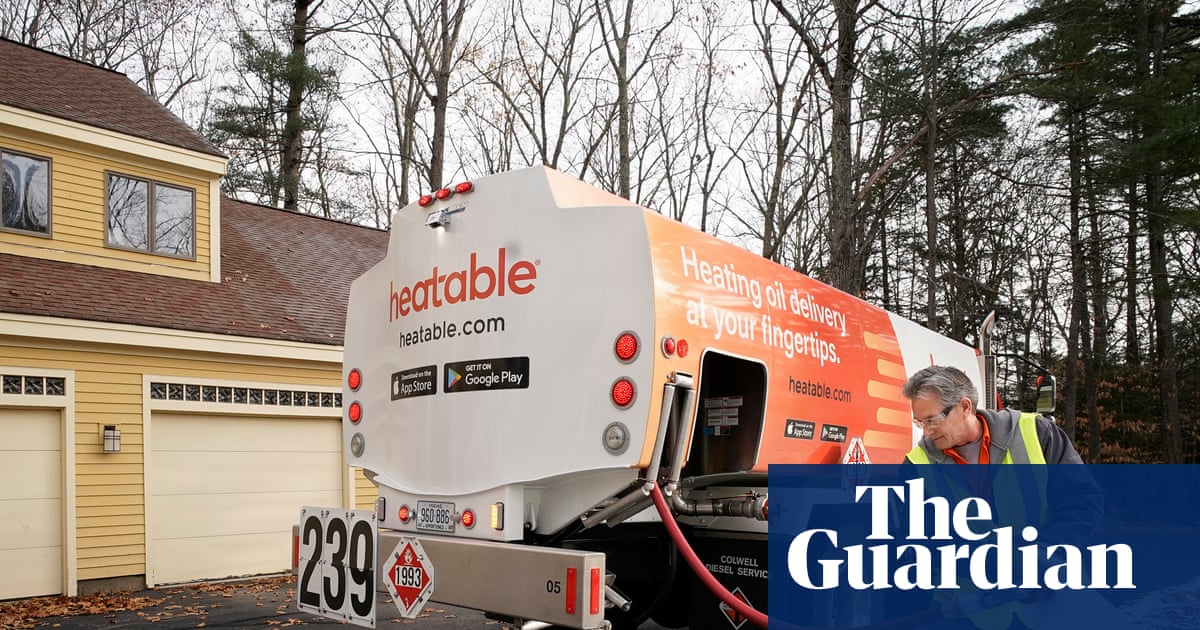
Fred Cyr delivers heating oil to a home in Falmouth on 14 November 2019. Photograph: Portland Press Herald/Getty ImagesView image in fullscreenFred Cyr delivers heating oil to a home in Falmouth on 14 November 2019. Photograph: Portland Press Herald/Getty ImagesAmericans relying on heating oil brace for harsh winter: ‘We’re often cold in our own home’ Surge in prices is forcing many to cut back on spending, with a projected 21% increase in costs of those households
Millions of homeowners in the US will pay hundreds of dollars more this winter to heat their homes as rising energy prices have pushed up the price of heating oil.
The US Energy Information Administration projects households that use heating oil can expect to pay 21% more this year compared with last winter, with warmer temperatures expected to partly offset price increases.
About 3% of US households rely on heating oil as their primary heat source. In the winter of 2023-2024, 4.79m US households used heating oil as their primary heat source, 82% of which were households in the north-east.
A recent report from the National Energy Assistance Directors Association found that overall, heating costs are expected to climb over 7% nationwide, with average heating bills rising 16.9% in the north-east.
Residents in Maine, where the temperatures can reach below 0F in many parts of the state, said they are bracing themselves for a pricey winter.
“My home heating oil costs have doubled this year,” said Heidi Unruh, 61, of Kittery, Maine, where the winter chill comes in December and lasts through the end of March. “They were already impossibly high in Maine before Trump took office, and I will feel serious pain as the Maine weather dives to it’s typical winter chill”
It costs more than $1,500 to fill her 250-gallon tank at home, which has to be refilled every 47 days when the temperatures are low. The increase in costs has forced her to try to cut back on other expenses.
“Between oil prices, tariffs, and rising food and energy prices, it will be an especially difficult winter,” Unruh said. “Mainers everywhere will struggle along with me. To compensate, I grew a lot of my own food this year. I have cut back on unnecessary expenses, and am trying overall to need less.”
Nikki Papadopoulos, who lives in Piscataquis, a county in the central part of the state, said that her family has started to use a wood stove because the cost of propane has also been high. They have also cut back on hot water, trying to use cold water to wash dishes, as the water heater also uses oil.
“We keep our thermostat turned down to the absolute lowest setting available, and honestly, we’re often cold in our own home. We’re wearing layers, sweaters and jackets indoors just to stay warm,” Papadopoulos said. “We’ve cut out pretty much all unnecessary spending. We’re down to the bare essentials.”
Though her husband recently received a pay increase, it’s been nearly eaten up by the higher cost of heating.
“We’re essentially making compromises in our everyday routines just to stretch what’s in the tank,” she added. “We’re taking the hit from every direction.”
Around 50% of households in Maine relied on heating oil in 2024, a reliance that has declined in recent years, though Maine still has the highest proportion of homes using heating oil in the US.
View image in fullscreenAn oil tank stands outside a residence at a mobile home cooperative as energy costs, from home heating oil to gasoline, are a key concern for Maine voters ahead of the US Senate election in Veazie, Maine, US October 31, 2026. Photograph: Taylor Coester/Reuters“It’s a necessity. For people in colder regions of America, they need it, it’s what they keep themselves warm with,” said Justin Barnes, a fuel delivery driver in the Bangor, Maine region, who has had to give residents bills that have been much higher compared with recent years. “It seems like these politicians ain’t doing a lick to lower the prices or make our lives easier, which is their responsibility.”
Democrat Troy Jackson, a logger and former state senator, won his election against longtime Republican senator Susan Collins in the recent midterm elections, where Republicans across the country lost their races in what was largely seen as a repudiation against the rising cost of living.
Much of it has been driven by the war in Iran, where the closure of a key oil trading route has led to a prolonged spike in energy prices. Gas prices at the pump have risen over 30% compared with last year. Other oil products, such as diesel and heating oil, have gone up even higher. Recent data showed that heating oil saw a 74.2% increase from September 2025 to September 2026, costing over $6 a gallon on average.
Russia’s export ban on diesel, which is similar to heating oil, amid the country’s war with Ukraine has also affected energy prices, said Patrick De Haan, head of petroleum analysis at GasBuddy. In 2025, Russia exported 10% of internationally traded diesel.
The Trump administration has attempted to strike a deal with Russia to export some diesel to the US, but the effort has failed so far.
Bob Carpenter, an electrician in Greenville, Rhode Island, relies on heating oil to heat his home and has had to save up, bracing for the price hikes to refill his home’s oil tank. When his heating oil was delivered last month, it was $1,425 for roughly 240 gallons – about $600 more than he paid in previous years.
The higher cost of heating oil comes atop other bills that have gotten more expensive, including electricity bills. “Two years ago, I thought $250 was expensive. Lately, my bills have averaged around $350 a month, which is starting to feel like the new normal,” Carpenter said.
Carpenter said he’s concerned about the effect higher prices will have on the ability of younger generations, including his children, to save for emergencies.
“When necessities take up more of your budget, there’s less left for an unexpected car repair or a roof that needs replacing,” he added. “What concerns me goes beyond energy. It’s the combined cost of groceries, housing, insurance, and other necessities. Inflation means our money doesn’t stretch as far.”