play Live Sign upShow navigation menuplay Live Click here to searchsearchSign upEconomy|US-Israel war on IranCan Tehran survive a ‘zero oil’ budget, if US blockade on Iran persists?The government is defiant and planning for the worst, but persisting siege is expected to make most Iranians poorer over the coming months.
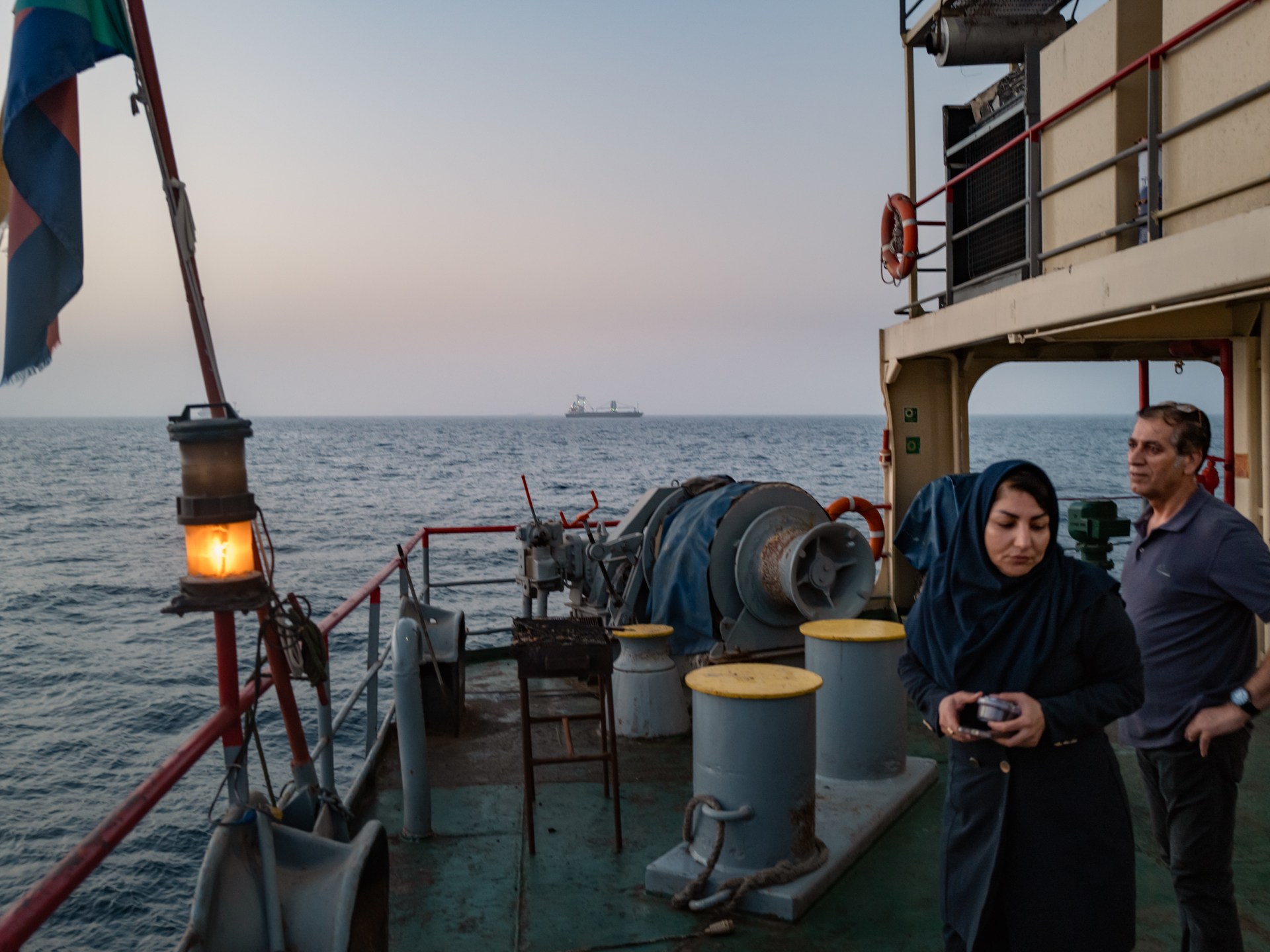
xwhatsapp-strokecopylinkgoogleAdd Al Jazeera on GoogleinfoAn Iranian captain and chief engineer go about their day as their vessel is stranded due to congestion at Port Sultan Qaboos, which has prevented them from docking and left their ship anchored off the coast for days, on June 23, 2026 in Muscat, Oman [Elke Scholiers/Getty Images]By Maziar MotamediPublished On 11 Nov 202611 Nov 2026Tehran, Iran – After months of oscillating between new bouts of fighting and negotiations, the administration of United States President Donald Trump has reportedly opted for a third option – gradual economic pressure on Tehran.
US Secretary of State Marco Rubio told his Group of Seven (G7) counterparts in Paris on Tuesday that a naval blockade, stringent sanctions and overland border disruptions could continue without a clear endpoint in sight, according to US media. He later said that Iran’s economy “continues to collapse” and predicted worsening conditions over the next one to three months.
Tehran-based economist and market analyst Isaac Saidian said that if the persistent economic siege on Iran brings the country’s oil incomes down to near-zero levels, Tehran will be faced with one of the most difficult challenges in its recent history.
“The issue is not just a decline in foreign currency incomes, but the government’s ability to account for current expenditure, paying salaries and pensions, providing essential goods, preserving the value of the national currency, and preventing budget deficits from turning into a new inflationary wave,” Saidian told Al Jazeera.
Iran’s President Masoud Pezeshkian has indicated that the cash-strapped civilian government is preparing to deal with a prolonged economic crisis caused by siege and sanctions, but has admitted that the lingering “no war, no peace” conditions will be harmful.
But the authorities have stressed that there are no prospects of economic collapse. They have also raised the prospect of “breaking the blockade” if necessary, although it remains unclear by what means.
In a budget directive on November 3, Pezeshkian’s administration set out two scenarios. One was the continuation of sanctions, the maritime blockade and present regional conditions. The other prediction was an improvement of the situation involving fewer financial and commercial restrictions, including a substantial or complete removal of the blockade.
“The government must prepare for circumstances in which oil revenue reaches zero,” Mohammad Ghasemi, deputy for coordination of planning and budget at Iran’s Plan and Budget Organization, told local media on Monday about a contingency for next year.
The US military first imposed a naval blockade of Iran’s southern ports, through which most of the country’s trade passed, on April 13. A memorandum of understanding in June lifted the blockade and allowed some oil and trade to pass through the Strait of Hormuz, but the deal fell apart within weeks. The second blockade has been in place since July 14, as Iran and the US fight for control of the Strait of Hormuz.
The US military says it has redirected 147 ships and disabled five while enforcing the blockade. It also claimed to have destroyed 10 Iranian oil tankers linked to the shadow fleet of Iran’s Islamic Revolutionary Guard Corps (IRGC). According to the US Treasury, the blockade has led to Iran loading no oil onto vessels since August 25.
A late October assessment by Kpler said Iran’s oil production had fallen below 2 million barrels a day in the preceding months. Iran produced 3.45 million barrels of crude per day in January and 3.59 million in the following month, but Israel and the US’s war on Iran began on February 28.
The volume of Iranian crude and condensate floating outside the blockade zone had also fallen from 88.8 million barrels on July 14 to zero in mid-October. Because Chinese buyers generally pay one to two months after discharge, Kpler anticipated crude and condensate receipts potentially drying up around mid-December. Around 43 million barrels remain stranded inside the blockade area.
The US sanctions have also limited air travel to and from Iran, while a new US task force announced this week aims at closing or disrupting most of Iran’s land borders with its seven neighbours.
The Iranian economy has already been dealing with chronic inflation, falling investments and purchasing power, as well as banking and budget imbalances for years. So removing oil revenues will undoubtedly exacerbate the situation.
The government has increasingly relied on taxes to account for a larger share of the budget, but oil still accounted for roughly one-third of planned government funding in the 2026–27 budget proposal.
Economist Saidian said if oil revenues fall sharply, the government’s next step should be to review public spending. Cutting spending on overlapping administrative structures and opaque budgetary grants, while suspending low-return public investment projects, could ease some of the fiscal pressure on the state, he said.
Reforming tax exemptions and tackling tax evasion, as well as carefully managed bond issuance and sale of some non-essential government assets, are other options. But he cautioned that any abrupt drops in salaries, pensions, or social support budgets would only deepen poverty.
The government has signalled that it will likely have to resort to reducing fuel and other energy subsidies again, which will increase prices, but the process will be gradual to lessen the impact on inflation.
“Expanding non-oil exports and facilitating trade with neighbouring countries are also essential,” Saidian said. “Even so, these exports cannot be expected to replace oil revenue in the short term, especially while restrictions on banking, insurance and transport remain in place.”
Government spokesperson Fatemeh Mohajerani said on Tuesday that next year’s budget would prioritise inflation control through fiscal discipline, household support and tighter oversight of banks. The administration will continue handing out electronic food coupons, although it has been struggling to preserve their value due to runaway prices.
Year-on-year inflation was at nearly 89 percent in the Iranian calendar month ending October 22, according to the Statistical Center of Iran.
Saidian pointed out that no amount of austerity measures or budget reforms can fully replace sustainable access to foreign trade, investment and foreign currency incomes, so exiting inflationary stagnation for a prolonged period would require reduced tensions.
“The historical significance of the 2027-28 budget lies in what it can reveal about how prepared Iran’s government is to move beyond an oil-dependent economy and toward transparent, accountable fiscal governance. The budget should not merely be a plan to manage the government in a difficult year, but a plan to prevent passing on today’s crisis to future generations and to start structural reforms in Iran’s economy,” he said.
“The greatest danger is not that the government might run short of funds for a few months. The real danger is that it could stay afloat on paper while passing the cost of doing so on to the public, leaving society poorer, eroding the middle class, widening poverty and weakening the country’s productive capacity.”