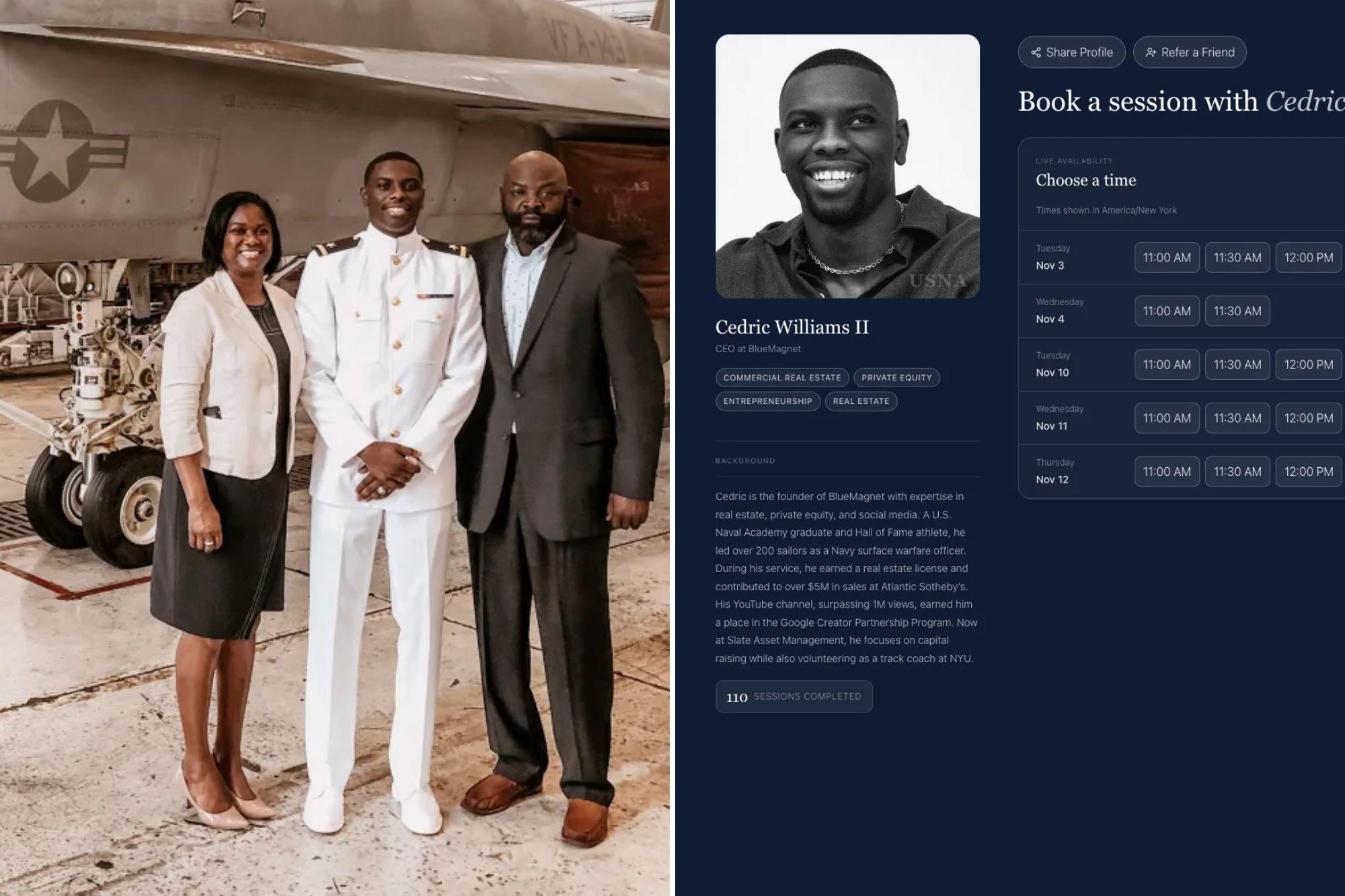
Make New York Post a Preferred Source Cedric Williams II, a 2020 graduate of the United States Naval Academy, is building the platform he wishes existed six years ago.
Launched in the summer of 2024, the LinkedIn-like BlueMagnet is designed to replicate the connections, camaraderie and network that support service academy members while they’re wearing the uniform — but all too often, deteriorate in the years after they transition to civilian life.
“People who raise their right hand and put their life on the line for our country [have to] rely on each other — the environment fosters [that need],” Williams told The Post. “BlueMagnet [mirrors] that proximity and makes it easy for people to give back around their own time and knowledge.”
The platform works by connecting service academy graduates with advisors and peers online and at in-person events. Users share their goals and experiences when signing up, and BlueMagnet recommends advisors who can help.
“It’s an open platform leveraging the entirety of the Academy network and all the nodes that stem from it,” Williams said. “As a grad, you can go in with any question, any need, and find exactly the right person to connect with.”
The project was inspired, in part, by the support Williams found at the Naval Academy after initially struggling.
In the seven-week boot-camp–like run-up for incoming freshmen, Williams lost 20 pounds. He went from being a star athlete in his hometown of Itta Bena, Miss., to being the lowest man on a totem pole taller than any he’d known before.
“I was looking sick, beat down,” Williams said.
But he found camaraderie in other first-year students.
“We were all swimming in the same direction,” recalled Cameron Hurd, a classmate of Williams’ and teammate on the track team.
Hurd and Williams grew close throughout their four years at the Academy and stayed in contact after graduation despite being stationed on different continents — the former as a surface warfare officer in Japan, the latter as an officer aboard the USS Carter Hall. That sustained friendship was something of an anomaly.
“When you go out into the fleet, life happens,” Williams said.
In the summer of 2023, following his time on the Carter Hall, Williams was trying to figure out his next steps.
He did a monthlong internship at Academy Securities, a veteran-owned and operated investment bank, then networked his way into an analyst job on Wall Street.
Williams’ peers and former classmates flooded him with questions about how he’d landed the job without a stint in business school and who they could reach out to. There were more queries than he could keep up with.
So, without any coding experience — and before the advent of AI-powered coding assistance — Williams set about building a website and database, reaching out to the advisors and peers already in his network. Only graduates of the five service academies can sign up as users, but anyone with an interest in mentoring or guiding veterans can join as an advisor.
To date, 770 people have enrolled — 680 as users, 90 as mentors.
Hurd was one of BlueMagnet’s earliest champions. He used the platform to connect with mentors in Southern California who ended up helping him to secure a successful pre-seed round for a startup he was working with, Clutch Kickback, the Japanese equivalent of Formula 1. Today, he serves on the racing league’s board and runs its operations.
BlueMagnet, in Hurd’s experience, “is a network of people who speak the same language and are open to learning from one another.”
In the summer of 2025, the platform was formally endorsed by the Naval Academy. In the months since, Williams has been talking with leadership at the other four academies about building similar associations.
“This is about making sure veterans can get in front of resources, companies and people,” he said, “no matter where they are in their life or in the world.”