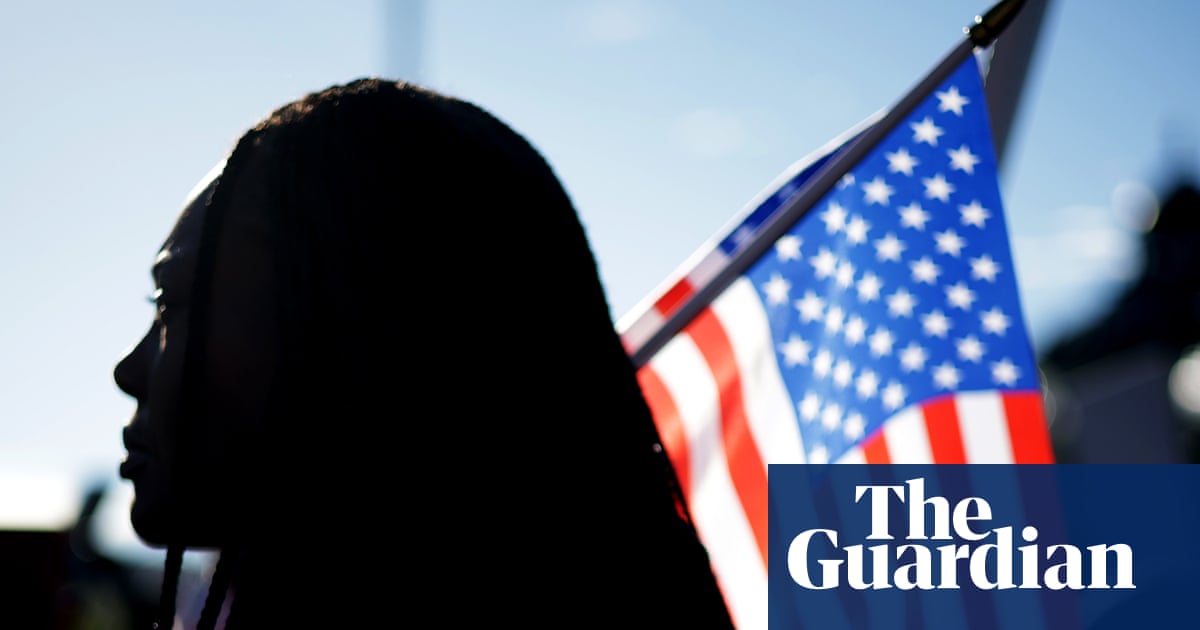
An activist holds a US flag during a rally in front of the US supreme court on 15 October 2025 in Washington DC. Photograph: Alex Wong/Getty ImagesView image in fullscreenAn activist holds a US flag during a rally in front of the US supreme court on 15 October 2025 in Washington DC. Photograph: Alex Wong/Getty ImagesUS southern states rush to redraw electoral maps to dilute Black voting powerLouisiana, Alabama, Tennessee and more are pushing to eliminate Democratic districts after supreme court ruling
US southern states are rushing to redraw congressional maps to eliminate Democratic districts and dilute the influence of Black voters in electing candidates, a bare-knuckled blitz occurring even in some states where voting in congressional primaries has begun, and prompted by the US supreme court’s decision gutting section 2 of the Voting Rights Act.
Tennessee Republicans have already enacted a new map, carving up the majority Black city of Memphis into three different congressional districts to get rid of the state’s lone Democrat in Congress. Louisiana, the state at the center of the supreme court’s Voting Rights Act decision, is on the brink of implementing a new map that would eliminate the seat of one of the state’s two Black Democrats in Congress. Alabama has successfully petitioned the US supreme court to allow it to eliminate a district currently represented by a Black Democrat. Instead, it will use a map this cycle that a court previously ruled was intentionally drawn to discriminate against Black voters.
In South Carolina, the Republican governor is reportedly poised to call a special session to draw a new congressional map to eliminate the district currently held by Jim Clyburn, the powerful Black House Democrat. Republican lawmakers had previously rejected an effort to move forward with such a plan.
View image in fullscreenState representatives look over a proposed congressional map during a meeting at the South Carolina state capitol in Columbia, South Carolina, on 8 May 2026. Photograph: Bloomberg/Getty ImagesGeorgia and Mississippi have opted against redrawing districts ahead of midterm elections this year, though they are likely to redraw ahead of the 2028 elections. States like Texas, Missouri, Florida and North Carolina, which already redrew their maps to add Republican districts, could also draw maps again before 2028 elections.
“This is a five-alarm fire for Black representation in the south,” said Michael Li, a redistricting expert at the Brennan Center for Justice. “The [supreme] court has signaled it’s going to be a redistricting wild west, and there will be no sheriff around.”
States have been ruthlessly aggressive in their push to redraw districts, with Alabama and Louisiana taking the unprecedented steps of cancelling primary elections after voting was under way. “Those ballots are discarded and those voters will vote again in November,” Louisiana governor Jeff Landry, a Republican, said during an interview on 60 Minutes. More than 42,000 ballots were cast in Louisiana before the governor cancelled the election.
“If anybody has a grievance, take it to the United States supreme court,” Landry said.
The Congressional Black Caucus, which has an all time high 58-members, is preparing for a potential decimation of its ranks. Democrats are reportedly mulling a counteroffensive for the 2028 elections in states where they control statehouses – New York, Illinois, Maryland, Colorado, Washington, and Oregon – though they face more hurdles than Republicans do to overcome state-imposed restrictions on partisan gerrymandering.
View image in fullscreenHakeem Jeffries speaks at a press conference with other members of the Congressional Black Caucus at the US Capitol in Washington DC on 29 April 2026. Photograph: Anadolu/Getty ImagesAfter the loss of section 2, different groups are beginning to test how far the supreme court’s decision extends. The American Civil Liberties Union sued Tennessee over its new map this week, seeking to invalidate the map on constitutional grounds. Civil rights groups have also asked a federal court in Alabama to block the state from using the 2023 map after it was found to have intentionally discriminated against Black voters.
A conservative legal organization has also cited the Callais decision as a basis to challenge the Illinois voting rights act, the first case testing whether the supreme court’s decision in the case can also be used to weaken state-level voting rights acts.
Having lawmakers cancel elections in which votes have been cast, absent a natural disaster or other kind of emergency, is unprecedented, election experts said.
“It’s not rolling things back to where they were in 2010. It’s rolling things back to where they were in 1975,” said Stuart Naifeh, a lawyer with the NAACP Legal Defense and Educational Fund. “The risk is that Black representation will disappear from the south and potentially other places too. And Latino representation as well.”
The chaotic redrawing process has in large part been facilitated by the supreme court itself. For decades, the court has abided by a principle that federal courts should not intervene and disrupt the status quo of an election that is near, let alone one that is under way. In case after case in recent years, the supreme court has blocked orders from lower courts striking down maps because it said an election was near. In many of those cases, the election was months away.
In December, for example, the justices blocked a lower court order striking down Texas’s congressional map as racially discriminatory. In its 4 December order, the court said that it was too close to Texas’s March primary elections to require the state to impose a new map. “The District Court improperly inserted itself into an active primary campaign, causing much confusion and upsetting the delicate federal-state balance in elections,” the court’s conservative majority wrote.
In February 2022, the court similarly ruled it was too late for Alabama to implement a new congressional map before its May primary.
View image in fullscreenSupreme court justices John Roberts, Elena Kagan, Brett Kavanaugh and Amy Coney Barrett during a State of the Union address at the US Capitol in Washington DC on 24 February 2026. Photograph: Bloomberg/Getty Images“When an election is close at hand, the rules of the road must be clear and settled,” Brett Kavanaugh, a supreme court justice, wrote at the time. “Late judicial tinkering with election laws can lead to disruption and to unanticipated and unfair consequences for candidates, political parties, and voters, among others. It is one thing for a State on its own to toy with its election laws close to a State’s elections. But it is quite another thing for a federal court to swoop in and re-do a State’s election laws in the period close to an election.”
Because of those decisions in prior cases, the court faced criticism on Monday for abandoning that approach and allowing Alabama to implement a new map a little more than a week before a congressional primary that was scheduled for 19 May (the state has since rescheduled it). The court offered no public explanation for why it was intervening to allow Alabama to implement new maps now, but had previously halted efforts to get legal maps in place months ahead of an election.
“You don’t need a law degree to see how inconsistently the court is behaving in these cases,” said Stephen Vladeck, a law professor at Georgetown University. “Consistency is bad enough, but now you have a court that has shown itself willing to step in, even when it knows the result of it stepping in is that votes are going to be thrown out.”