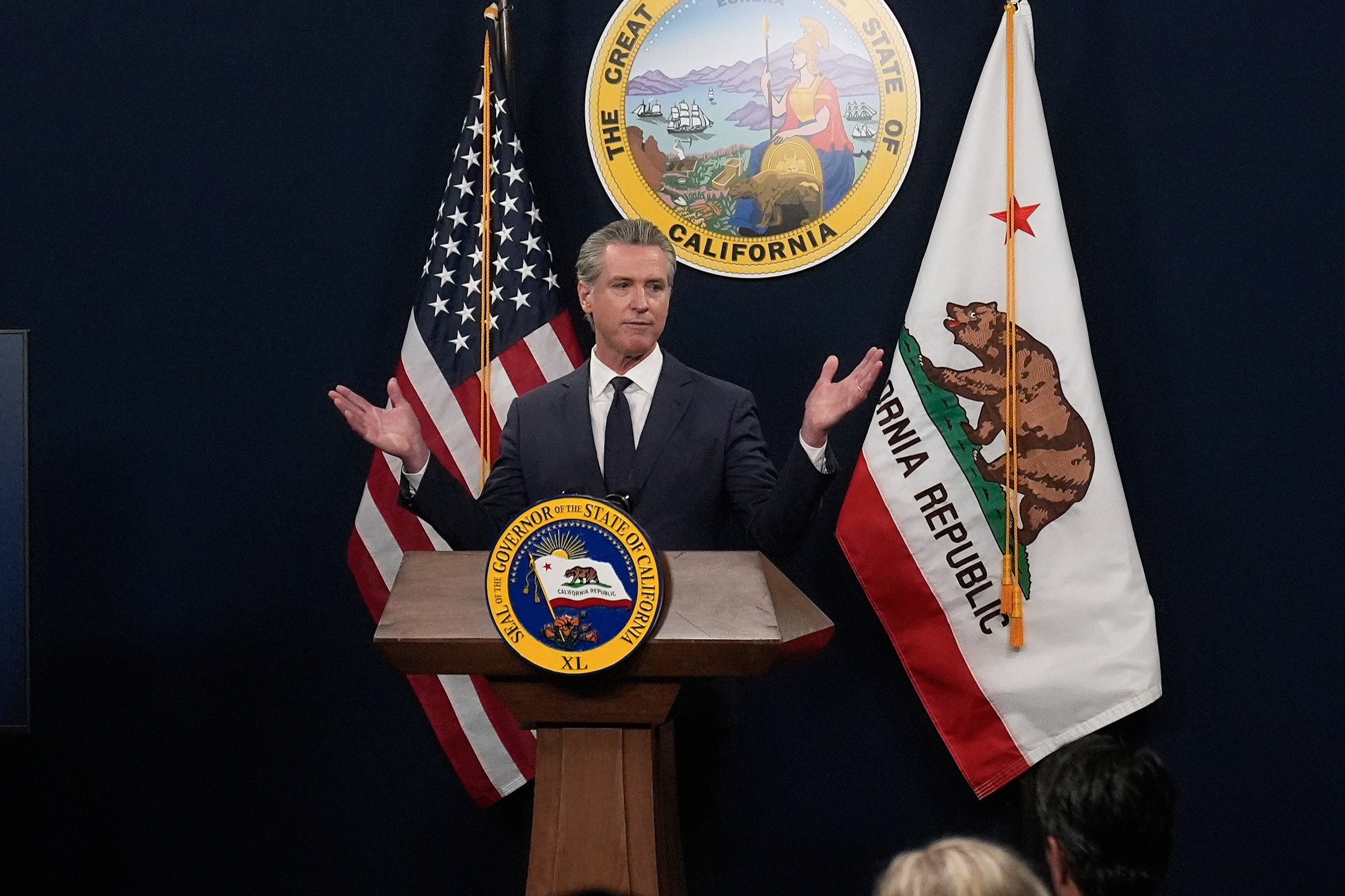
Gov. Gavin Newsom straddled the line of cheerleader and combatant in his delivering of his revised California budget Thursday, boasting about better-than-expected revenue while leveling broadsides against President Trump’s record.
Newsom accused the president of waging a war on innovation and affordability and tanking the national economy while California continues to “dominate” the developed world.
Standing beside slides mocking Trump’s tariffs, economic record and even “California derangement syndrome,” Newsom unveiled a revised $349.9 billion spending plan fueled by stronger-than-expected tax revenues and California’s booming AI-driven economy.
“We have a president who doesn’t give a damn about the economy,” Newsom said.
The revised budget proposal balances the budget not only for the upcoming fiscal year, but through 2027-28, while reducing projected long-term operating deficits by more than half, according to the administration.
The revised plan comes after California collected $16.5 billion more in “Big Three” tax revenues — personal income, corporate and sales taxes — than projected in January over the state’s three-year budget window.
Personal income taxes alone accounted for $13.6 billion of the increase, largely driven by capital gains tied to the stock market and AI.
The May revision estimates general fund spending at $246.6 billion in 2026-27, about $1.8 billion lower than proposed in January.
Despite the improved revenue picture, Newsom warned California’s tax system remains vulnerable to sharp swings in capital gains collections and market downturns.
“The issue of revenue volatility has to be addressed,” Newsom said.
The revised budget proposes depositing $9.7 billion into the state’s new Surplus Holding Account to help stabilize future budgets and reduce structural deficits. The administration projects operating reserves of $4.5 billion in 2026-27 and $2.1 billion in 2027-28.
The state would also carry nearly $29.9 billion in total reserves, including $15.1 billion in the Rainy Day Fund and $10.3 billion in the Proposition 98 school stabilization account.
But the political centerpiece of Newsom’s rollout was his attempt to contrast California’s economy against national trends under Trump.
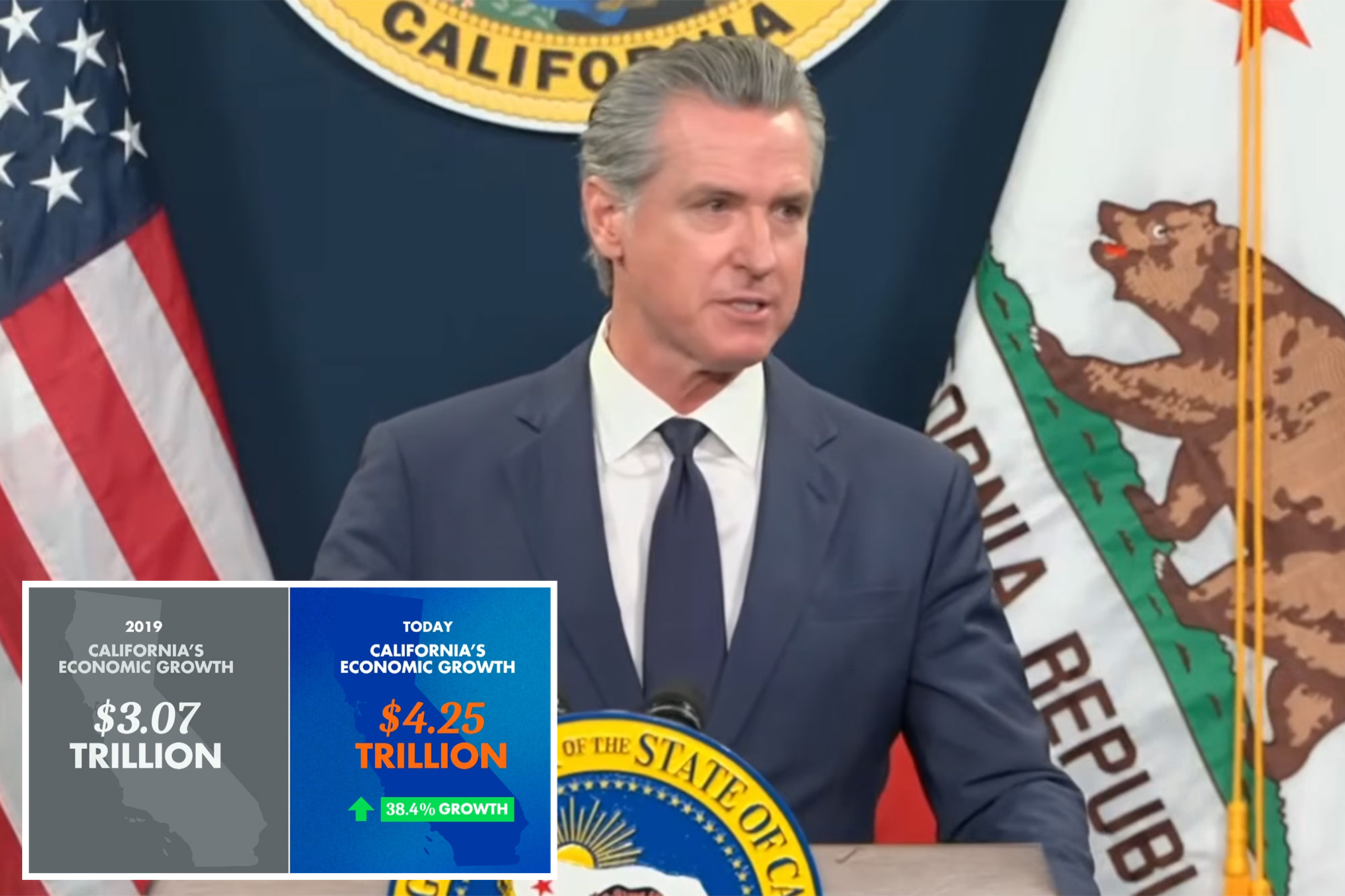
Newsom said California’s economy has grown roughly 38.4% since 2019 and now totals about $5.4 trillion, solidifying its standing as the fourth-largest economy in the world.
The governor repeatedly highlighted California’s dominance in venture capital, technology and business creation, noting the state is home to 58 Fortune 500 companies, attracts roughly two-thirds of all U.S. venture capital investment and has seen 1.4 million business starts.
“We have no peers in the developed world, not just in the United States,” Newsom said.
A slide shown during the presentation compared California’s economic growth since 2019 against other global economies, claiming California posted 40% growth compared to 32% in China, 16% in Germany and 15.1% for the United States overall.
Newsom framed research and development as foundational to California’s success while accusing Trump of undermining the state’s innovation economy.
Another slide accused Trump’s budget proposal of slashing scientific investment, citing proposed reductions of 40% to the National Institutes of Health, 57% to the National Science Foundation and roughly $32 billion in grant funding overall.
“Research and development is foundational to the success of our economy,” the governor said.
Newsom also repeatedly attacked Trump’s trade policies, particularly tariffs on China.
“What was the whole argument for Liberation Day? Well, let’s look at the scorecard,” Newsom said before displaying slides showing falling exports and rising costs.
One slide claimed Trump’s tariffs amounted to an $18.4 billion tax increase on California families while contributing to a 32% decline in beverage exports to China and a 64% drop in farm exports to China.
Newsom also acknowledged the trade war has battered California’s alcoholic beverage industry, citing a 32% decline in wine and spirits exports to China. Newsom himself started as a wine entrepreneur.
The governor additionally argued Trump’s immigration policies are undermining California’s economy by restricting legal immigration pathways for highly skilled workers and agricultural laborers.
“Trump has hampered California’s ability to get first-round draft picks,” Newsom said, referring to global talent recruited into California’s technology and agriculture sectors.
“Everything you hear from his mouth is literally made up in this respect,” Newsom said, arguing 33 states have seen larger gas-price increases than California.
At another point, Newsom mocked conservative criticism of California while displaying a slide featuring Fox News host Sean Hannity.
“With respect to those with California derangement syndrome,” Newsom said, “it’s time to update your talking points.”
Education emerged as one of the biggest winners in the revised budget.
The May revision includes $151.6 billion for TK-12 education programs, including $91.3 billion from the general fund. Proposition 98 funding for schools and community colleges would rise to $127.1 billion in 2026-27 — roughly $28 billion higher over the three-year period compared to the 2025 Budget Act.
Newsom said total per-pupil funding would reach $28,282 under the revised proposal, which he described as roughly a 68% increase since taking office. Proposition 98 funding alone would provide about $21,013 per student.
The proposal includes a 4.31% “super COLA” for schools and community colleges, including a discretionary 1.4% increase on top of the statutory adjustment.
The budget also includes what Newsom described as the largest special education investment in California history — nearly $2.4 billion in additional funding, a 43% increase over the prior budget year. The proposal would increase special education funding rates from $999 per student to $1,340 per student statewide.
The administration also proposed requiring all TK-12 schools and community colleges to provide employees with up to 14 weeks of paid pregnancy disability leave beginning in 2026-27.
Another education proposal would provide $428.8 million to extend the state’s literacy coaches and reading specialists program through 2031, alongside $60 million for expanded mathematics coaching and teacher training.
The revised budget additionally includes a $300 million proposal to stabilize California’s Obamacare marketplace after enhanced federal subsidies expired. The administration said the funding would help preserve zero-premium health plans for lower-income residents and reduce costs for middle-class families.
The proposal also includes a 50% tax cut on LLC fees for new small businesses over three years and permanent limits on the use of corporate tax credits by large companies.
Still, the revised budget acknowledges continuing pressures on the state’s finances.
The governor’s office estimates a $4.2 billion Medi-Cal shortfall in 2025-26 and projects total Medi-Cal spending will reach $216.7 billion in 2026-27.
California Post News: Facebook, Instagram, TikTok, X, YouTube, WhatsApp, LinkedInCalifornia Post Sports Facebook, Instagram, TikTok, YouTube, XCalifornia Post Opinion California Post Newsletters: Sign up here!California Post App: Download here!Home delivery: Sign up here!Page Six Hollywood: Sign up here!