Video Stone Age dog buried with 5,000-year-old dagger found in Sweden Archaeologists have discovered an exceptionally well-preserved Stone Age dog skeleton buried with a 5,000-year-old bone dagger in a Swedish bog.
A discovery straight out of a King Arthur legend recently unfolded in Norway, where a hiker unearthed a 1,500-year-old gold sword fitting hidden beneath a tree.
The news was announced May 5 by the University of Stavanger, a public university in Norway.
The artifact was found in the Austrått district of Sandnes, a city in southwestern Norway. It dates to the sixth century, during Norway's Migration Period, a turbulent era of upheaval following the fall of the Roman Empire.
MELTING MOUNTAIN ICE REVEALS 'RARE' 1,500-YEAR-OLD HUNTING FACILITY STILL SMELLING OF REINDEER
The anonymous hiker, who lives in Austrått, said he "like[s] to explore and get to know the local area."
After noticing a tree felled by a storm, the man — a father of two — began probing the ground beneath it.
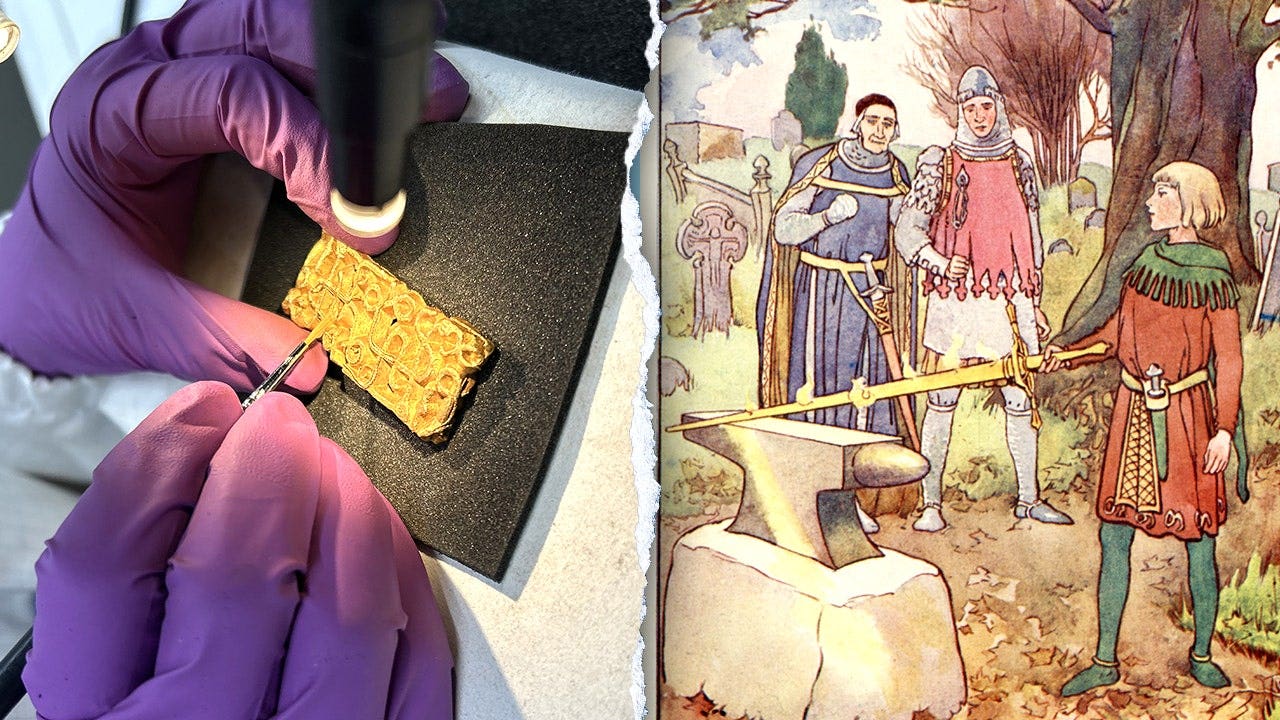
A discovery reminiscent of King Arthur legends has emerged in Norway, where a gold sword fitting that dates back 1,500 years was recently uncovered by a hiker. (Annette Græsli Øvrelid/Museum of Archaeology, UStavanger/Cover Images; Transcendental Graphics/Getty Images)
"I saw a slight rise in the soil under the tree and poked at it with a stick," he said, according to the release.
ANGLER EXPECTING A FISH PULLS UP RARE 700-YEAR-OLD SWORD: ‘REAL TREASURES’
"Suddenly I saw something gleaming. I didn’t quite understand what I had found."
Unlike King Arthur and Excalibur, the find was only a small gold sword fitting, measuring about six centimeters wide.
"You are completely taken by surprise when finds like this appear."
They noted that the sword "likely belonged to a chieftain who ruled at Hove."
WORKERS STUMBLE UPON HISTORIC BURIAL SITE AND 'INCREDIBLY RARE' FIND DURING SEWER PROJECT
"It is richly decorated and would have adorned a scabbard worn on a belt, from which the sword hung," the release noted.
"This is the first time such a find has been made in Rogaland, and only 17 others have been found in Northern Europe so far."
Officials say the rare gold artifact likely belonged to a regional chieftain. (Annette Græsli Øvrelid/Museum of Archaeology, UStavanger/Cover Images)
Archaeologist and university professor Håkon Reiersen called the find "spectacular."
CLICK HERE TO SIGN UP FOR OUR LIFESTYLE NEWSLETTER
"You are completely taken by surprise when finds like this appear. The odds of finding something like this are minimal," said Reiersen.
"At that time there were crop failures and crisis, and people likely deposited valuable objects as offerings in hopes of better times."
The professor said the sword's owner "was likely the leader in this area in the first half of the sixth century, with a retinue of loyal warriors."
He added, "Gold scabbard fittings usually show little sign of use, but this one is worn and well used, which suggests the chieftain actually used it a great deal. It emphasized his position and power."
CLICK HERE FOR MORE LIFESTYLE STORIES
As for why it was concealed, archaeologists believe the sword fragment was buried in a rock crevice "as an offering to the gods."
Researchers, seen above, say the find adds valuable context to the study of leadership and power in early Norway. (Annette Græsli Øvrelid/Museum of Archaeology, UStavanger/Cover Images)
"At that time, there were crop failures and crisis, and people likely deposited valuable objects as offerings in hopes of better times," officials said.
The artifact is now slated to be put on display at the Museum of Archaeology at the University of Stavanger.
CLICK HERE TO DOWNLOAD THE FOX NEWS APP
Kristin Armstrong-Oma, the director of the museum and a professor, said she "extend[s] a big thank you to a very observant hiker."
The small gold fitting measures about six centimeters wide and once adorned a sword scabbard. (Annette Græsli Øvrelid/Museum of Archaeology, UStavanger/Cover Images)
"[The hiker gave] us a new puzzle piece connected to the power center at Hove during the Migration Period," said Armstrong-Oma.
"At the museum we have some of the world’s leading researchers on such objects, which allows us to continue studying the find itself and its ornamentation and to discover new answers about the elite who ruled here at that time."
TEST YOURSELF WITH OUR LATEST LIFESTYLE QUIZ
She added, "This find will be made available to the public, so people can see it and share in the gold fever with us."
Andrea Margolis is a lifestyle writer for Fox News Digital and Fox Business. Readers can follow her on X at @andreamargs or send story tips to andrea.margolis@fox.com.
A look at the top-trending stories in food, relationships, great outdoors and more.
By entering your email and clicking the Subscribe button, you agree to the Fox News Privacy Policy and Terms of Use, and agree to receive content and promotional communications from Fox News. You understand that you can opt-out at any time.
You've successfully subscribed to this newsletter!