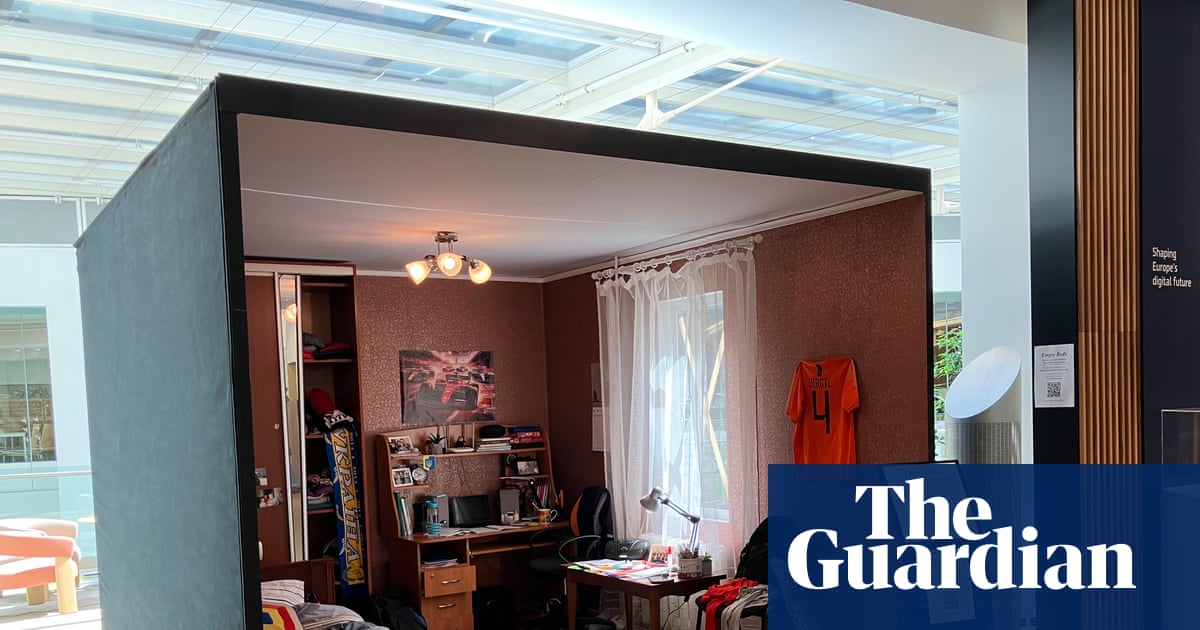
The installation is on display at the headquarters of the European Commission. Photograph: Jennifer Rankin/The GuardianView image in fullscreenThe installation is on display at the headquarters of the European Commission. Photograph: Jennifer Rankin/The GuardianTeen bedroom art installation shines spotlight on Ukraine’s stolen childrenSince the start of the current conflict, more than 20,500 Ukrainian children have been taken by Russia
It looks like a typical teenager’s bedroom: football shirts on the wall, crumpled clothes on the floor, exercise books open on the desk. But it is a work of political art, intended to evoke the empty rooms of more than 20,500 Ukrainian children unlawfully taken to Russia.
The work was on display on Monday at the headquarters of the European Commission in Brussels, as delegates from 63 countries and international organisations gathered to discuss how to bring Ukraine’s children home. “It’s essentially a way for someone to step into Ukraine without having to actually travel there,” Isaac Yeung, a co-creator of the installation, said.
View image in fullscreenA lot of the details in the room make it recognisable to anyone who grew up in Ukraine. Photograph: Jennifer Rankin/The GuardianAdding to the empty room’s unsettling vibe is a barely audible hum, punctuated by occasional explosions and the rattling wind. “It creates a tension in your head, in your chest,” said Leung, who works for Bird of Light Ukraine, the NGO behind the installation.
Read moreThe room belongs to Artem, a 13-year-old character, whose story is a composite of real testimonies of children who cannot be named. With its heavy Soviet furnishings and early 2000s shiny wallpaper, the room is immediately recognisable to anyone who grew up in Ukraine, said co-creator and head of Bird of Light Ukraine Zhanna Galeyeva. Artem lived with his widowed single mother in Ukraine’s occupied territories, enduring months of shelling, until Russian soldiers told her to send him to a “health camp” in Crimea. It is a painful and grim reality for thousands of children and their families.
Ukrainian authorities have identified more than 20,570 children who have been unlawfully deported or forcibly transferred to Russia. Only 2,133 have returned. The rest have been stripped of their identities, indoctrinated in military camps or put into forced adoption or institutions across 210 locations in Russia and Belarus. Researchers fear this is an underestimate, as Russian authorities falsify identities and erase records.
Ahead of the meeting, Ukraine’s western allies announced new sanctions – asset freezes and travel bans – on people and entities involved in the policy: EU foreign ministers agreed 23 listings, and the UK confirmed 29.
One common target is the so-called warrior centre, the state-led Centre for Military Sports Training and Patriotic Education of Youth, which, according to the EU listing, involves cadet-style military instruction and weapons. The UK also sanctioned Yulia Velichko, minister for youth in the self-proclaimed Luhansk People’s Republic in occupied Ukraine for her role in deporting Ukrainian children, including programmes exposing them to Russian ideology and issuing passports. She was put under EU sanctions in October 2025, as were others on the longer UK list.
Read moreWestern allies also announced funding to help trace stolen Ukrainian children. Stephen Doughty, the UK’s Europe minister, told the Guardian this was “the first crucial task, because we need to understand where these children are, where they’ve been taken”. He announced a further £1.2m to help Ukraine trace children and verify identities, adding to the £2.8m pledged by the UK last December.
Doughty said: “This is one of the most heinous and horrendous aspects of Russia’s war against Ukraine, not just what it’s doing to these children and their families today, but also because it’s an attempt to erase the future of Ukraine and a Ukrainian language, identity, culture in its young people and its future.”
The UK separately announced sanctions on 56 people and agencies involved in Russian disinformation and influence operations.
EU officials hope more non-European countries will join the coalition to increase pressure on Russia and play a role in mediating returns.
The group meeting for discussions at the European Commission, formally known as the International Coalition for the Return of Ukrainian Children, is co-chaired by Ukraine and Canada and has 49 members, mostly in Europe.
Out of the spotlight, Turkey, Qatar and other neutral states have been involved in mediating around 100 returns. EU officials would like to increase mediated returns, because they are safer. For now, the vast majority of returns are undertaken by parents and other family members at great personal risk to themselves and those helping them.
View image in fullscreenReferences to football and video games fill the installation. Photograph: Jennifer Rankin/The GuardianThe EU’s foreign policy chief, Kaja Kallas, said getting the children back was hard: “With the prisoners of war, you can exchange them. But because Ukraine hasn’t deported any Russian children, you can’t really exchange children to children. So that’s why it’s much more difficult … We need to use all the international support, also those countries who are dealing with Russia more closely.”
Attendees at the conference were expected to discuss reintegrating Ukrainian children back into families, after the trauma of prolonged separation.
The installation is due to appear in other public venues, including the Italian parliament and the European parliament in Strasbourg.
“It is a really, really traumatic experience when you suddenly are told to believe something opposite to what you knew,” Galeyeva said. “This is why we brought this here, so that the policymakers wake up their own father and mother inside, and their own child inside, and remember that this cannot wait.”