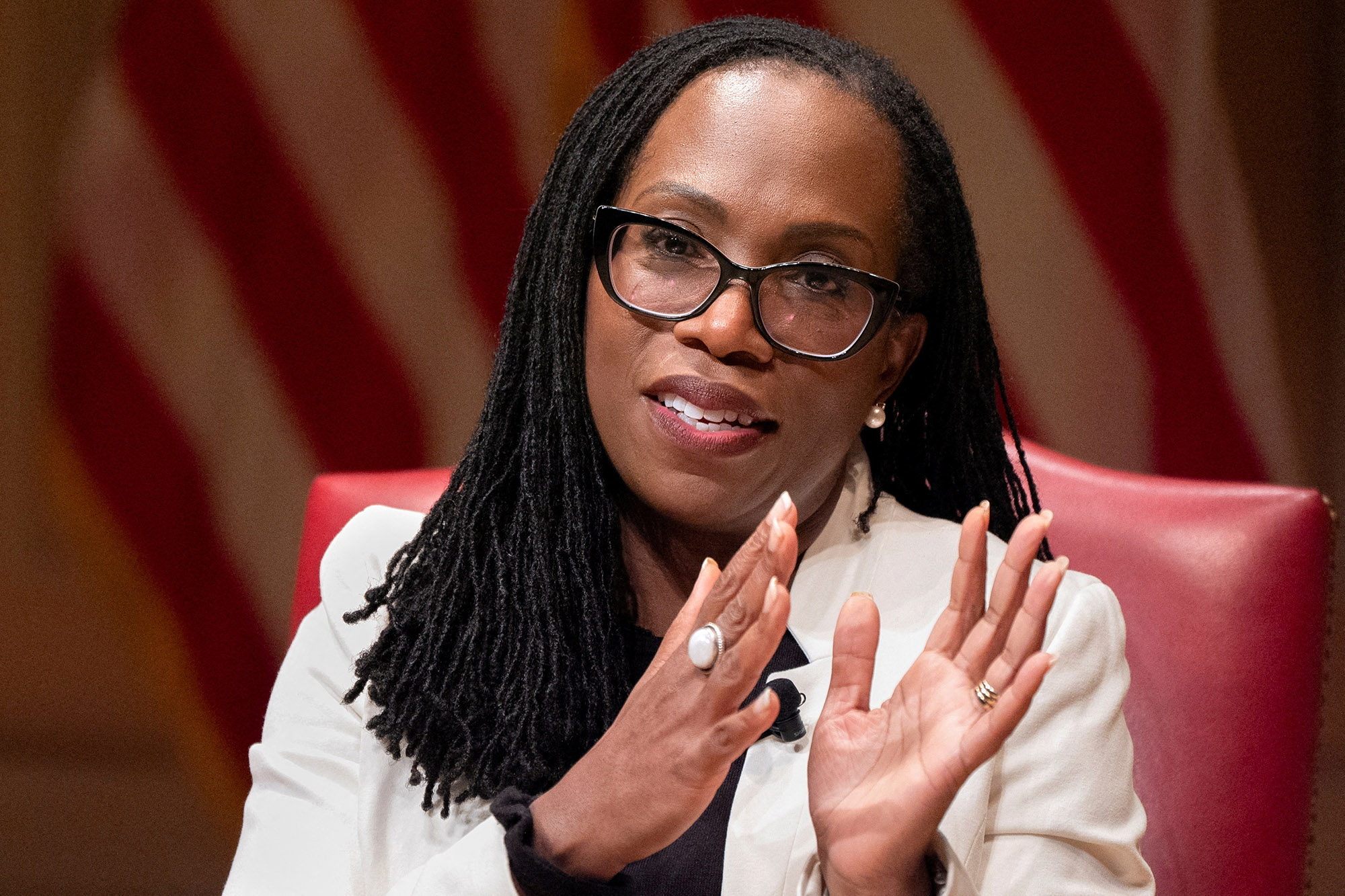
Supreme Court Justice Ketanji Brown Jackson speaks to the 2025 Supreme Court Fellows Program, Thursday, Feb. 13, 2025, at the Library of Congress in Washington, D.C., U.S. via REUTERS The call is coming from inside the house.
The Supreme Court’s decision in Louisiana v. Callais has made progressives even more determined to delegitimize the court — and Justice Ketanji Brown Jackson is among them.
In a dissent involving a post-decision procedural question, Jackson accused the majority of acting out of pure partisanship.
Her opinion said that the court “unshackles itself” from all constraint and “dives into the fray” (meaning the partisan fray).
In its jurisprudence, “principles give way to power.”
It is acting with an “abandon” that is “unwarranted and unwise.”
These harsh charges occasioned a stinging and well-deserved rebuttal from Justice Samuel Alito.
But, merits aside, the tenor and substance of the Jackson dissent captures the mindset of a left that is increasingly determined to destroy the Supreme Court in order to save it.
The technical matter under dispute was whether the court would wait 32 days to finalize its decision in Louisiana v. Callais.
This is the usual practice under the court’s Rule 45.3; the idea is to allow the losing party time to file a petition for re-hearing.
But the rule is flexible, a default “unless the Court or a Justice shortens or extends the time.”
The winning side in the case petitioned to get the decision finalized as soon as possible, since time is of the essence for Louisiana.
With the scheduled May 16 primaries rapidly approaching (they’ve now been delayed), the state wants to re-draw its maps in keeping with the court’s decision.
Jackson’s dissent quotes a 2019 decision of the court in Rucho v. Common Cause for the proposition that courts should not “risk assuming political . . . responsibility for a [partisan map-drawing] process that often produces ill will and distrust.”
But that was a warning against courts involving themselves in minute questions of partisan gerrymandering.
Here, the court has set out a bright-line principle that district lines can’t be race-based — but otherwise said that the political authorities are welcome to gerrymander or not, as they please.
Jackson also slapped the majority for creating “chaos in the State of Louisiana.”
This is quite rich given the history: Louisiana didn’t draw up its congressional lines undisturbed by judicial interference.
When the state created a congressional map after the 2020 census with just one majority-minority district, it got sued for not sufficiently taking race into account; a judge ordered it to make a second minority district.
When Louisiana complied by manufacturing a monstrosity of a district stretching 250 miles to randomly scoop up black voters, it got sued again — this time, for taking race too much into account — and that case made it to the Supreme Court.
It is a sign of how weak the Jackson dissent is that neither of the other progressives joined it, not even Justice Sonia Sotomayor.
There’s no doubt that it would have been much better if this case had been decided sooner, but Alito dropped a suggestive footnote in his rejoinder to Jackson.
He noted that the constitutional question in the case was “argued and conferenced nearly seven months ago.”
This implies that the case was effectively decided right after oral arguments in October of last year, and that the dissenters slow-walked it.
Now, Jackson wants more delay — it serves the partisan interests of Democrats to preserve unconstitutional race-based congressional districts as long as possible.
The reaction to Louisiana v. Callais has been so incandescent on the left because it believes that, unless black voters have black representatives, they are disenfranchised.
But this is not how representative democracy works.
Were white voters in Georgia disenfranchised in the 2022 US Senate race when two African-American candidates, Democrat Raphael Warnock and Republican Herschel Walker, ran against each other?
Were the voting rights of Christians in New York City crimped in 2025 because a Muslim man won the mayoral election?
All indications are that a commitment to some version of court-packing will be orthodoxy among Democratic presidential candidates in 2028.
They will seek to make the highly isolated and wholly unpersuasive Justice Jackson part of a new court majority — imposed by political fiat.