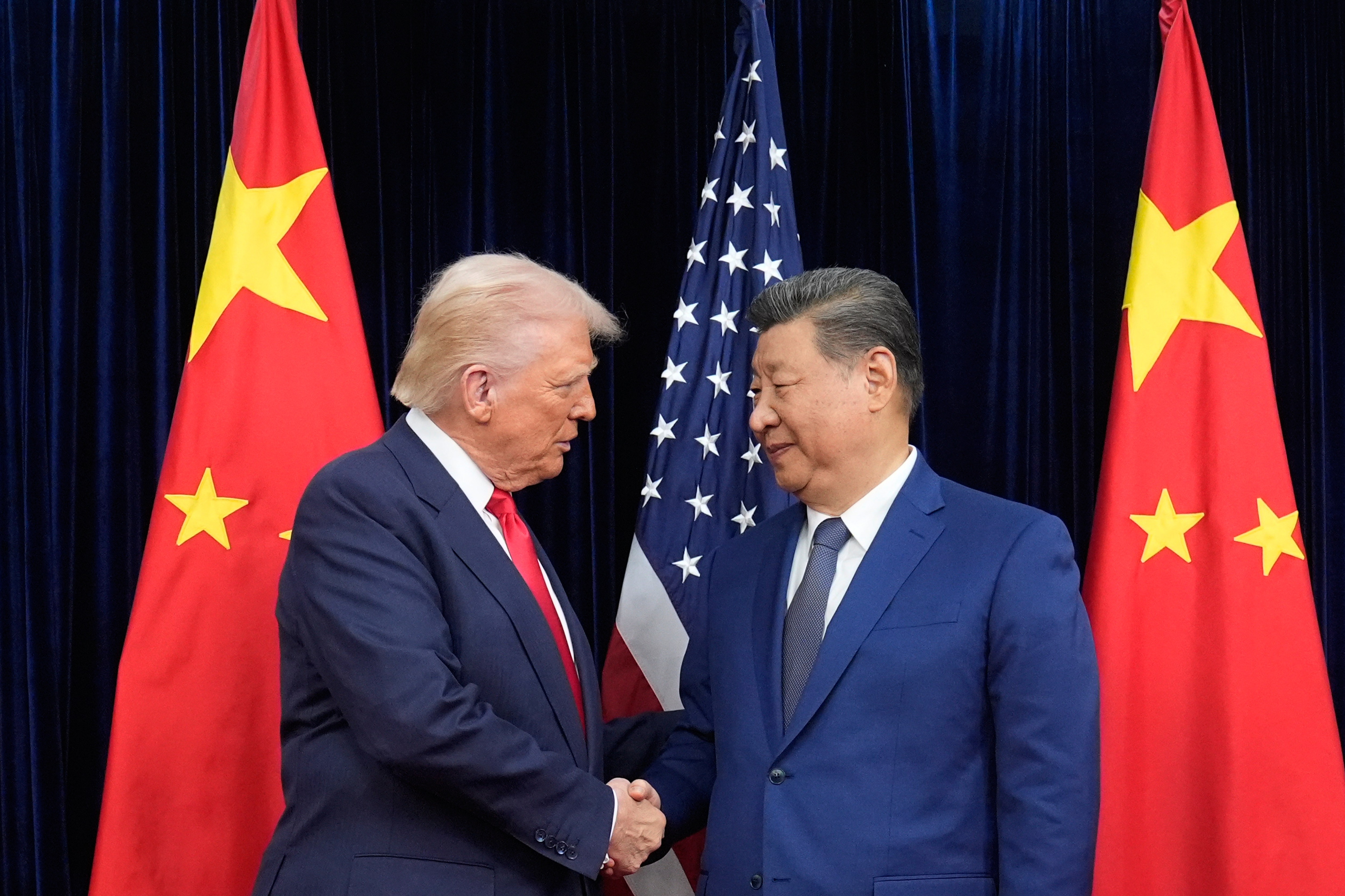
WASHINGTON – The war in Iran looms large over President Trump’s trip to China next week as the US seeks Chinese President Xi Jinping’s help in lowering gas prices but may have to concede ground in the technology war in return.
Beijing’s economy is also feeling the squeeze with gas prices rising and manufacturing bottlenecks causing a slowed demand in exports.
One option is for President Trump to press China to release oil from its massive strategic oil reserve of 1.4 billion barrels. But Xi could ask, in return, for the US to lift some of its restrictions on AI and other American technology.
The US has tried to slow China’s development of advanced chips, a major annoyance for Beijing, as the two countries engage in a technology war. US tech leaders – including from companies like NVIDIA , Apple, Exxon, Boeing, Qualcomm, Blackstone, Citigroup, and Visa – are being invited to join Trump on the trip, Semafor reported.
Michael Clark, a China expert at the Center for American Progress, predicted Xi would ask for the loosening of restrictions on AI chips in exchange for meeting Trump’s oil demands, seeing it as a long-term gain for some short-term pain.
“We’d be giving China exactly what they need to upgrade their own technology, and in turn military capabilities, using US technology,” he told The Post. “If China can trade a bit of oil, which they can replace with Russian imports, in exchange for permanent know-how and IP, I’d say they would go for it.”
There’s long been worry from the Americans that China is trying to steal American technology – including AI models and AI chips – to advance their own technological growth while protecting their own technological advances.
But tech companies see China as an untapped market for their goods. NVIDIA CEO Jensen Huang has estimated the China market could be worth $50 billion annually.
The White House cautioned that until the business delegation list is finalized, reporting on CEOs invited to China should be treated “as baseless speculation.”
There are other points of contention, including Beijing ordering its companies to disregard US sanctions targeting Iranian oil.
China is Iran’s biggest customer when it comes to crude oil and the Trump administration has pushed its leaders to use their influence in Tehran to help open the critical Strait of Hormuz.
Beijing has been cautious about its level of involvement in the war talks as its leaders watch and wait to see what happens.
But, despite the differences, experts believe both sides recognize a stable, open relationship is better in the long run.
“The two sides are pretty invested in not allowing this to destabilize the broader relationship,” Brookings Institute’s Patricia Kim told reporters at a briefing Thursday, adding Washington and Beijing both want to keep a “managed detente.”
The president’s visit to Beijing next week will be the first by a US president in eight years. Originally scheduled for April, the president delayed it because of the war in Iran.
For China, there are some positives in Trump’s war efforts.
The president’s focus on the Middle East keeps his attention and American resources in that region of the world instead of the Indo-Pacific, which China sees as its sphere of influence.
The conflict also has opened up opportunities for China with other Gulf nations, expanding its foothold in the region and giving it a broader base of countries to purchase its oil.
Xi has met with Abu Dhabi’s crown prince, Sheikh Khaled bin Mohamed bin Zayed Al Nahyan, and spoken with Saudi Crown Prince Mohammed bin Salman about the conflict as China sought to deepen its relationships around the Middle East.
Then there are China’s own priorities for next week’s meeting, at the top of which is Taiwan.
Xi wants to redefine Taiwan’s legal status and demand the US stop supporting Taiwan independence. In his New Year’s speech, he vowed to take the island and called reunification “unstoppable.”
Economic policy is also a major theme of the two-day meeting.
One of the original goals of this summit was to manage the trade imbalance between the two sides.
The US would like to see China buy more of its goods, including soybeans and airplanes, to decrease its trade surplus. Beijing would like to avoid any additional tariffs from Trump.