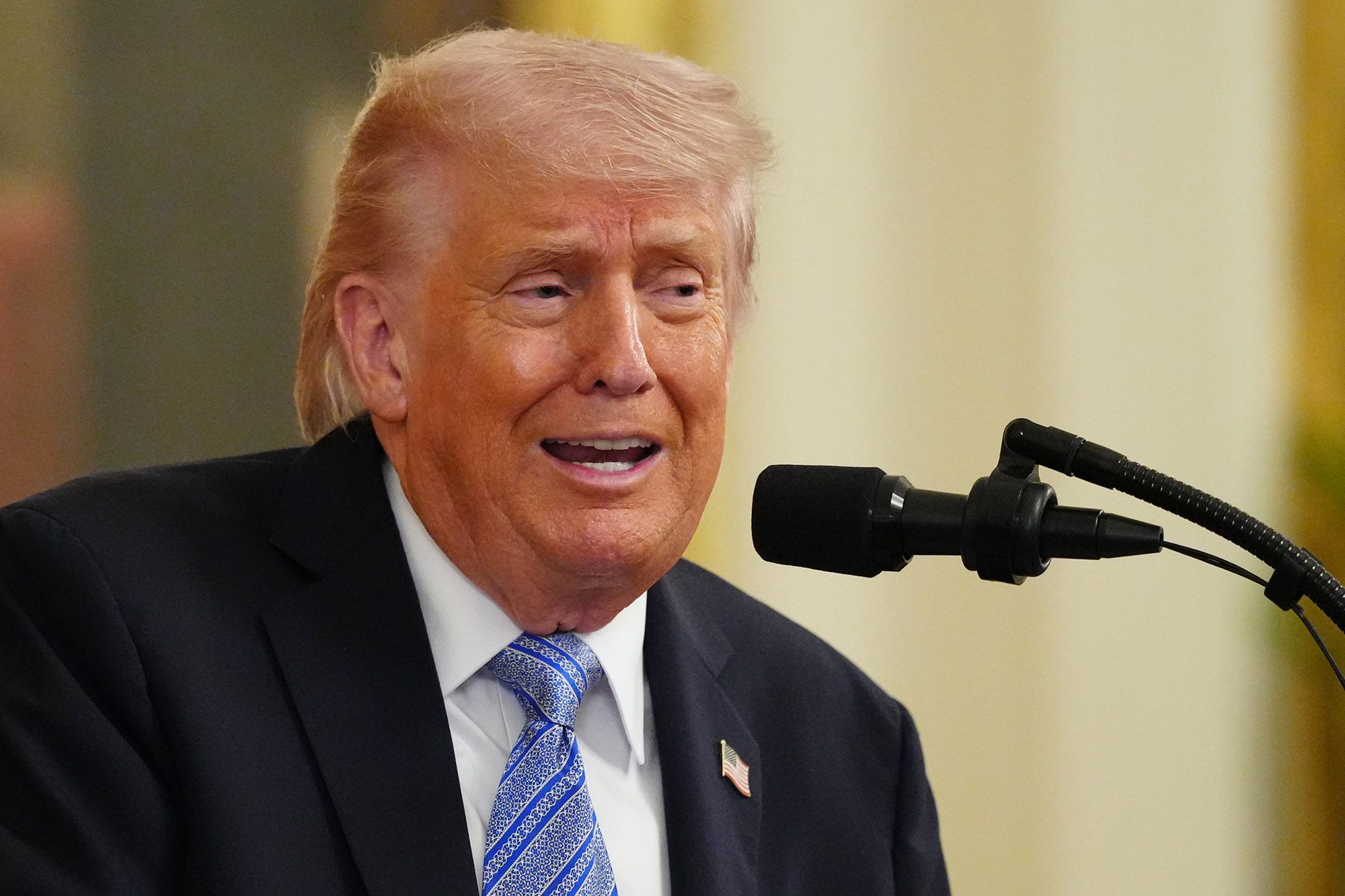
President Donald Trump speaks during an event with small business owners, Monday, May 4, 2026, in the East Room at the White House in Washington. AP Ken Griffin, the billionaire chief of the Citadel Investment empire, recently expressed his amazement at how President Donald Trump has had the fortitude to survive multiple assassination attempts while still bringing his A-game for the American people.
You can say the same thing about the Trump economy.
Yes, there are headwinds: The war in Iran continues to create economic uncertainty.
Prices remain stubbornly high, thanks to sticky inflation that wasn’t helped by Trump’s tariff policies.
Many people are working, but finding a new job isn’t easy.
Artificial intelligence is bringing rapid, sometimes unsettling change to various industries.
Current economic growth is decent — at a 2% annualized rate — but nothing to rave about.
But unless I’m missing something, the stock market keeps reaching record highs, buoyed by the mother’s milk known as corporate earnings, the ultimate indicator of underlying economic strength.
Those earnings are also heading toward record levels, possibly growing more than 21% in 2026, analysts say.
It’s “one of the best earnings seasons in 20 years,” Deutsche Bank number-crunchers said this week.
If history is any guide, such solid earnings and strong balance sheets mean one thing: Companies are poised to hire, maybe exponentially, once the current economic cycle turns.
I know what the naysayers are thinking: This time it’s different.
AI is creating amazing productivity gains, computerizing tasks that were once handled by humans.
Big companies can continue to churn profits, their stocks zooming up, without the real economy of Average Americans sharing their prosperity.
Wall Street and corporate America are winning, while Main Street just muddles along.
One problem with that argument is that it ignores the reality of the modern US economy: Wall Street and Main Street are more intertwined than ever.
Average Americans are stock investors, through their 401k and pension plans.
Blackrock CEO Larry Fink makes the point that middle America will embrace AI by investing in it, and many are.
The new so-called Trump Accounts, tax-advantaged investment plans for Americans under the age of 18, are making sure that hedge-fund traders aren’t the only beneficiaries of the AI boom, the profit surge and the concomitant rise in the markets.
Plus, it isn’t just technology-focused companies raking in the dough.
The current corporate profit bonanza is broad-based: Manufacturing, retail and health care are all gaining.
They’re tapping into AI, of course — but market strategists like Jason Trennert of Strategas Research say the breadth of the corporatist boom is directly related to Trump’s economic policies.
Charlie Gasparino has his finger on the pulse of where business, politics and finance meet Sign up to receive On The Money by Charlie Gasparino in your inbox every Thursday.
His One Big Beautiful Bill Act has sparked investment in plants and equipment, and eventually in the jobs that are bound to come once things settle out globally.
“If it weren’t for the war we would be talking about a reaccelerating in the economy,” he tells me.
That’s because of the tax advantages accruing to the businesses making those physical investments.
Consumer spending remains strong because Trump extended the tax rates he lowered during his first term.
All those elements factor into profits, and eventually jobs.
The Iran conflict will end — and when it does, given all the drilling we’re doing at home, oil prices will plummet, as will the price of a gallon of gas.
Consumers will feel better and spend more, and companies will tap into this sentiment by hiring.
And while AI will take away some jobs, it will create many more.
That’s already happening, in fact: Who do you think is building out our AI infrastructure?
It’s not some investment banker rolling up his sleeves, it’s a hard-working dude making a decent wage.
AI job-creation possibilities — again, if the past is any guide — will be vast.
Throughout history, as new technologies end redundant tasks, they open up novel employment options.
Recall, Amazon was supposed to destroy small businesses by making retail outlets obsolete — but the opposite happened, with mom-and-pop shops tapping into its portal to sell stuff.
Despite the current speed bumps, the corporate profit boom is foreshadowing a bright future.