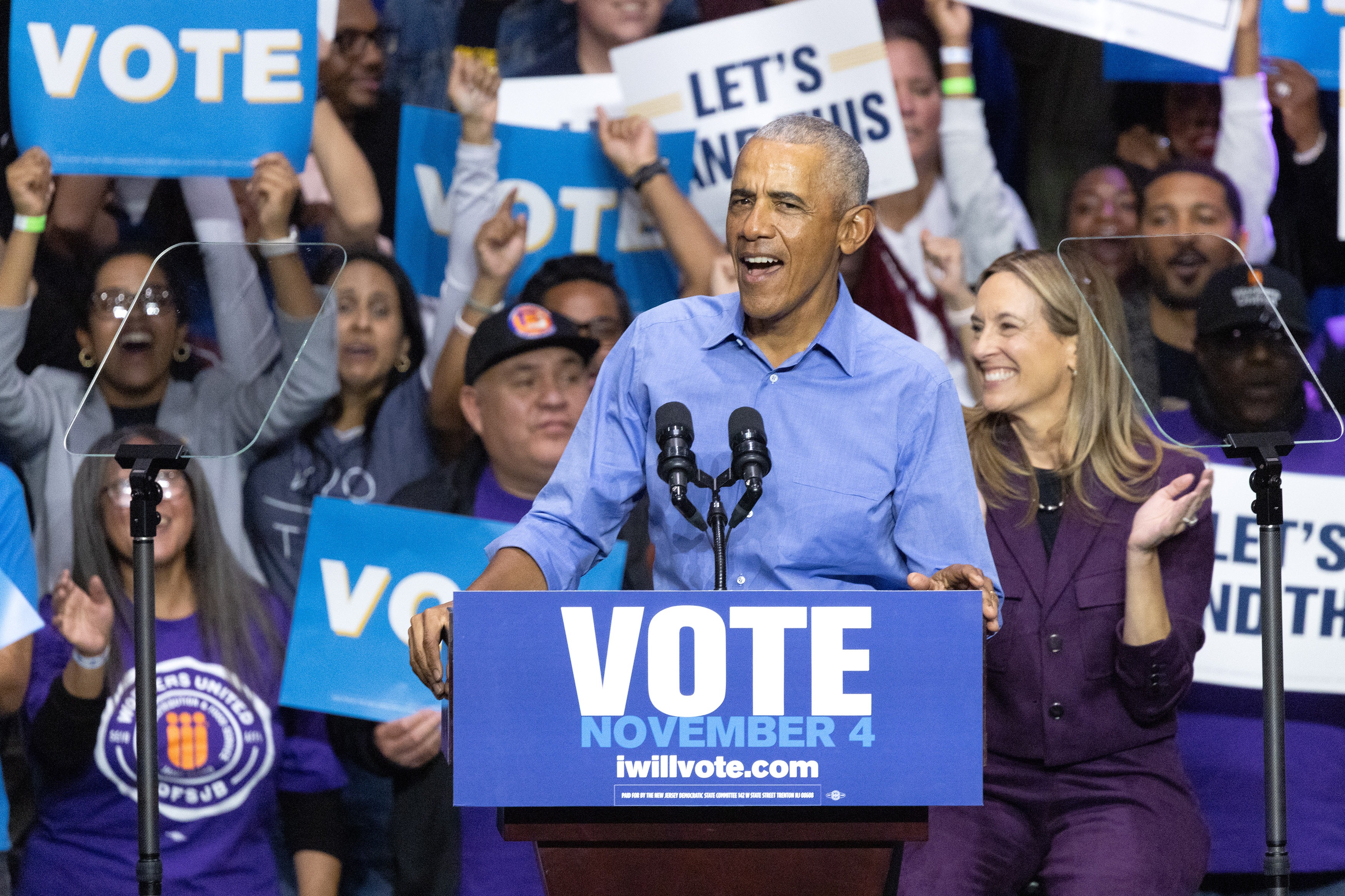
Former President Barack Obama campaigns for New Jersey Democrat gubernatorial candidate Rep. Mikie Sherrill at the Essex County College gymnasium in Newark. Aristide Economopoulos for NY Post Conservative: Bam’s Bogus Voting-Rights Gripe
“Fainting spells on the left” over the Supreme Court’s nixing of race-based gerrymandering were “probably to be expected” because Democrats “reject colorblind public policies” and “scoff at clear evidence of America’s racial progress,” notes The Wall Street Journal’s Jason L. Riley. Ex-Prez Barack Obama’s claim that the decision will “dilute and weaken the voting power of racial minorities” is “nonsense,” because he is “pretending that the decision somehow threatens the black franchise” though the court has not touched “Section 2 protections against efforts to restrict black voting.” Obama’s real gripe “has nothing to do with voting rights” and everything to do with “the ability of Democrats to use the 1965 act to gain a partisan advantage in drawing political maps.”
Economist: Look Who Fears ‘Politics’ at the Fed
As his time as Federal Reserve chairman ends, Jerome Powell is still staying on the board for now, claiming concern for “political factors”’ “Cry me a river,” scoffs Brian Wesbury at RealClearPolitics. For 18 years, “Fed policy has had more impact on the political environment than” ever. Its post-2007 “quantitative easing” tripled the money supply, worsening inequality, with young people losing out most — and blaming capitalism; “Mayor Mamdani is the poster child for upset youth.” Plus, the Fed’s COVID-era “artificially low” interest rates and purchase of Treasury debt financed a “very damaging set of policies,” leaving the Fed and private banks now “sitting on $1.5 trillion in losses on those bonds.” Just “who violated the separation between monetary policy and politics first?”
Health-care beat: GLP-1 Economics Lesson
“Why are GLP-1s getting cheaper” while overall health care “remains expensive?” asks David Goldhill at City Journal. Answer: Most consumers “have to pay actual prices” for GLP-1 drugs. Because coverage for the weight-loss use of the drug expanded quite slowly, manufacturers had to sell directly to consumers, and thus faced the same competitive forces as other industries. “Emerging technologies” are lowering health-care costs, but “unnecessary costs” and “invented complexity” will subsume the savings unless we redirect “dollars toward patient-consumers,” reduce “the role of intermediaries purchasing care on their behalf” and stop “expanding what routine insurance covers,” reserving it instead for “genuine catastrophic risk.” Other industries once considered “too essential for normal competition” have been transformed. “Health care can be next.”
Politics: Dems Embrace Antisemites
Events are showing “almost no resistance within the” Democratic Party’s “structure to the ascendant anti-Zionist contingent,” grimaces Commentary’s Seth Mandel: “There won’t be a fight for the party; there will simply be a process in which the old hand the reins to the new.” Chris Rabb, an AOC-backed Dem House candidate, has campaigned with “anti-Semitic influencer Hasan Piker”; New Jersey House candidate Adam Hamawy was outed as “an associate of terrorist mastermind Sheikh Omar Abdel-Rahman — the ‘Blind Sheikh.’ ” Maine Senate candidate Graham Platner survived “revelations about his Nazi tattoo,” while, “Abdul El-Sayed in Michigan caught a wave of momentum after also appearing with Piker.” Even more alarming, the party establishment is doing little “to mitigate the influence of anti-Semitic progressive celebrities.”
Welfare watch: Trump SNAP Reforms Working
President Trump’s reforms have “cut” the “bloat” produced by the “massively increased access to food stamps” under Biden and Obama, cheer the Washington Examiner’s editors. Trimming 3.5 million people from the SNAP rolls is “reducing deficits and increasing independence.” Thanks to last year’s reforms, “able-bodied adults ages 18 to 64 without children must work or participate in a job-training program” to get benefits, while “most immigrants” have been cut. Democrats view these “welcome developments” as a “catastrophe,” as they want the “public hooked on government benefits.” But the reforms are proving that dependency is a policy choice, not an economic inevitability,” and should signal the end of the “Obama-Biden dependency machine” for good.