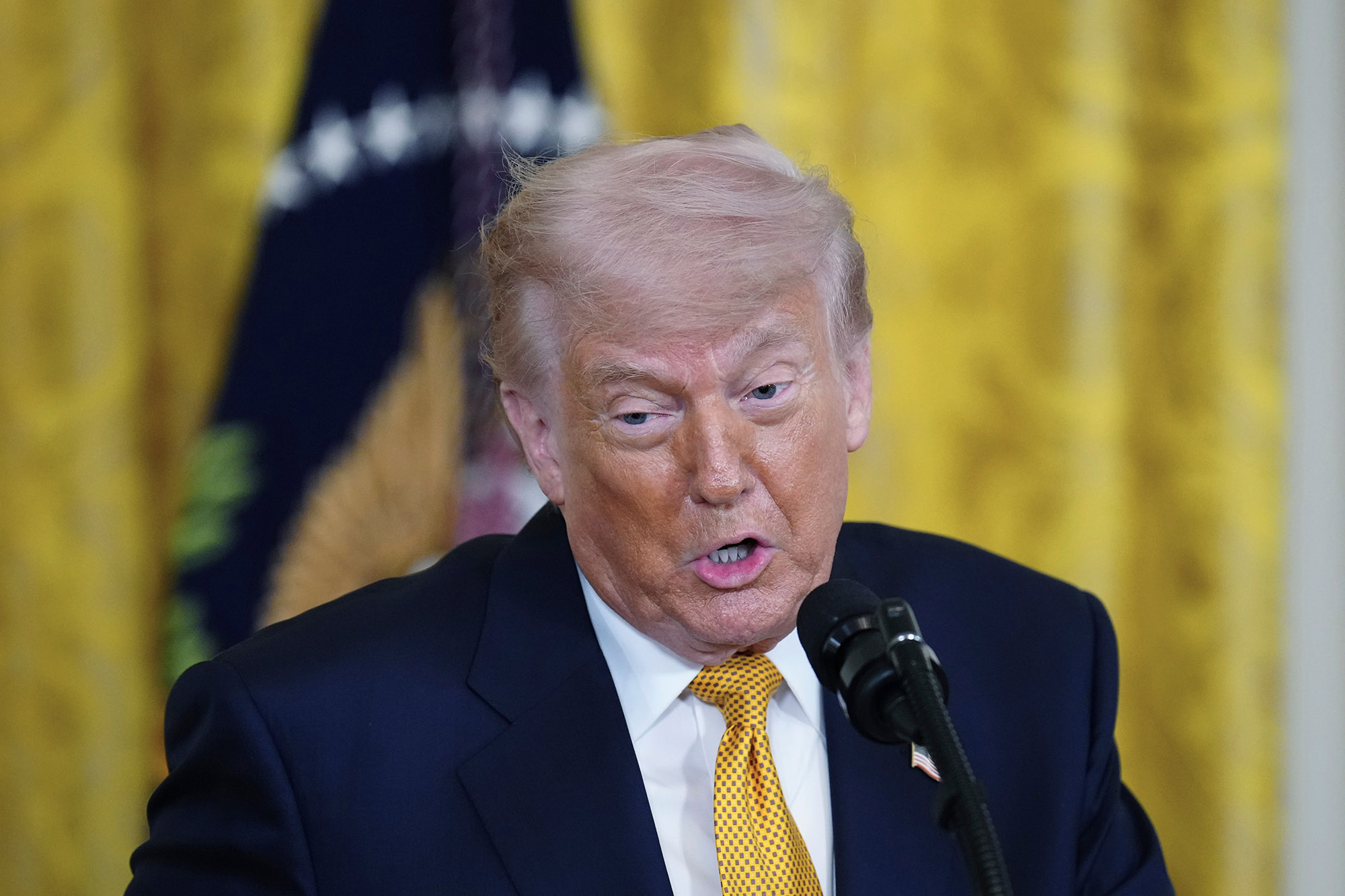
President Donald Trump speaks in the East Room of the White House, Wednesday, May 6, 2026. AP Trade, Taiwan and global tensions will likely top President Donald Trump’s agenda when he travels to China next week for a two-day summit.
But as he speaks with President Xi Jinping and other Chinese Communist Party officials, he should also make a point of directly addressing the Chinese people.
That’s what President Ronald Reagan did in 1984, when he delivered a historic speech to students at Fudan University in Shanghai.
Reagan set out to “introduce America” to those young minds — and such a mission is as important today as it was then, to counter Beijing’s narrative control and its relentless anti-American propaganda.
Reagan framed his commencement-style address as a means of helping the United States and China to get to know each other “in friendship,” calling such a development “the hope of the world.”
Describing America to China’s youth, directly and without CCP media censors, would jump-start this friendship, he believed.
And while some of his speech seems in hindsight naively optimistic — such as a passage envisioning growing cooperation in science and space exploration — the bulk of it focused on a decidedly more provocative topic: the two nations’ political differences.
“There’s no point in hiding the truth,” he remarked, a startling comment to an audience brought up under the CCP’s boot.
After all, hiding inconvenient truths is the party’s stock in trade: From the Cultural Revolution to the one-child policy and beyond, Beijing’s constant policy has been to cover up its catastrophes, large and small.
Reagan described a free, democratic America, drawing from our history, culture and founding principles.
He said nothing overtly critical of the Chinese communist system; he left it to his audience to ponder the stark differences for themselves.
He explained how America’s diverse people are united by a belief in “the special genius of each individual, and of his special right to make his own decisions and lead his own life,” based on the “unalienable rights” listed in the Declaration of Independence.
Nothing could be more anathema to Communist Party doctrine.
He spoke of free speech, saying that in our “disputatious nation,” Americans are “free to argue and disagree with each other.”
He spoke of religious freedom, describing America’s religious diversity and citing the significance of Judeo-Christian ethics in American culture.
When Reagan spoke, Chinese Protestant and Catholic churches were starting to recover from Mao Zedong’s brutal religious crackdown.
Shanghai’s own bishop, Cardinal Ignatius Kung, was released from his 30-year imprisonment the next year; within a decade, Chinese church membership surpassed the party’s.
And five years later, in 1989, the Chinese people’s demands for freedom culminated in pro-democracy protests at Tiananmen Square — which the CCP violently repressed.
Today, the Chinese people are in dire need of a new message of liberty.
Beijing’s religious repression is intensifying, with an ongoing genocide against Uyghur Muslims and a campaign against Falun Gong that reportedly entails forced organ harvesting of its practitioners.
It seeks to consolidate control over Tibetan Buddhism and intends to appoint the next Dalai Lama.
It forces the Catholic Church into the party’s Patriotic Association and detains and disappears bishops who resist; it jails renowned Protestant pastors and bans youth from all churches and Bible schools; it requires all religious communities to submit to strict oversight and co-option by the CCP’s United Front.
Trump’s visit gives him a chance to re-introduce America and its values to China’s youth.
He should make a point to describe America’s First Amendment freedoms, including our broad array of media and our independent internet.
By contrast, China jails scores of journalists and advocates like Apple Media founder Jimmy Lai, serving a 20-year sentence for pro-democracy messaging, and Zion Church Pastor Ezra Jin, under arrest for “abusing the Internet” by streaming his sermons.
Trump should emphasize that the US Constitution restricts governmental power, giving it no authority to establish or license religions, appoint their leaders, approve sermons or compel religious re-education.
And if he can’t directly address Chinese students in China, Trump can do so right here at home — at an American college campus.
In 1984 only a handful of Chinese students were studying in American universities, but this year alone we’re hosting 266,000 Chinese international students.
Their American professors probably teach them little about the principles to which we pledge our allegiance, so the president should use his powers of persuasion to sell them on America’s core freedoms.
As a now powerful China grows more threatening, it’s time to explain American principles and values to a new Chinese generation in Reagan’s spirit of friendship.
They have a great role to play in both our nations’ futures.
Nina Shea is a Hudson Institute senior fellow and director of its Center for Religious Freedom.