To play this video you need to enable JavaScript in your browser.This video can not be played
Doku scores late to salvage draw in six-goal thriller
Football issues correspondentPublished8 minutes agoEverton's pulsating 3-3 draw with Manchester City was full of drama - late goals, a defensive calamity and, of course, a bit of video assistant referee (VAR) controversy.
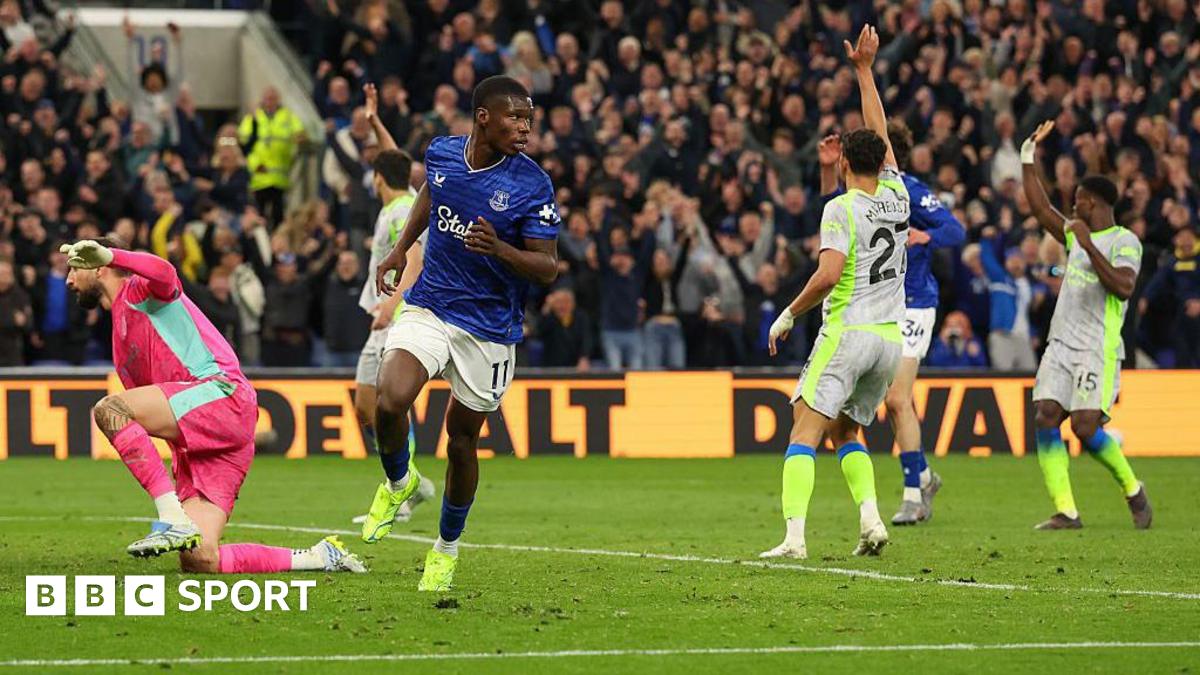
At the top of the list was Thierno Barry's goal, with the Everton striker benefiting from being in an offside position thanks to a bizarre "assist" from City's Marc Guehi.
Toffees boss David Moyes said he was "amazed" his side were not given a penalty when Bernardo Silva dragged down Merlin Rohl in the final five minutes.
And then there was the potential red card for Everton defender Michael Keane, flying into a challenge on Jeremy Doku.
Paul Howard, the VAR, stayed out of all three decisions and left them with the on-field call of referee Michael Oliver.
Image source, Getty ImagesImage caption, The assistant initially raised his flag for offside against Thierno Barry before referee Michael Oliver deemed the goal should be allowed to stand
Barry was waiting on the shoulder of Guehi, weighing up when to make his move as Rohl played a through ball.
It was not a good pass by the German midfielder, straight to the feet of the Manchester City defender.
While Barry had started to move towards Guehi, he was not placing the opponent under pressure. Inexplicably, Guehi under hit a back pass which Barry latched on to to score.
Barry was offside and the assistant raised his flag to disallow the goal initially, but he was quickly overruled by Oliver.
The law asks a few key questions: Did Barry do anything which could have caused Guehi to rush, or to influence his poor pass?
Barry did move towards the ball, but did that really impact Guehi?
And did Guehi have full expectation of a controlled outcome from playing the ball?
"Barry is in an offside position when the ball is played but it's down to Guehi," former Manchester City and Everton defender Andy Hinchcliffe said on Sky Sports.
"He is in control of his actions, so suddenly the attacker goes from offside to onside. That is why the goal rightly stands. That is disastrous from Guehi."
Without these subjective judgements, you would have to penalise every player just for being in an offside position - even if they were not close to the opponent.
Guehi's mishap is among the most obvious examples of a pure defensive howler, and clearly should cancel any offside.
But we've seen far more controversial ones, such as Bruno Fernandes' goal in the Manchester derby three years ago.
Marcus Rashford, from an offside position, ran after the ball but he did not touch it and Fernandes came in from behind to score.
In April last year, Liverpool's Luis Diaz was standing offside behind James Tarkowski as the centre-back attempted to intercept a loose ball. It resulted in Diogo Jota scoring the winning goal for Arne Slot's team.
Some take issue with this rule because, as in those two cases, it can inadvertently disadvantage defenders who know there is an opponent close by, but do not know they are offside.
In Tarkowski's case, would he have acted differently if Diaz was not there?
It is not something you can fix easily. You would have to make offside completely binary, and loads more goals would be ruled out.
"If that doesn't get given as a penalty, then it's an absolute free-for-all from now on," David Moyes said after the game.
The Everton manager wanted a spot-kick after Rohl was pulled to the ground by Bernardo Silva at an 85th-minute corner.
"I might have to start coaching my defenders how to defend differently completely," Moyes added. "It looks like now you're able to sort of grapple and wrestle on the ground if you want.
It was checked by Howard, the video assistant referee, but he ultimately decided that the foul took place before the ball was in play.
And you cannot give a free-kick or a penalty if the ball is out.
The referee can take disciplinary action, but the restart has to remain the same.
Last season, Southampton's Jack Stephens was sent off via a VAR review for pulling the hair of Chelsea's Marc Cucurella when the ball was out. The game still got under way again with a corner.
It is often why you see a lot of the pushing and shoving taking place just before a corner taker delivers the ball into the box.
In February, Erling Haaland asked for a spot-kick after being dragged down by Tottenham's Radu Dragusin.
Just like in this case, it was decided the holding had ended by the time the corner was taken.
It was a clear non-footballing action, too, with the Portugal international having both arms around the waist of Rohl and no interest in challenging for the ball.
There is no doubt that most of the holding was before the ball was kicked. But Everton fans argue it was still happening when James Garner kicked the ball, and that VAR should have intervened.
The VAR stats show why Everton feel so frustrated.
With three rounds to go, they are the only team in the Premier League yet to have an overturn go in their favour. In fact, no other team has fewer than two.
At the other end of the scale, Chelsea have had 11 VAR interventions go their way.
The last time the Toffees gained from a review was in January 2025, for a penalty at Brighton.
Were Arsenal right to be 'fuming' with refereeing after Atletico draw?
Keane's tackle had speed and intensity, as he slid in at pace. You could see the arguments for a red card.
Referee Oliver produced a yellow card, which would be supportable because the point of contact on Doku was very low, on the boot.
Had it been any higher, for instance on the ankle, then a VAR intervention should have been expected.
"A challenge like that is very close to ticking the boxes [of a red card]," Hinchcliffe said. "He is very lucky to get away with that one. If it was any higher it may have been different."
We saw a similar kind of challenge by Fernandes in Manchester United's 3-2 win over Liverpool on Sunday. Again, a booking would be an acceptable disciplinary outcome.
Fernandes had chased down Dominik Szoboszlai and, much like Keane, slid in and hit his opponent on the boot.
Somewhat controversially, Doku had to go off the pitch for 30 seconds despite Keane having been booked.
While the laws do say a fouled player should be able to stay on if a yellow or red card is shown, that only applies if the treatment is quick - within 20 or 30 seconds.
Doku can probably consider himself unfortunate. While the game was stopped for two minutes, the physio was only with him for 30 seconds.
Get news, insight and fan views on your Premier League team