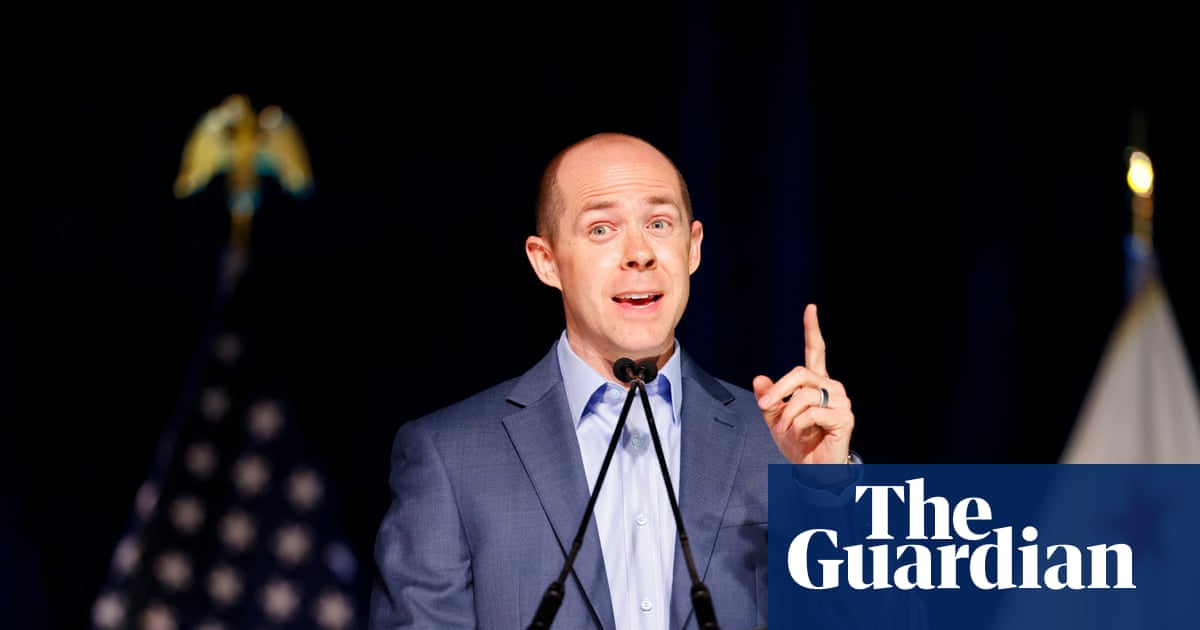
Rusty Hicks, the California Democratic party chair, in Anaheim last year. Photograph: Carlin Stiehl/Los Angeles Times/Getty ImagesView image in fullscreenRusty Hicks, the California Democratic party chair, in Anaheim last year. Photograph: Carlin Stiehl/Los Angeles Times/Getty ImagesTop California Democrat urges change to ‘free-for-all’ primary to keep governor’s mansion blueRusty Hicks concerned that Democrats could crowd each other out in ‘open’ system and hand victory to Republicans
The chair of the California Democratic party says he wants to get rid of the state’s idiosyncratic “open primary”, calling it a failure that risks pitting a crowded field of Democratic candidates against each other to the point where a Republican can be elected governor of one of the bluest states in the US.
“The current system we have does not work,” Rusty Hicks said in an interview. “It needs to be revised or repealed.”
Hicks argued that California’s free-for-all primary, in which voters are free to choose any candidate and the top two vote-winners advance regardless of party, was too prone to quirky outcomes and gamesmanship. He wants a different structure put to voters as early as this November.
With the weeks ticking down to the 2 June primary, Hicks is not the only Democrat losing sleep over the statistical possibility that the two leading Republicans for governor, Steve Hilton and Chad Bianco, could end up in first and second place because the six Democrats left in the race have failed to put enough distance between each other.
Such a scenario would be politically disastrous for the party at a time when it is counting on California as a bastion of resistance to the Trump administration and a model for alternative governance at home and abroad.
California Democrats enjoy a two-to-one registration advantage over Republicans, hold supermajorities in both houses of the state legislature, and have not lost an election for statewide office since 2006.
“The stakes are so incredibly high,” Hicks said. “We have democracy itself under attack, and the United States [is no longer] the beacon of hope for democracies around the world the way it once was.”
Hicks himself became a lightning rod in March when he issued an open letter urging candidates with no viable path to the governorship to drop out. The field has thinned a little since, but at the time some of the lower-polling contenders took offence at what they saw as unwarranted interference. “It’s really hard to sit here and be told you should get out of the race when, OK, we’re Democrats, I thought we believed in having choice,” former state legislative leader Ian Calderon, one of the candidates who has since dropped out, said in a television interview.
Other prominent California Democrats did not immediately join Hicks’s call to change the top-two primary. The party’s top polling gubernatorial candidates, Tom Steyer and Xavier Becerra, did not offer a comment and neither did Robert Rivas, the speaker of the state assembly – a reflection perhaps, of the issue’s sensitivity while the race is in full swing.
The top-two open primary, sometimes called the “jungle primary”, was part of a package of electoral reform measures championed by Arnold Schwarzenegger at the end of his governorship in 2010. The idea was to give the state’s independent voters more influence, cultivate consensus-driven candidates with cross-party appeal, make races more competitive, and encourage higher voter turnout.
The reform was not, however, the result of long and careful deliberation. Rather, it was hatched in a hurry to help resolve a short-term budgeting impasse and, according to critics across the political spectrum, has either failed to deliver on many of the benefits it promised or has exposed flaws that undermine its architects’ intentions.
“It was supposed to be a way of getting moderation, and an opportunity not to have one party dominate,” said Sara Sadhwani, a political science professor at Pomona College who also serves on the state redistricting commission. “The reality is that, despite the top-two primary, we have one-party domination in California and not a whole lot of moderation.”
The problem highlighted in the governor’s race – of intense competition on one side of the party divide scrambling the math – has arisen before and tripped up Republicans and Democrats. In 2012, two white Republicans running for a house seat in Redlands, east of Los Angeles, qualified for the general election even though the district was majority Democrat and majority Latino.
Two years later, something similar happened in a key swing district in the Antelope Valley north of LA, where the two parties run very close. Yet, instead of a Democrat and a Republican facing off in a general election, it got two Republicans.
In 2022, it was the GOP’s turn to be shut out of a state senate election in the Sierra Nevada mountains, despite the fact that 60% of the primary electorate voted Republican.
Even in races that have not ultimately produced such stark outcomes, party leaders have spent significant resources pressuring second-tier candidates to drop out or have come up with schemes to game the system.
Adam Schiff, now California’s junior senator, raised eyebrows in a 2024 primary when he ran a flurry of attack ads against a Republican who posed no serious competitive threat, Steve Garvey. The effect was to raise Garvey’s profile to such an extent that he won a place in the general election over Democratic congresswoman Katie Porter, who would most likely have presented Schiff with a much stiffer challenge and accused Schiff’s backers of rigging the election, an accusation she later took back.
Hicks said he didn’t have an alternative to propose to the top-two system, only a conviction that it needed “a review, a reconsideration and maybe even a repeal”. He hoped either the state legislature of “someone with significant resources” would put a different model before the voters. “It could be done as early as 2026,” he said, “but it could be done in a future election as well.”
Historically, the two major parties have tended to prefer primaries accessible only to registered members because the outcomes are easier to control that way. California, however, has a history of political experimentation and briefly ran a so-called “blanket primary” – in which any voter can choose any candidate, and one winner from each party advances to the general election – until the US supreme court deemed it unconstitutional in 2000.
Voting rights advocates generally say the top-two system should be tweaked, not abandoned, and that ranked choice voting can help decipher voter preferences in a crowded field. In 2020, Alaska voters adopted a model first advocated by the Washington reform group FairVote.org in which the top four candidates in a primary advance to the general election and the ultimate winner is determined through ranked choice voting.
That system has received high marks from thinktanks and good government groups since its implementation in 2022, but it is also bitterly opposed by Alaska’s Republican party, the dominant force in the state. Republicans tried to repeal it in 2024 and are trying again this year. Trump, weighing into the battle, recently called the Alaska model “disastrous and very fraudulent” – a reaction that may cause California’s hotly anti-Trump Democrats to look on it more kindly.
“If there were to be a change, does it come from the top down and get pushed on to voters, or is there a ground-up movement?” Sadhwani asked. “Maybe a new voting system can move the hearts and minds of voters … The real question is, would it be better?”