We are restarting our live coverage of the US-Israeli war on Iran.
Iran needs “credible guarantees” against more US-Israeli attacks before it can ensure security in the Gulf, Tehran’s envoy to the UN has said, while on a Russian visit Iran’s foreign minister blamed Washington for the failure of peace talks.
“The US approaches caused the previous round of negotiations, despite progress, to fail to reach its goals because of the excessive demands,” the minister, Abbas Araghchi, said on Monday in St Petersburg, where Vladimir Putin promised him Moscow’s support in ending the war.
Donald Trump on Sunday had told Fox News that if Iran wanted talks, “they can call us” – adding that his cancellation of sending his envoys to Pakistan at the weekend did not signal a return to hostilities.
On Monday Amir Saeid Iravani, Tehran’s UN ambassador, told a security council session: “Lasting stability and security in the Persian Gulf and the wider region can only be achieved through a durable and permanent cessation of aggression against Iran supplemented by credible guarantees of non-recurrence and full respect for the legitimate sovereign rights and interests of Iran.”
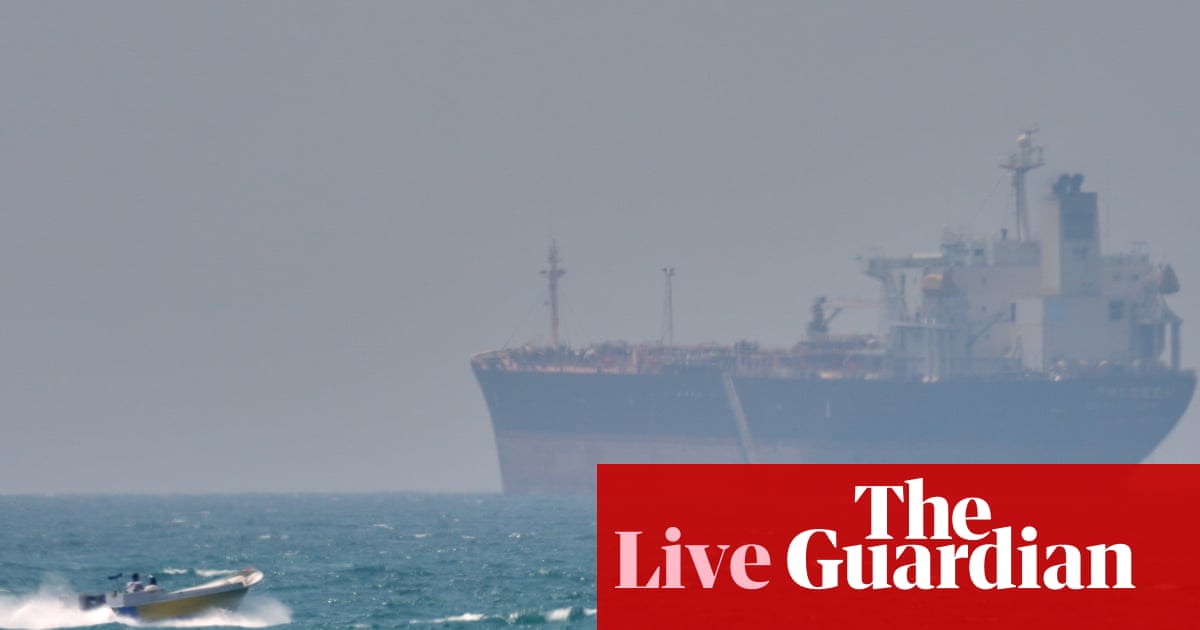
Vessels in the strait of Hormuz off Musandam, Oman, on Monday. Photograph: ReutersMeanwhile, Israeli prime minister Benjamin Netanyahu claimed, without providing evidence, that Hezbollah’s rockets and drones were a key threat demanding military action as the Israeli army expanded airstrikes on Lebanon. Authorities there reported at least four people were killed on Monday despite a supposed ceasefire.
Donald Trump is unhappy with an Iranian proposal on the war because it does not address Iran’s nuclear program, Reuters cited a US official as saying on Monday, after Trump discussed the proposal with his top national security aides. Iran had offered to end its closure of the strait of Hormuz if the US lifted its blockade and ended the war in a proposal that would postpone discussions on Iran’s nuclear program, the Associated Press reported earlier, citing two unnamed regional officials. Later reporting quoted White House spokesperson Karoline Leavitt as saying the proposal was “being discussed”.
Lebanese president Joseph Aoun said direct talks with Israel sought to end the war on Lebanon and that those who dragged Lebanon into it were the ones committing “treason” – a jab at the Iran-backed militia Hezbollah, which claimed several attacks on Israeli targets in south Lebanon on Monday.
Iraq’s newly elected president nominated businessman Ali al-Zaidi as the country’s prime minister-designate on Monday, after the country’s leaders yielded to US pressure not to support the bid of a former premier close to Iran.
The Coordination Framework – an alliance of Shia factions with varying links to Iran – had initially backed powerbroker Nouri al-Maliki to become the country’s next premier, but Trump’s ultimatum left Iraqi leaders looking elsewhere.
The US and Iran clashed at the UN on Monday over Tehran’s nuclear program and its selection to be one of dozens of vice-presidents at a month-long conference to review the nuclear non-proliferation treaty. US official Christopher Yeaw said Iran’s selection was an “affront” to the treaty. Tehran’s envoy to the International Atomic Energy Agency, Reza Najafi, rejected the US statement as “baseless and politically motivated”.