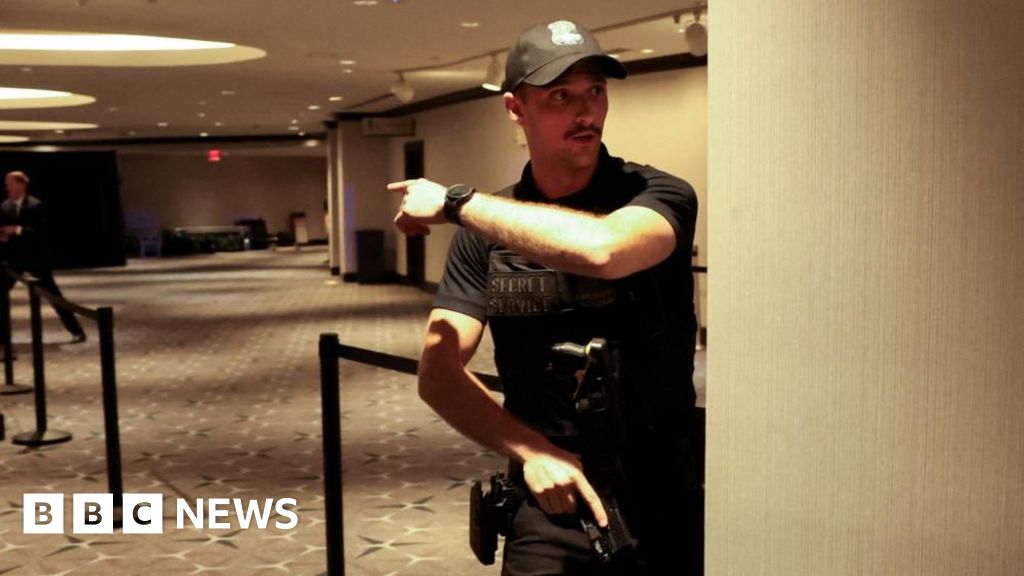
ShareSaveAdd as preferred on GoogleAnthony ZurcherNorth America correspondentTrump: How shooting at White House correspondents' dinner unfoldedFor many in the ballroom at the White House Correspondents' Association dinner on Saturday night, the scene was painfully familiar. Shots fired, confusion and panic, and a sense that the normal order of things had been violently interrupted.
Erika Kirk, whose husband, the conservative activist Charlie Kirk, was shot and killed last September, was in tears. Congressman Steve Scalise, majority leader in the House of Representatives who suffered life-threatening injuries in a shooting at a baseball practice with Republican teammates in 2017, was escorted out by security.
So was Health Secretary Robert F Kennedy Jr, who lost his father and uncle to assassin's bullets.
Many journalists in attendance had been at the 2024 rally in Butler, Pennsylvania, where an assailant opened fire on Donald Trump, grazing his ear, before being killed by a Secret Service sniper.
In modern America, it seems, political violence has become an ever-present storm, that can strike anywhere, at any moment.
Saturday night was the third time that Trump has been directly targeted – after the Butler attack and another attempt in 2024 at his Palm Beach golf resort. In a separate incident, the Secret Service killed an armed man trying to enter Trump's Mar-a-Lago club, although the president was not in Florida at the time.
These incidents have become frequent enough that there is almost a routine to them.
Trump, reflective, calls for unity and a cooling of political rhetoric. News coverage speculates about a "new tone" from the president. Ultimately, partisan divisions reassert themselves – often with Trump leading the way.
"His many detractors should grant that his comments late Saturday at a White House press briefing hit the right notes of gratitude and comity," a Wall Street Journal editorial observed.
On Sunday evening, in a sit-down with CBS' 60 Minutes programme, Trump blamed Democrats for creating an atmosphere that encouraged the shooting, then derided interviewer Norah O'Donnell as "a disgrace" and "horrible" after she asked about the manifesto written by the alleged assailant.
Neighbours of White House correspondents' dinner shooting suspect reactThe contours of the policy goals for Trump and his Republican allies also have quickly come into view. Some on the left, fuelled by concerns about a crackdown on free speech or Democratic activism, circulated unfounded conspiracy theories that the attack was a means of boosting the president's standing.
But Trump's response since the shooting has focused largely on removing obstacles to constructing a massive ballroom at the White House where the mansion's east wing once stood.
On Sunday, Trump posted on social media that Saturday's incident was "exactly the reason" he wants the ballroom.
In a letter to the historic preservation group that filed a lawsuit challenging the legality of the ballroom, Assistant Attorney General Brett Shumate said the structure would ensure the president's "safety and security".
"Your lawsuit puts the lives of the president, his family and his staff at grave risk," he wrote.
Several Republicans in Congress promised to introduce legislation explicitly authorising the ballroom.
"The ballroom will be a solution for this," Speaker of the House Mike Johnson, referring to the correspondents' dinner, said in a Monday interview on Fox News. "It'll be a safe environment to do events like that."
It's unclear if the White House Correspondents' Association, which organises the fundraising dinner, would want the president – traditionally an invited guest – to host the annual event. And even with a fortified ballroom at their disposal, presidents typically travel around America for speeches, fundraising events and other public appearances.
A ballroom by itself will not fully address safety concerns raised by Saturday's incident. Those concerns include how a man was able to bring weapons into a building hosting a president and top government officials, whether the security perimeter set out by the US Secret Service was sufficient, and whether guests in other parts of the hotel should have been screened.
According to a senior administration official, White House Chief of Staff Susie Wiles is convening with Secret Service officials early this week to "discuss protocol and practices for major events" involving the president – including US 250th centennial celebrations this summer.
After the Butler shooting at a fairground near Pittsburgh, Trump drastically curtailed his outdoor rallies. Since becoming president, he has preferred appearances at secure military bases, and speeches and roundtables in smaller venues. Larger public appearances have moved to indoor arenas, where it is easier for the Secret Service to screen attendees.
With the midterm elections looming, however, Trump will be pressed to hit the campaign trail to encourage his supporters, who often stay home when he is not on the ballot, to turn out to vote.
A bunker mentality may make for a safer president. But it could come at a political price.