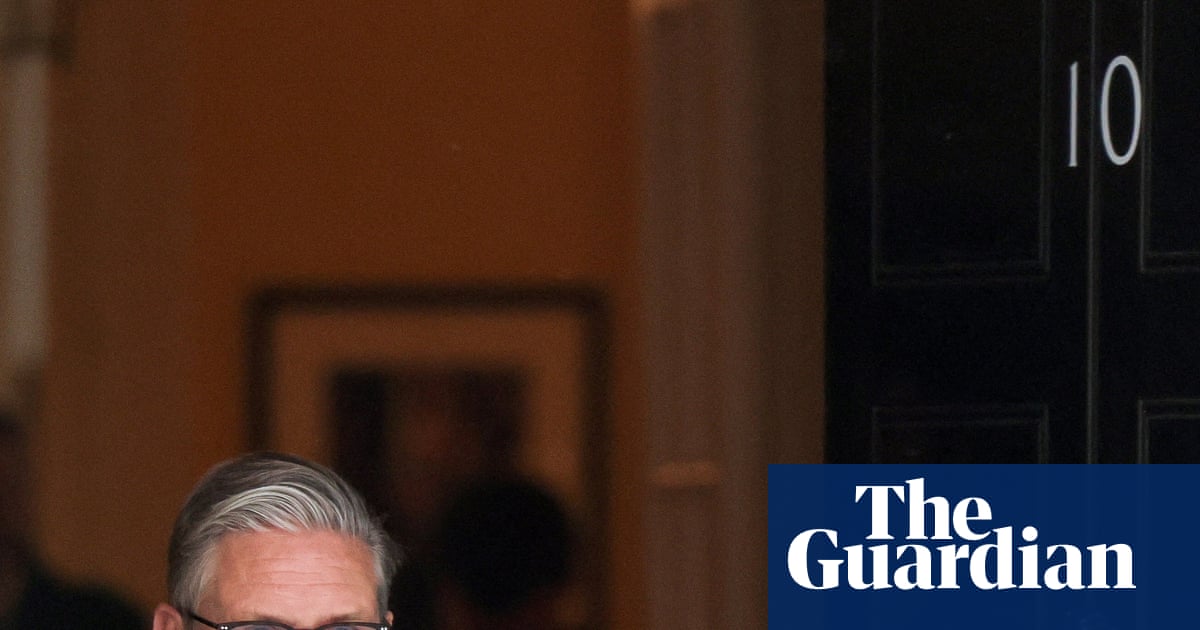
Keir Starmer faces a critical day for his premiership on Tuesday. Photograph: Toby Shepheard/ReutersView image in fullscreenKeir Starmer faces a critical day for his premiership on Tuesday. Photograph: Toby Shepheard/ReutersStarmer tells MPs to ‘fight together’ before critical day for his premiership The prime minister faces a standards investigation over Mandelson affair and testimony from Morgan McSweeney
Keir Starmer has told Labour MPs to “stick together and fight together” as ministers launched a massive operation to shore up his fragile position before a critical day for his premiership.
The prime minister faces the double threat of a standards investigation into his decision to appoint Peter Mandelson as ambassador to the US and a potentially damaging testimony from Morgan McSweeney, his former chief of staff.
Allies including Richard Hermer, the attorney general, and Jenny Chapman, a foreign office minister, were among those who rang round Labour MPs before Tuesday’s Commons vote on whether to refer him to parliament’s privileges committee.
Senior Labour figures including Gordon Brown and former cabinet ministers Alan Johnson and David Blunkett called for restraint from backbenchers, dismissing the vote as a political stunt designed to destabilise the party before the May elections.
The Guardian understands that Labour MPs will be whipped to vote against the Conservative motion to refer Starmer to the committee. Any rebellion is likely to be limited because most appear to accept that while there is anger towards the prime minister, they do not want to hand the opposition a win.
However, Starmer faces a second moment of jeopardy on Tuesday with McSweeney’s appearance in front of the foreign affairs committee (FAC) inquiry into Mandelson’s appointment.
While McSweeney, who left government over the row, has said he takes “full responsibility” for advising Starmer to appoint the former ambassador, he is likely to face questions over whether due process was followed, including whether he put pressure on the Foreign Office over Mandelson.
He is also expected to be quizzed over who in No 10 had argued that Mandelson did not require vetting at all, and on the theft of his official phone shortly after Mandelson was sacked as ambassador over his links to the convicted child sex offender Jeffrey Epstein.
Philip Barton, who ran the Foreign Office before Olly Robbins – the top official sacked by Starmer last week – will also give evidence, and will be asked whether McSweeney told him to “just fucking approve” the appointment.
In a further development, a letter from Ian Collard – the director of security who briefed Robbins – to the FAC on Mandelson’s vetting revealed on Monday night that he had not seen the document which recommended security clearance was denied.
Instead, he received an oral briefing from officials who told him it was “overall … a borderline case” that could be handled through “robust risk management”. He admitted he felt under pressure to deliver a “rapid outcome” to the case, but that it did not have an impact on his final judgment.
In an attempt to bolster support among his own MPs, many of whom have been dismayed by the Guardian’s revelation that Mandelson was installed as ambassador despite failing security vetting, Starmer addressed the parliamentary party before the vote.
“I have responsibility for being totally transparent with you, with parliament and the British public,” he said. “I take that very seriously as well.
“But this is not about a lack of transparency. This is a political stunt by our opponents who want to bring us down, obscure our message, stop us getting on with our work. And the timing tells you everything nine days before local elections … Tomorrow is pure politics and we need to stand together against it.”
Downing Street took the unusual step of releasing a letter from Chris Wormald, the former cabinet secretary, to Starmer last September in which he concluded that “appropriate processes were followed” during Mandelson’s appointment.
The Tories have also questioned the prime minister’s claim that there was “no pressure whatsoever” applied on the Foreign Office over the affair, when Robbins had said there was.
No 10 has said his comment referred specifically to the security vetting process rather than the broader appointment of Mandelson. Knowingly misleading parliament is considered a resigning offence for ministers.
Senior Labour figures accused the Conservatives of political point scoring and Downing Street said it was a “desperate political stunt” designed solely to inflict damage on the government before crucial elections next week.
Brown urged Labour MPs to “put the needs of the country first” at a time when there are “conflicts raging around the world” with serious consequences for the UK. He said Starmer deserved their support and dismissed the vote as a “parliamentary game”.
Johnson and Blunkett released a joint statement calling the Tory move a “nakedly political stunt with no substance”, dismissing comparisons with Boris Johnson’s referral to the privileges committee, which precipitated his departure as an MP, as “absurd”.
Emily Thornberry, the chair of the FAC, said she could not see the need for a second inquiry while the one she was leading was still taking place.
After the parliamentary Labour party meeting, many MPs appeared convinced that with the crucial local and devolved elections approaching and the conflict in the Middle East, this was not the time to attempt to oust Starmer by initiating a standards inquiry.
One said: “I am firmly in the ‘stick with the PM’ camp. I can’t see how a new leader taking the reins just as the Iran inflation shock takes hold would be good for them, or the party.” Another described any vote for the referral as “like lemmings embracing the cliff”.
However, some Labour MPs believe Starmer should refer himself to the committee to avoid allegations of a cover-up, with one pointing out that Johnson did so to counter fury on the Tory backbenches, even though he ended up out of office.
John McDonnell, the veteran leftwinger, posted that although the Tory plan was a political stunt, “to blow it out of the water Keir Starmer should show confidence and refer himself, demonstrating there is nothing to hide. Whipping a vote against will produce smears we’re backing a cover-up.”