New York Post photo composite Printing industry analysts estimate that a typical home user spends roughly $120 a year on ink.
That’s not a typo. Over five years, your “budget” $60 traditional inkjet printer has quietly eaten $600 in consumables.
This is the razor-and-blades model perfected. Printer manufacturers sell hardware at or even below cost, then make their margins on proprietary cartridges that run dry after a few hundred pages. It’s been this way for decades, and for decades, most people just accepted it.
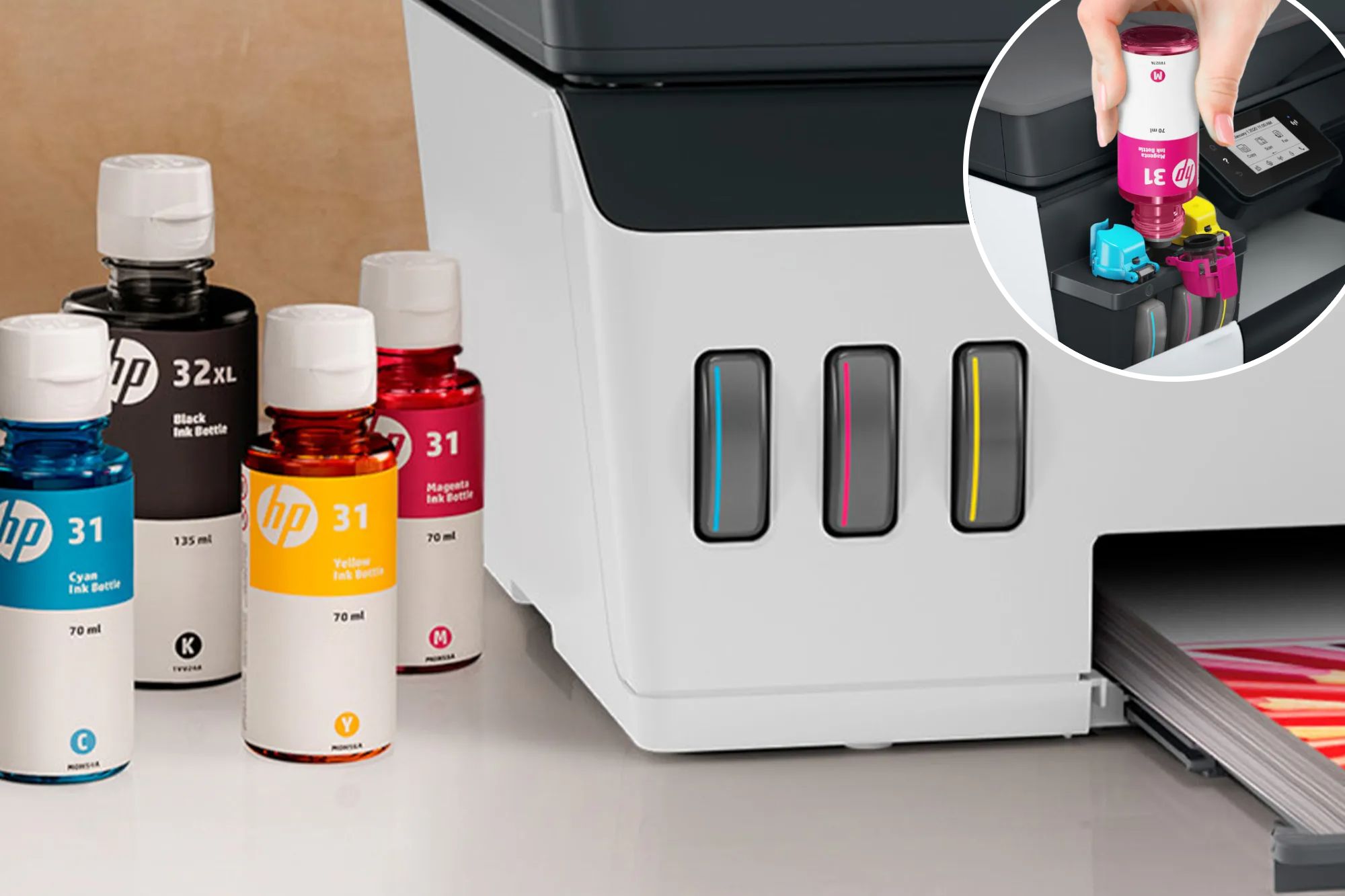
But a newer category of printer has been chipping away at that model: the refillable-ink-tank printer. Instead of snapping in a sealed cartridge every few weeks, you pour ink from a bottle into a built-in reservoir. One bottle can last for thousands of pages. And the economics change fast.
A printer with refillable ink tanks replaces the traditional cartridge slot with large, built-in reservoirs that you fill from bottles. Think of it like the difference between buying single-serve coffee pods and pouring from a bag of beans. Same output overall, but a wildly different cost structure.
HP’s Smart Tank series is probably one of the most widely recognizable examples of this technology. The HP Smart Tank 7602, for instance, ships with enough bottled ink to print up to 6,000 black pages or 8,000 color pages right out of the box – equivalent to up to three years of ink – straight from the box. A replacement ink bottle runs about $13.
Compare that to a standard ink cartridge, where a two-pack of black and color cartridges can cost $40 to $55 and yield about 200 pages combined. The per-page cost isn’t even close.
Refillable Tank Printers vs. Cartridge Inkjets: Cost, Quality and Long-Term Value Here’s where it gets concrete.
A typical cartridge inkjet can cost roughly 7 to 20 cents per page, depending on coverage and whether you’re printing color. A refillable, cartridge-free ink tank printer like the HP Smart Tank series can bring that down to around 1 cent per black page and roughly 2 to 3 cents per color page.
For a household printing 100 pages a month, that’s $7 to $20 on cartridges versus roughly $1 to $3 on tank ink. Over a year, the savings are anywhere from $50 to $200. Over the life of the printer, it can add up to hundreds.
Then there’s color quality. Refillable tank printers use the same dye-based or pigment-based inks as their cartridge cousins. Photo output from a good tank printer rivals what you’d get from a dedicated photo inkjet. If you print holiday cards, kid art or product shots for a side business, the quality holds up.
And of course, there’s the environmental angle. Cartridge printers can generate a steady stream of plastic waste if you’re a power printer: shells, packaging, shipping materials. A refillable tank printer tends to produce a fraction of that, significantly reducing that waste.
With HP Smart Tank, a single ink bottle can replace multiple traditional cartridges.
Laser printers aren’t going anywhere, and for certain users, they shouldn’t.
If you print 1,000-plus pages a month, mostly black text, a laser printer is still the speed king. A midrange laser can crank out 30 to 40 pages per minute. Most tanks top out at around 12 to 15, max. For a busy office that’s printing contracts, invoices and reports all day, that gap matters.
Laser toner doesn’t clog, either. You can leave a laser printer untouched for six months, and chances are it’ll fire up like you were never gone. The toner is a dry powder, not a liquid, so there’s no risk of dried-out print heads.
But lasers come with their own challenges. Color laser printers are expensive upfront, often $400 to $800 for a decent multifunction model. Individual toner cartridges can run $70 to $150 each, and a full set of four (black, cyan, magenta, yellow) can cost $300 or more. Per-page cost is low for text, but you’re paying a premium upfront.
They’re also bigger. Like, noticeably bigger.
A color laser multifunction printer takes up real desk space. If you’re working out of a one-bedroom apartment or a cramped home office, that square footage matters more than you might think.
Things to Consider with Refillable Ink Tank Printers Refillable tank printers aren’t without trade-offs. Here’s what the spec sheets won’t emphasize.
Print speed is slower. If you’re churning out a 50-page document, a tank inkjet will feel leisurely compared to a laser. For most home users printing a few pages at a time, this is a non-issue. For a small office doing bulk jobs daily, it’s worth noting.
If you don’t print often, the ink can dry inside the print heads. This is true of all inkjet printers, not just tank models, but tanks hold more ink, so it’s something to be mindful of. Running a cleaning cycle once a week, or just printing something every few days, prevents the problem. HP’s Smart Tank models also include automatic maintenance routines designed to help prevent this.
And the printers themselves are a little larger than a basic cartridge inkjet. The tanks add a little bulk. It’s not dramatic, but if you’re comparing footprints, a cheap cartridge printer is almost always more compact. For most users, these trade-offs are minor compared to the long-term savings.
This comes down to what you print and how much of it.
If you print fewer than 50 pages a month, mostly text, and already own a laser? Keep it. You’re fine.
If you print regularly (photos, school projects, shipping labels, work documents, side-hustle materials) and you’re sick of keeping up with cartridges, you’re not alone. A refillable, cartridge-free tank printer is often the best fit. The HP Smart Tank series hits the sweet spot for home users and small home offices: low per-page cost, solid photo quality and enough ink in the box to last months and months (and months) before you even think about a refill.
If you run a high-volume office with 500-plus pages a day of straight text? Laser printers still make sense for raw throughput.
For everyone in the middle, which is most people, the refillable, cartridge-free tank printer often wins on cost, flexibility and reduced waste. Cartridge printers can still work for occasional use, but many users find the long-term costs add up over time.
A refillable ink tank printer is a type of inkjet printer that replaces traditional, disposable ink cartridges with large, built-in reservoirs. Instead of buying new cartridges, users pour ink directly from high-yield bottles into the printer, which significantly lowers the cost per page and reduces plastic waste.
A typical household can save between $50 and $200 a year by switching to a refillable ink tank printer. While standard cartridge printers cost roughly 7 to 20 cents per page, ink tank models drop that cost to about 1 cent for black-and-white pages and 2 to 3 cents for color pages. Over time, this can add up to hundreds of dollars in savings.
Yes, refillable ink tank printers produce high-quality prints because they use the same dye-based or pigment-based inks as standard cartridge inkjet printers. The photo and color output from a high-quality tank printer rivals dedicated photo printers, making them ideal for holiday cards, school projects and small-business materials.
The main disadvantages of refillable ink tank printers are slower print speeds compared to laser printers and the potential for ink to dry out in the printheads if the machine is not used regularly. Additionally, even with spill-free bottles, the ink refilling process can occasionally cause minor spills if directions aren’t followed and the printers themselves have a slightly larger footprint than basic cartridge models.