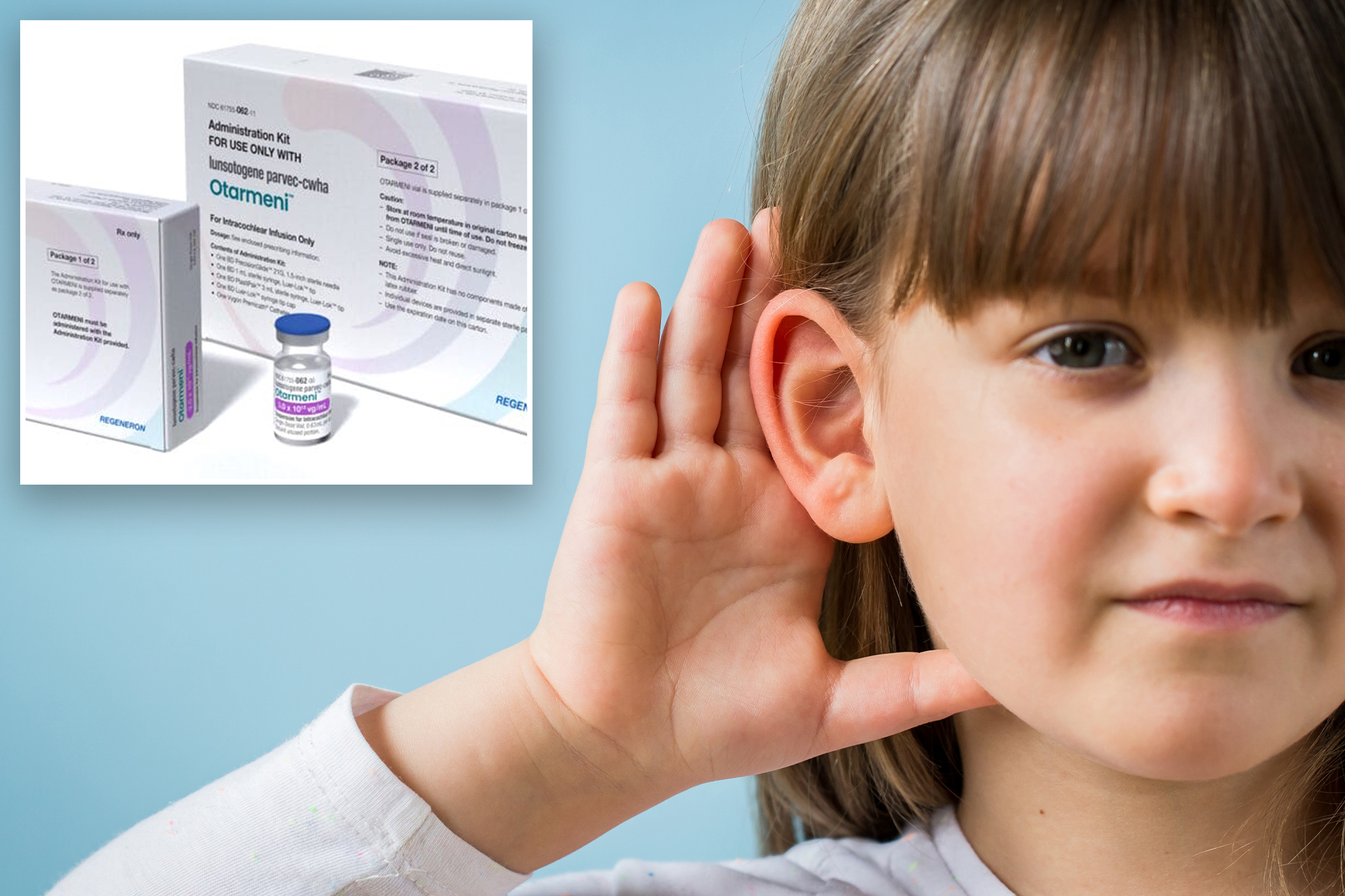
In a landmark move, the Food and Drug Administration on Thursday approved the first gene therapy for a rare, inherited form of hearing loss.
And while these treatments often come with million-dollar price tags, Regeneron — the maker of Otarmeni — said it will be free for US children and adults.
“This unprecedented breakthrough in gene therapy has already proven to be life-changing for many of the children in our clinical trial and their families,” Dr. George D. Yancopoulos, Regeneron’s president and chief scientific officer, said in a news release.
The free rollout, he explained, “serves to highlight our belief that the biopharmaceutical industry can be a genuine force for good in the world.”
Otarmeni is designed for people born deaf because of a mutation in a gene called OTOF. That gene normally helps the body make a protein called otoferlin, which is needed to hear.
Without it, tiny hair cells in the inner ear can’t send sound signals to the brain. The result is severe to total deafness from birth.
About 50 babies in the US are born with this rare condition each year. It often causes major delays in speech and language development, which can lead to frustration, social withdrawal, anxiety and difficulty communicating.
Otarmeni works by delivering a working copy of the OTOF gene directly into the inner ear. This helps restart production of the missing protein and restore hearing signals.
It is delivered as a single injection into the cochlea, the part of the inner ear that handles hearing, while the patient is under general anesthesia.
The FDA’s approval of Otarmeni stemmed from a clinical trial involving 20 children ages 10 months to 16 years, all born with the mutation. Each received one dose of the gene therapy in one or both ears.
After five months, 16 of the children showed hearing improvement. Of those followed for at least 11 months, five of 12 had hearing that was essentially normal, including the ability to hear whispers without assistive devices.
Researchers reported that the treatment was generally safe. No major serious side effects were observed, though some patients had ear infections, inflammation, nausea, vomiting or dizziness.
“This really is life-changing for families with children with hearing loss,” Dr. Eliot Shearer, a pediatric otolaryngologist at Boston Children’s Hospital and a principal investigator on the Regeneron trial, told NBC News.
He said the only available option for these patients is cochlear implants, which help people hear speech and music but don’t fully restore natural sound.
With gene therapy, he added, hearing improvements are “on 24/7 and don’t rely on batteries.”
Because treatment options for this type of deafness are so limited, the FDA fast-tracked Otarmeni through its new Commissioner’s National Priority Voucher program, which speeds up reviews for products targeting major unmet medical needs.
Otarmeni is the first gene therapy approved under the program.
“It’s miraculous,” a mother of one of the clinical trial participants told CNN.
Her son, Miles, received the treatment at 13 months old. At his latest checkup, his hearing tested normal.
“You go from being told your child is profoundly deaf and may only ever hear with technology to your child hearing right alongside his friends,” she said. “This is just amazing.”
While the treatment applies to only a small percentage of people with hearing loss, experts say it could open the door to more gene therapies down the line.
Drugmaker Eli Lilly and researchers in China are already working on similar treatments for OTOF-related deafness.
In one recent study, a team of US and Chinese scientists found that in 24 patients, hearing gains from their treatment lasted more than two years in some cases.