play Live Sign upShow navigation menuplay Live Click here to searchsearchSign upFeatures|Israel-Palestine conflict‘Silent suffering’: Why children in Gaza are losing their ability to speakAn estimated 1.1 million children in Gaza now need mental health and psychosocial support, as a growing number lose their ability to speak due to trauma and injuries from Israeli attacks.
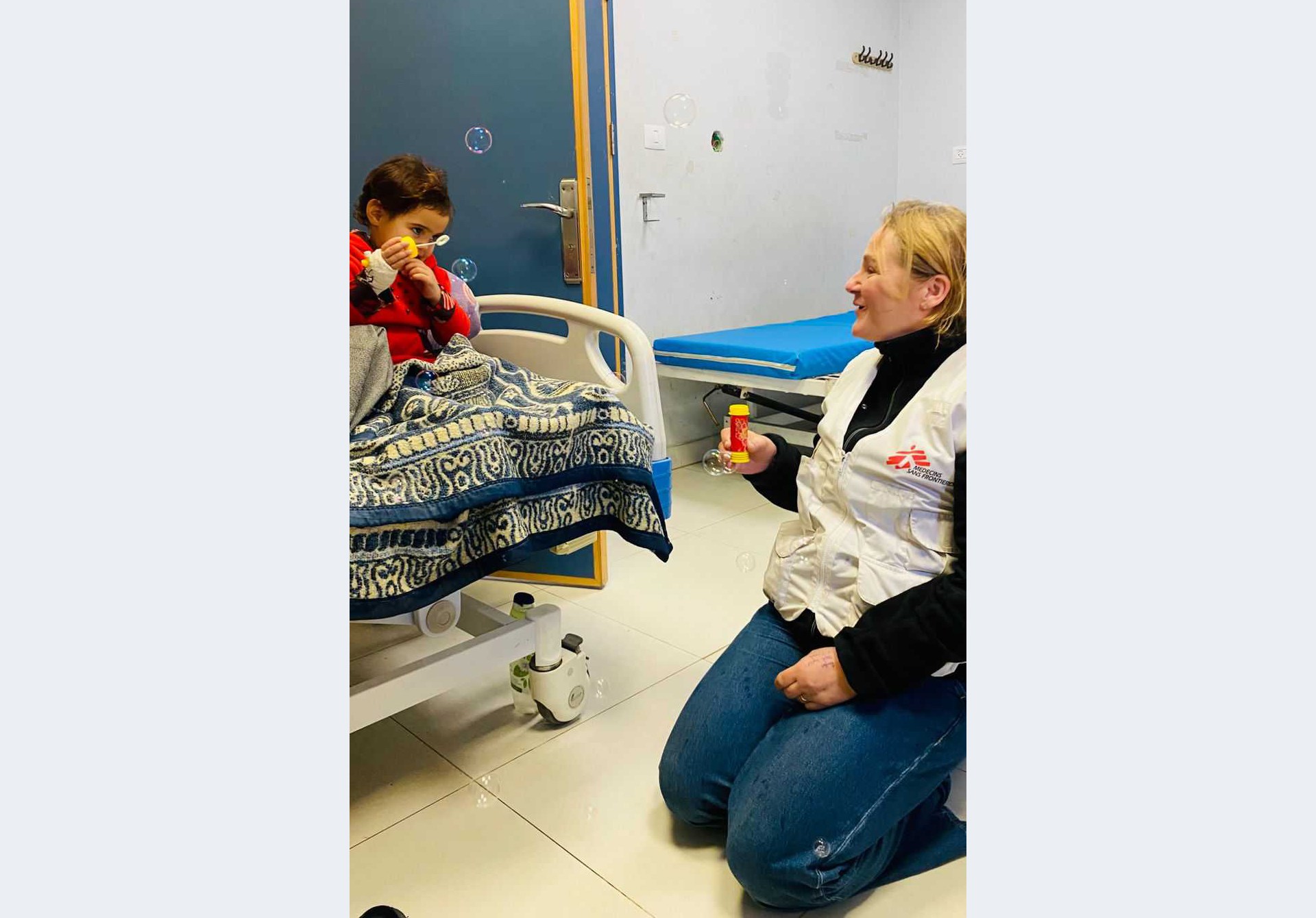
xwhatsapp-strokecopylinkgoogleAdd Al Jazeera on GoogleinfoChild psychotherapist Katrin Glatz Brubakk working with Me decins Sans Frontieres (MSF) blowing bubbles with a Palestinian child. [File: Courtesy of Katrin Glatz Brubakk]By Mariem Bah and Ibrahim al-KhaliliPublished On 24 Apr 202624 Apr 2026After an intense bombardment struck near his home, five-year-old Jad Zohud suddenly lost his ability to speak.
He is not alone. Across Gaza, specialists are reporting a rising number of children who can no longer speak following war-related injuries or psychological trauma.
For some, the cause is physical – head injuries, neurological damage or blast trauma. For others, there is no visible wound. Their silence follows repeated exposure to violence that overwhelms their ability to process or communicate.
Child psychotherapist Katrin Glatz Brubakk, who has worked in Gaza twice with Doctors Without Borders, known by its French initials MSF, describes it as “silent suffering” often hidden beneath the scale of the destruction.
At Gaza City’s Hamad Hospital, doctors say cases of speech loss among children are increasing.
Dr Musa al-Khorti, head of the hospital’s speech department, told Al Jazeera that in some cases, “a child could lose the ability to speak entirely,” referring to conditions such as selective mutism or hysterical aphonia, which is a functional loss of voice linked to extreme psychological distress.
The cases vary, but many follow a similar pattern: a sudden loss of speech after violence or injury.
Five-year-old Jad had no prior speech difficulties, his mother said, but after a bombardment near his home, he woke unable to speak – unable to form sounds or words.
Jad is not alone. Four-year-old Lucine Tamboura lost her voice after falling from the third floor of her home when a staircase, damaged by an Israeli air strike, collapsed beneath her.
“The fall affected her speech and caused partial paralysis in her arm and leg,” her mother, Nehal Tamboura, told Al Jazeera. “Her leg and arm recovered, but she still has trouble with speech. We are continuing her treatment for that.”
Doctors warn that without sustained care, these conditions can have long-term effects on development, particularly when linked to psychological trauma.
Child psychotherapist Katrin Glatz Brubakk says children lose speech as a response to extreme trauma.
“These are children who have been exposed to extreme trauma and, without any medical cause, stop talking,” she says. “It’s always extreme trauma.”
She describes children who have lost family members, witnessed death, been injured, or lived through repeated violence, where silence becomes the only way to cope.
“At some point, the world feels completely unpredictable, and the child is in acute danger,” she says. “It’s not a choice. It’s a physical response.”
Many enter what she calls a “freeze response”, where the body shuts down under threat.
“The body says: I can’t fight this. People can die. I can die. So the safest thing is to stay still,” she says. “It’s waiting until the world feels safe again.”
But the impact goes beyond the loss of speech, she explains.
“If children stop playing and interacting, they stop learning and developing,” she says. “I call it cognitive war injuries.”
She explains that prolonged trauma keeps the brain in survival mode: the amygdala – the brain’s alarm system – remains alert, while systems responsible for learning and emotional regulation are suppressed.
“Even when a child looks shut down, the nervous system is still on high alert,” she says. “Over time, that has very serious effects on development.”
Brubakk says the scale and totality of trauma in Gaza is unlike anything she has seen in more than a decade of work.
“I’ve been working in the field for 12 years, and there’s nothing that can compare to Gaza. Nothing,” she says. “There is nobody in Gaza now that’s not affected.”
She says Gaza is defined by a complete lack of safety.
“Bombs everywhere, everybody affected, everybody in danger – there is no safety.”
This issue, she explains, is only exacerbated by the collapse of healthcare and essential services.
“You can’t get the help you need, physically or mentally, and you can’t escape,” she says. “There’s nowhere to go. And this combination makes the impact so severe.”
For Brubakk, the most overlooked consequence is not only the visible injuries, but what she calls a “silent long-term consequence” unfolding beneath them.
“It’s easy to show amputations or bandages,” she says. “But this is the silent suffering. It’s everywhere.”
In Gaza, she says, even the basic assumption of safety no longer exists.
“We can’t say to anyone that they are safe, because you don’t know,” she says. “Even with a so-called ceasefire, people are still being killed. You never know when it’s your turn.”
For Brubakk, recovery from trauma-related mutism is slow and fragile.
She recalls a five-year-old boy, Adam, who developed selective mutism after witnessing his father’s death in an Israeli air strike. He stopped speaking to anyone except his mother, communicating only in faint whispers, and withdrew almost entirely.
At first, he refused all interaction. But gradually, small signs of recovery appeared.
“One day he whispered to his mother, ‘Get rid of that woman, I don’t like her,’” she says. “And I was actually happy, because it meant he was reacting again.”
From there, recovery came in fragments – brief eye contact, moments of curiosity, small steps back towards engagement before he slowly found his voice again.
Brubakk says this kind of progress depends on structured, consistent care that is increasingly difficult to provide. At Hamad Hospital, al-Khorti says children with conditions such as selective mutism require specialised tools and long-term rehabilitation.
“These conditions require specialised therapeutic intervention and rehabilitation tools,” he told Al Jazeera. “Many have been damaged or lost during the war.”
Despite this, Brubakk says recovery can still begin in the simplest of ways.
One of her tools is what she calls “hope bubbles” – soap bubbles used in therapy with withdrawn children.
“They’re so beautiful, and so peaceful just falling slowly,” she says. “And it helps children shift attention from fear.”
Blowing them also becomes a way of regulating breath and calming the nervous system.
“If you want big bubbles, you need to breathe slowly,” she explains. “It becomes a way of calming the body through play.”
She says this shift, from fear to curiosity, can help children begin to engage and relax again.
“It helps them relax, sleep better, regulate their nervous system,” she says. “It puts them back onto a developmental track.”
She recalls Adam again, her eyes distant. Recovery, she explains, doesn’t come through one breakthrough, but through many small, almost imperceptible returns.
“You have to be patient,” she says. “Every small step matters.”
In Gaza, she says, even the smallest moments of safety carry enormous weight precisely because they are so rare.