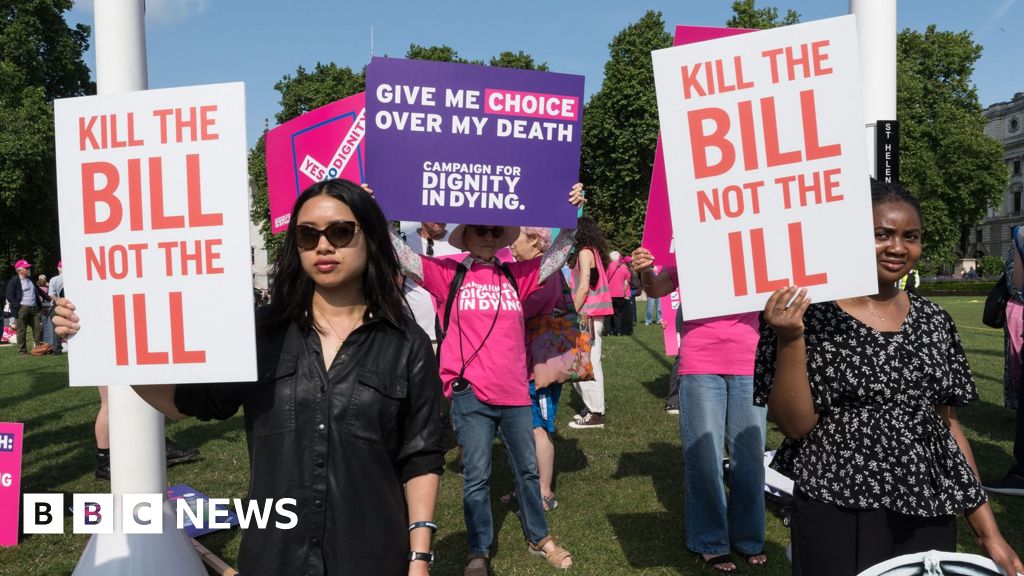
ShareSaveAdd as preferred on GoogleRichard WheelerPolitical reporterGetty ImagesDemonstrators on both sides have campaigned in Westminster as the bill has progressed through ParliamentA proposed law to legalise assisted dying in England and Wales will run out of time on Friday, almost 17 months after MPs first voted in favour of it.
The bill has stalled in the House of Lords after the House of Commons supported allowing terminally ill adults expected to die within six months to seek medical help to end their life, subject to certain safeguards.
Supporters and opponents have accepted the bill will not complete all the required stages to become law in the current session of Parliament, with no further debate time allocated beyond Friday.
But there is a possibility another attempt is made to introduce the proposals in the next session of Parliament, which will begin on 13 May.
Several peers who support the bill have signed a letter to MPs saying the elected chamber should decide what happens next and they believe Parliament "must come to a decision on choice at the end of life as soon as possible".
They accused opponents in the Lords of using "delaying tactics" but critics have argued the bill lacks safeguards and the debates in the upper chamber have "exposed further problems".
Opponents have also written to MPs in which they accuse the backers of the bill of having "stonewalled or rejected nearly every attempt to amend or improve" it.
More than 1,200 amendments were tabled in the Lords, which is believed to be a record high for a bill introduced by a backbencher.
The Terminally Ill Adults (End of Life) Bill was supported in principle by MPs on 29 November 2024 by a majority of 55 and cleared the Commons on 20 June last year with a majority of 23.
In the Lords, the bill has not cleared all its stages and Friday marks the 14th and final day of committee – which allows the legislation to be assessed line by line and for changes to be considered.
Labour MP Kim Leadbeater, who introduced the bill in the Commons, told the BBC she was a "mixture of feeling extremely disappointed and upset and also quite angry" that the legislation would fall in the Lords.
She said there were MPs willing to take the same bill on during the next session should they be successful in the private members' bill ballot, which can guarantee debating time on Friday sittings.
Leadbeater said she hoped it would then clear the Commons again and agreement could be reached with peers over amendments.
She also acknowledged the powers in the Parliament Acts could be used to prevent it falling again.
Under the terms of the rarely used legislation, if an identical bill passes the Commons a second time then the Lords cannot prevent it progressing again and it would become law at the end of that second session even without peers' approval.
The Parliament Acts were last used in 2004 to push through a ban on fox hunting.
Leadbeater said: "We don't want to get to that stage, we want this to go through the normal legislative process."
Baroness Grey-Thompson, who opposes the bill, said peers had been scrutinising the bill line by line and it was a "red herring" to criticise the number of amendments tabled.
She told the BBC: "When it fails the biggest reason is because it's a poorly written bill.
"It was written in haste and there are so many gaps in it that a number of peers are really uncomfortable with this particular bill, even though they may be in favour of the principle."
Baroness Grey-Thompson said she was "not against the principle", adding: "But if we're going to do this, we have to have safeguards and I really don't think there are anywhere near enough safeguards in it."
Labour peer Lord Falconer of Thoroton, the bill's sponsor in the Lords, has tabled a proposal which would allow peers to discuss the issue more generally on Friday rather than continue making progress through the amendment paper.