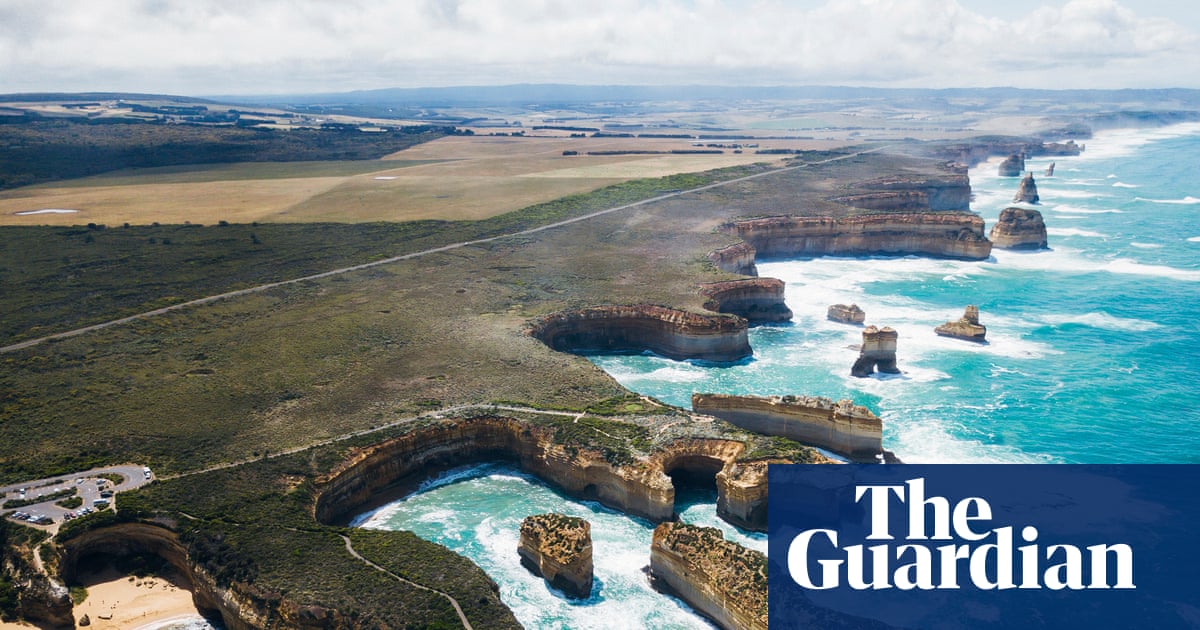
The Twelve Apostles have now been dated at between 8.6 to 15m years old. Photograph: Evgeny Vasenev/Getty Images/Cavan Images RFView image in fullscreenThe Twelve Apostles have now been dated at between 8.6 to 15m years old. Photograph: Evgeny Vasenev/Getty Images/Cavan Images RF‘A history of the Earth’: Twelve Apostles revealed to be as old as 14m yearsTectonic plate movements over millions of years have lifted and tilted the layers, with records of ancient earthquakes in the rocks
Get our breaking news email, free app or daily news podcast
Microscopic fossils embedded in limestone have helped reveal the true age of Victoria’s Twelve Apostles, as 8.6 to 14m years old.
The conclave of giant golden pillars is visited by 2.8 million tourists each year, a highlight for those travelling along the Great Ocean Road south-west of Melbourne.
But where visitors see rocks rising out of the Southern Ocean, geologists see layers of history, said A/Prof Stephen Gallagher, from the University of Melbourne. “We see layers, we see time, we see a history of the Earth”.
Tectonic plate movements over millions of years have lifted and tilted the layers of underlying Gellibrand marl (15m years old) and the Apostles’ yellow and grey Port Campbell limestone, rocks formed since the mid Miocene, he said. They are topped by a more recent layer of red-brown soil called Hesse clay.
“The tectonic movements didn’t push up the Apostles perfectly straight. Instead, they forced layers to tilt and break along the way. If you look closely at the cliffs around the Twelve Apostles today, you can see the limestone layers are not flat but are, in fact, tilted by a few degrees. Small fault lines can also be seen, which are records of ancient earthquakes,” he said.
The rocks might be ancient, but the seven or eight sea stacks – originally known as the “Sow and Piglets” on nautical maps – formed more recently as the cliffs eroded.
“You go to the look out platforms and you see this fantastic vista in front of you with millions of years of strata, and millions of years of a story. And then those sea stacks are the tiny last minute in that story, the last few thousand,” Gallagher said.
“Because only 20,000 years ago, you could walk to Tasmania because Bass Strait was a lake – you could walk about another 70km offshore from the present Twelve Apostles and you would still be on land.”
The geology of the Twelve Apostles has now been painstakingly described and precisely dated by scientists using photographs, digital mapping, samples, measurements of gamma radiation and analysis of minuscule popcorn-like fossils extracted from the rock. The results are published in the Australian Journal of Earth Sciences.
The fossils, tiny critters that evolved, lived and went extinct at particular times, were used to establish exact ages for each layer of rock.
View image in fullscreenMicrofossils from within the layers of the Twelve Apostles. Photograph: Stephen Gallagher/University of MelbourneThese single-celled organisms, called foraminifera, were a really useful method for dating rocks and fossils in marine ecosystems, said Dr Matthew McCurry, curator of palaeontology at the Australian Museum who was not involved in the study. It was a technique palaeontologists often used in combination with radiometric dating.
Dr Erich Fitzgerald, senior curator of vertebrate palaeontology at Museums Victoria Research Institute, said the Apostle’s rocks were forming during a time of major environmental change. Known as the Middle Miocene Climatic Transition, it was “a slide into proper sustained global cooling”, setting the scene for what would later become the Ice Ages, he said.
As clays, muds and limestones were forming the Apostles, seas were higher and brimming with plankton and a diversity of ocean life. “Sharks were never larger, never had it better,” he said. “That is the peak reign of the gigantic mega-tooth shark, Megalodon, for example.”
Fitzgerald, who was not involved in the study, said it was an important paper, “bookending” the age of the Twelve Apostles and the cliffs opposite in geological time.
“When we are trying to understand critical events in the history of our planet, and the evolution of the Earth – its environment, and, of course, all the organisms, all the animals and plants in it – there is one thing that we really have to get a good handle on to understand that, and that is dating it.”
“Despite, you know, more than 100 years of scientific inquiry by geologists and palaeontologists, what this highlights is how much we are still learning and still have to learn about even the most famous and heavily visited and recognisable natural features in the state of Victoria.”