Jess Warner Judd does not remember much about that night in Rome.
It has been a long and difficult journey since, but the 31-year-old speaks with admirable ease about the traumatic events which have led her to a London Marathon debut in 2026.
"I'm very lucky to have had sort of a second chance at running. It's a second chance I just didn't think I'd probably have," Warner Judd tells BBC Sport.
"I remember having really horrible discussions after trying to restart my track season and it quickly not happening. The doctors, who were brilliant, saying that I would probably have to retire if I kept trying before I had therapy, because my body wasn't going to cope."
The distressing details of what unfolded at Stadio Olimpico are recalled vividly by her husband Rob, who witnessed it all from the stands alongside Warner Judd's father and coach, Mike, in June 2024.
Less than 10 months had passed since Warner Judd celebrated one of her proudest achievements, placing eighth in the world over 10,000m, but it became evident early in the European Championship final that something was amiss.
The noticeable lack of co-ordination. The veering out into lanes two and three. The distress increasingly visible across her face.
"It got to the point around five or six kilometres in when Mike and I had got as close as we could to the track and were shouting at her to stop," says Rob.
Warner Judd struggled on until, with 600m to go, she collapsed.
It was not until late into the night that Rob and Mike were finally able to visit Warner Judd. In hospital but unaware of the seriousness of what had occurred, she apologised for not being able to finish the race.
She had suffered a seizure, caused by undiagnosed epilepsy. Another had followed once she had been taken off the track on a stretcher, this time so severe that she had to be sedated.
"That really hit home that it was a very, very serious scenario," says Rob.
"It also hit home that there are more important things to life than running. At that point, I was like, I don't care if she never races ever again, as long as she's OK."
The first indication had arrived a few months earlier when, at a low-key 10,000m race in California, Warner Judd failed to cross a finish line for the first in her career.
She had suffered a similar mid-race seizure there but, because epilepsy is difficult to diagnose and seizures are often the only symptom, subsequent medical tests were unable to identify the cause.
This time, Warner Judd got an answer when she was diagnosed with focal epilepsy, meaning her seizures typically start in one side of the brain and cause unusual feelings, sensations or movements.
Unsure then what the future might hold, her journey back has proven far from straightforward.
Trapped nerve and wee stops - running a marathon 22 weeks pregnant
For an athlete with an 800m personal best below two minutes, it took her a demoralising 12 minutes to run her first mile.
But even once she was physically able to resume normal training, her epilepsy under control with the help of medication, it became clear that she had not moved on mentally.
Warner Judd recalls feeling like she was "having a panic attack" upon returning to the track, and required a year of therapy to fully process her trauma.
"It was really difficult to love running again," says Warner Judd.
"Going for a run used to be my safe space, to clear my head and feel better. Then to have that association between racing and having a seizure... I was so scared of that happening again.
"It realigns your aims and perspective on life. Coming back to running, I just wanted to do it for me.
"If I run well and achieve good things, great. But that's very much a secondary goal. You never know when it will get taken away, so I want to enjoy it the best I can."
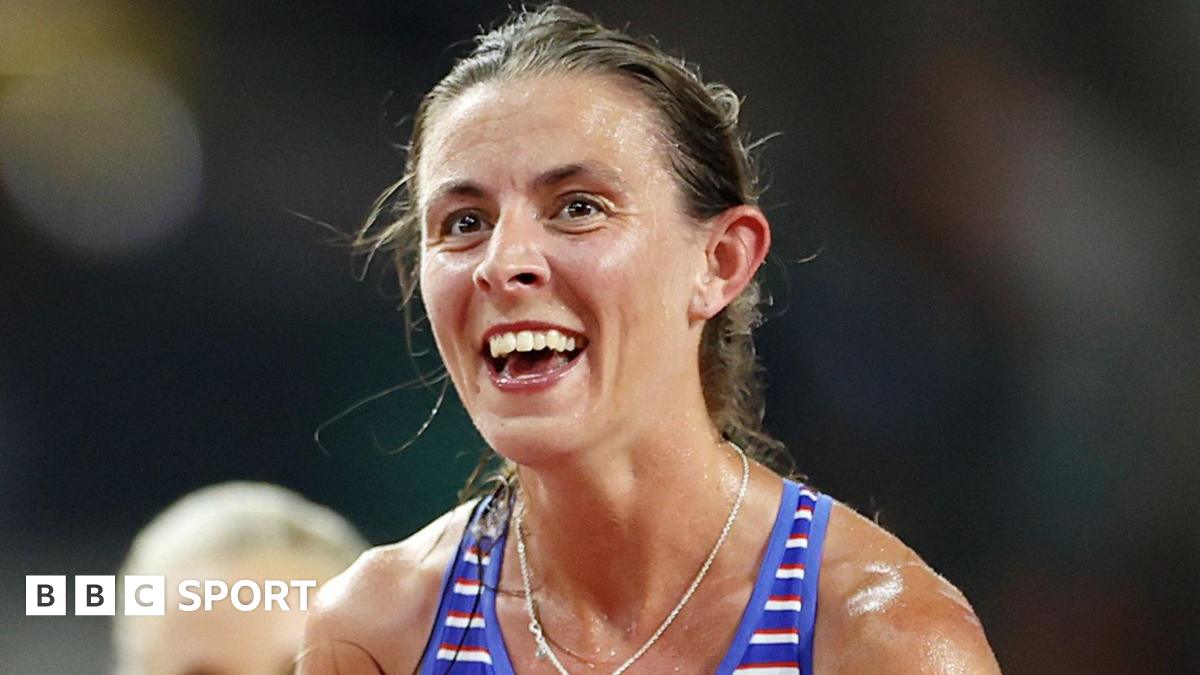
Image source, Getty ImagesImage caption, Jess Warner Judd placed eighth in the 10,000m at the World Championships in 2023, seven seconds off the podium
Warner Judd has settled in to her new home in Rob's home town of Clitheroe. The couple moved to Lancashire last year, accompanied by cocker spaniels Bruce and Bernie, and rabbits Bea and Bailey, after Warner Judd completed her PhD in regenerative medicine at Loughborough.
The pair train together on the surrounding hills and country lanes - Rob is also running this year's London Marathon - while Warner Judd has quickly grown fond of her part-time job at a local supermarket.
For Rob, the difficulty is often striking a balance between concern for his partner's wellbeing while, he says, "also acknowledging she has to push herself at times".
While Warner Judd's return to elite-level athletics is itself remarkable, her marathon debut in New York in November suggests much more is to come.
Although it may have taken her family time to accept the idea of targeting the 26.2-mile distance, she exceeded all expectations by clocking two hours 24 minutes and 45 seconds on the challenging course.
Placing seventh, Warner Judd, who maintains her only goal was to finish, crossed the line two seconds behind Olympic champion Sifan Hassan and within five minutes of winner Hellen Obiri.
It took just 24 hours for Warner Judd to reverse her claim that she would never do another - and she could not turn down the opportunity to race in London.
And so on Sunday, little over a marathon away from her home town of Canvey Island, in Essex, Warner Judd will complete a full-circle moment when she lines up in Greenwich Park, 14 years after winning her fourth Mini London Marathon.
As for a return to the track? While that once felt impossible, Warner Judd is leaving the door open.
But, following a rollercoaster two years during which she feared her time in the sport might be over, it will only happen on her terms, when she is ready.
"I really want to go back to it," Warner Judd says.
"But before, I wanted to go back to prove that I could do it. I think that part has gone now.
"Now, I want to go back if I'm going to enjoy it and I feel I can run well.
"I do feel like there's unfinished business there. It's not goodbye forever - just for now."