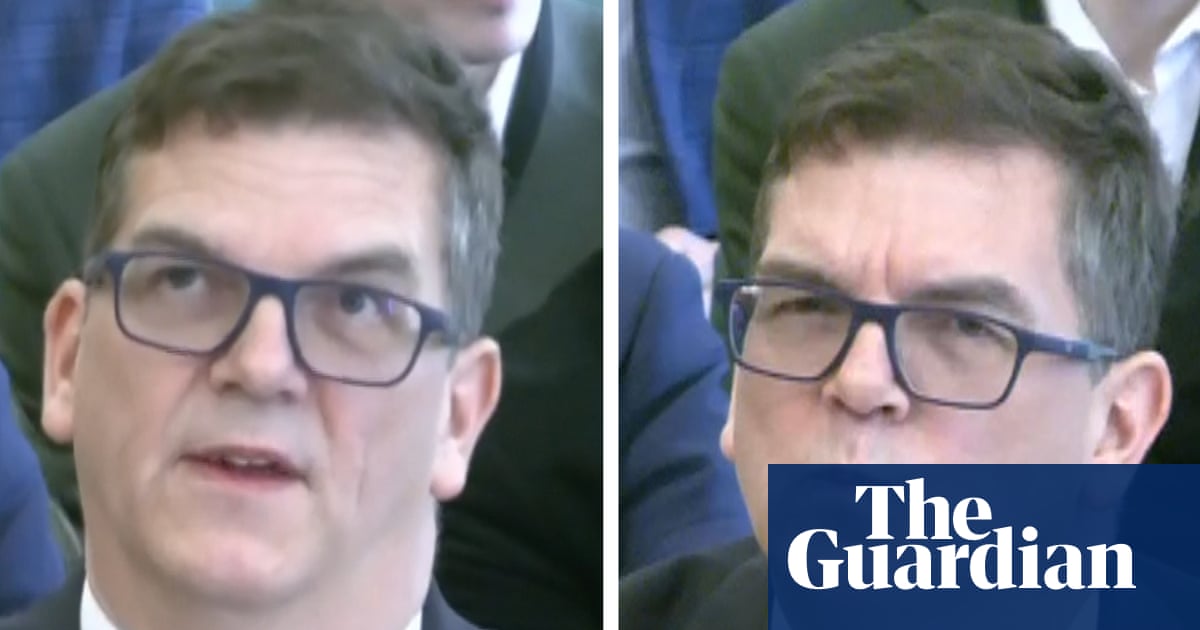
Olly Robbins described the vetting file as sitting in a ‘hermetically sealed box’, and relied entirely on an ‘oral briefing’ from the Foreign Office’s director of security. Composite: UK ParliamentView image in fullscreenOlly Robbins described the vetting file as sitting in a ‘hermetically sealed box’, and relied entirely on an ‘oral briefing’ from the Foreign Office’s director of security. Composite: UK ParliamentAnalysisHow Olly Robbins’ knightly charm glossed over burning questions on Mandelson vettingPaul LewisMandelson received two ‘clearance denied’ red ticks yet top Foreign Office civil servant says he did not have access to file – which he later read
The verdict on Olly Robbins’ parliamentary testimony, among fellow knights of the civil service realm at least, was unanimous. Lord Sedwill, a former Cabinet secretary, called on the prime minister to “retract his accusations against Olly Robbins and reinstate him”.
Simon McDonald, who once held Robbins’ job as top civil servant in the Foreign Office, said if Keir Starmer had only waited to hear his evidence to the foreign affairs select committee he would never have sacked him.
Even heavyweights in the media class seemed satisfied with Robbins’ decision to grant Peter Mandelson developed vetting clearance, and not tell Starmer he had done so against the advice of the official vetting agency. The former BBC journalist Jon Sopel declared while watching the evidence: “I am seeing the very best of the civil service.”
All of which would suggest that Robbins emerged from the cross-examination victorious, even if it did require – as some observers noted – two litres of water to get him through it.
But look more closely at what he actually said and there are stark questions about the defence Robbins mounted, both of himself and the system through which the national security establishment vets people who will be trusted with state secrets.
Begin with Robbins’ account of the facts, and his claim that Mandelson’s case was somehow “borderline”. At the heart of this whole affair sits a single document: Mandelson’s vetting file, which was completed by UK Security Vetting (UKSV) on 28 January 2025, weeks before he was due to take up his post.
Thanks to the Cabinet Office’s decision to publish a template of the file online, we now know it uses an easy-to-understand traffic-light system. There is a space for a vetting officer to mark their “overall decision or recommendation”. They have three options: a green clearance approved, an amber clearance approved “with risk management”, or – in glaring red – clearance denied.
Downing Street, the Cabinet Office and the Guardian have all made clear the vetting officer in Mandelson’s case chose the third option. According to the BBC, the night before Robbins gave evidence, MPs on the committee were given an in-person briefing with senior officials in the Cabinet Office to clarify this point. They came away with the clear impression that UKSV gave Mandelson two ticks in the red boxes.
The point was hammered home at the House of Commons dispatch box on Wednesday when Starmer said the vetting agency recommended “with red flags” that Mandelson’s clearance be denied.
Yet Robbins gave a markedly different account. The day after the vetting file was completed, and amid “pressure” to quickly get Mandelson in post, Robbins met the Foreign Office’s director of security, Ian Collard, to be briefed on UKSV’s findings.
Robbins, by his own admission, did not see the vetting file, which he described as sitting in a “hermetically sealed box”, and relied entirely on Collard’s “oral briefing”.
Read moreAccording to Robbins, Collard briefed him that “UKSV considered Mandelson a ‘borderline’ case” and was only “leaning towards recommending clearance be denied”. Even so, Robbins said, he was told UKSV had indicated the Foreign Office “may wish to grant” Mandelson clearance, with mitigations put in place.
It raises the question of how Robbins could have been persuaded that mitigations were possible without seeing the full context in the report of the risks they addressed.
Robbins was unable to say if there was a detailed record that would confirm his account of this conversation, so we are left speculating how something so seemingly black and white – or glaring red, as the UKSV file had it – became so fuzzy?
His answer rested on his argument that the whole process had been misunderstood. Robbins stressed (as was reported in the Guardian’s original story) that while UKSV has the final say over many civil servants, in the Foreign Office clearance is granted by the department.
That enabled Robbins to quibble with the language used by Starmer and others who said that Mandelson had “failed” the UKSV assessment. It was a bureaucrat’s point, but one that enabled Robbins to segue into the kind of mushy account that could draw comparisons to Sir Humphrey from the TV series Yes Minister.
Robbins told MPs that Mandelson’s vetting was “to some extent” a “dialogue” between “extremely experienced security professionals” in UKSV and the Foreign Office – presumably Collard – who speak “many, many times a day”.
He went further, to reveal that these officials “debated” UKSV’s findings about the risks posed by Mandelson. Remarkably, those assessments of risk then “shifted up and down a bit”. Was this the opaque process by which red – clearance denied – had morphed into amber by the time he was briefed?
The select committee has called Collard to give evidence. Did he speak to Robbins before his parliamentary evidence on Tuesday? Does his recollection of the oral briefing match that of Robbins? On whose suggestion did the risk factors “shift up and down a bit”? Did Collard see the UKSV vetting file?
Robbins argued it was perfectly proper that he – the person giving the clearance – was not shown the document in question. He mounted a defence of what he repeatedly called “the system”, saying that if people outside the vetting process saw such documents it would endanger national security. Even top mandarins, he said, could only see vetting files in “wholly exceptional circumstances”. Was this not a wholly exceptional situation? “No,” he replied.
Robbins was unbending in his defence of “the system”, which could only remain intact if vetting files stayed sealed in a safe.
Yet that argument was undercut by a subsequent, barely noticed admission in his testimony. Robbins did, in the end, “consider” looking at Mandelson’s UKSV file. Not before he gave Mandelson clearance, as would seem logical. But seven months later, after the ambassador had been sacked.
Robbins did not say why exactly he wanted to see Mandelson’s vetting file at that stage, and no one on the committee asked him. Presumably it was for a wholly exceptional reason?
The notion that Robbins might, in September 2025, see Mandelson’s vetting file was “discussed” with the Cabinet Office, which was the department that houses UKSV. Curiously, he said, there were “different views” on the matter.
Still, he seemed content with the conclusion – no, Robbins could not now see the vetting file. The response that he only see it with a national security justification was, he added, “completely consistent with my understanding of the system”.
Surely now it is “the system” that needs to come under the spotlight. It is one that has emerged from this process riddled with confusion and inconsistencies. And there is also the very obvious question of whether it works.
For all of the Robbins revelations, the most remarkable is perhaps the one that has received least attention. The risks identified by UKSV, he said, “did not relate to Jeffrey Epstein”. How could those have been missed?