German charities warn of increases of 70-80% in the costs of essentials in wartorn Sudan amid the unrest in the Middle East. Donors gather in Berlin on Wednesday on the third anniversary of the outbreak of the war.
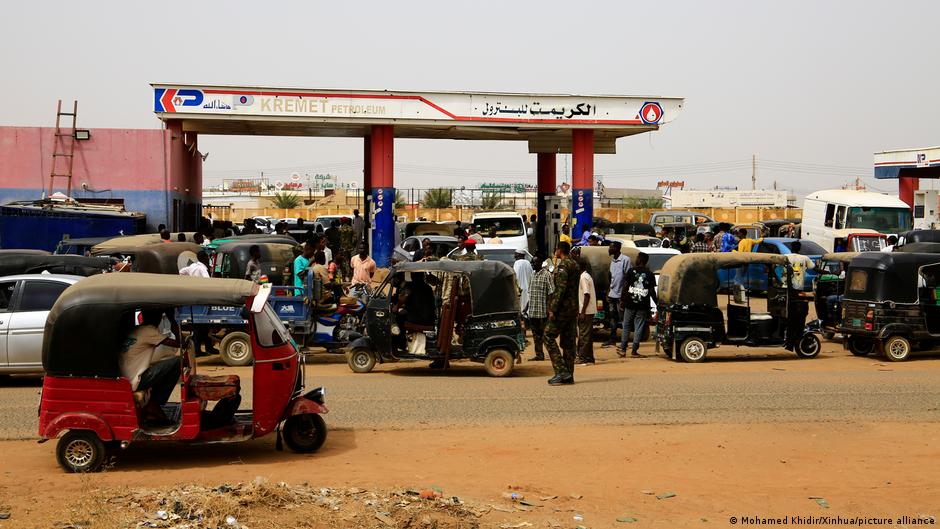
https://p.dw.com/p/5C9wGAll of Sudan's diesel comes from the Gulf region, and queues and crowds at filling stations have been commonplace this monthImage: Mohamed Khidir/Xinhua/picture allianceAdvertisementAid officials gathered in Berlin for a conference on Sudan on Tuesday warned that the war in Iran and the wider Middle East has put even greater strain on the supply of food and fuel, three years into the African country's civil war.
Prices for food and fuel are rising rapidly, and the country is also dependent on the Gulf region for deliveries of fertilizer, posing longer-term threats to harvests.
Some 19 million people in Sudan are already at risk of acute hunger amid an entrenched internal conflict that has displaced more than 11 million people and has effectively split the country in two.
Sudan’s Civil War — the limits of humanitarian aidTo view this video please enable JavaScript, and consider upgrading to a web browser that supports HTML5 video
Senior officials from the German food aid organization Welthungerhilfe and the UN's World Food Program (WFP) told reporters in Berlin that the Iran war was having "dramatic consequences" for the costs of various essentials.
"Our teams in Sudan report massive price rises," Welthungerhilfe head Matthias Mogge said. "Fuel has become up to 80% more expensive, and basic foodstuffs like wheat by around 70%."
Mogge said that the costs of delivering aid had also risen sharply, reducing the number of deliveries it was possible for groups like his to supply.
Carl Skau, WFP's deputy head, warned that all of Sudan's diesel came from the Gulf region, with deliveries currently severely impeded by the disruptions in the Strait of Hormuz.
"I'm also worried about the longer-term impact here, because all the fertilizer in the country comes from the Persian Gulf ... and there is even lack of access to that fertilizer," Skau said.
Beyond this, much of Sudanese agriculture depends on irrigation using water pumped from the Nile river, a process that requires fuel.
"So I'm worried also about the production side here, and down the road — what that would mean for access to food," Skau said. "So this war in the Middle East is hitting us everywhere, but in a place like Sudan, it is really having dramatic consequences."
Hundreds of civilians have been reported killed in drone strikes in Sudan since January, the UN said on Tuesday in Geneva.
"In the first three months of this year, nearly 700 civilians were reportedly killed in drone strikes," UN humanitarian chief Tom Fletcher said.
Drone strikes have become a near-daily occurence in the country, with both sides using the technology. They are particularly common in the disputed South Kordofan region, currently the war's primary battleground, and in areas controlled by the paramilitary Rapid Support Forces (RSF) in the west like Darfur.
The UN's chidren's agency (UNICEF) said drones were "responsible for nearly 80 percent" of the at least 245 children reported killed or injured during the first three months of the year.
"Drones are killing and wounding girls and boys in their homes, in markets, on the roads, near schools and health facilities," UNICEF's spokeswoman in Sudan Eva Hinds said.
Who are Sudan's RSF? To view this video please enable JavaScript, and consider upgrading to a web browser that supports HTML5 video
Reinforcing this longer-term data, the Doctors Without Borders (MSF) group on Tuesday reported two deaths and 56 wounded from five drone attacks carried out by the Sudanese Armed Forces (SAF) in the Darfur region.
"As Sudan enters its fourth year of war, these attacks by the Sudanese Armed Forces demonstrate complete disregard for civilian life," the Geneva-based medical charity said in a statement. "We call on the warring parties in Sudan to protect civilians."
An uneasy alliance between Sudan's military and the RSF militia broke down entirely in 2023, with open war breaking out by April 15 of that year.
The RSF can trace its roots back to the Janjaweed militia responsible for atrocities targeting non-Arab communities in Darfur two decades ago, with observers alleging the group plans ethnic cleansing of groups like the Fur and Zaghawa peoples.
It now controls most of southern and western Sudan, while the country's military, which reclaimed full control of the capital Khartoum in March 2025, holds most of the north and east.
Fighters from both sides face allegations of war crimes and of attacking non-combatants.
The RSF has set up a parallel administration based in Nyala, leaving the country in a state resembling a de facto partition.
Some 19 million people are thought to be facing acute hunger, particularly in the more contested areas further inland, and more than 11 million have been displaced, either internally or across borders.
The UN warns that donors have provided just 16% of the funding required for aid projects in Sudan this year.
Plugging some of this gap will be perhaps the most pressing goal of Wednesday's conference in Berlin, on the third anniversary of war breaking out. France, Germany, the UK, the US, the EU and African Union joined forces to organize the event.