Burkina Faso's junta leader Ibrahim Traore rejects democracy, while a new alliance in exile pushes for its return — but Traore holds the advantage.
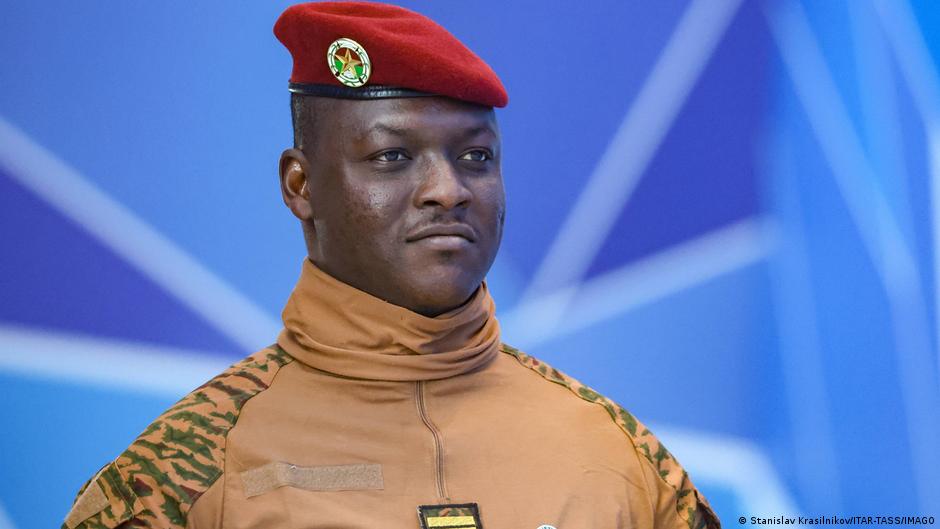
https://p.dw.com/p/5C4wX'Efficient autocracy' over democracy: Ibrahim TraoreImage: Stanislav Krasilnikov/ITAR-TASS/IMAGOAdvertisementIt is striking who is not meant to be part of Burkina Faso's Popular Progressive Revolution (RPP): the people.
The revolution was proclaimed a year ago by the military junta of Ibrahim Traore, with the aim of restoring the legacy of the legendary Burkinabe leader Thomas Sankara (1983–87), improving the precarious security situation, and increasing state revenues, for example through gold and oil.
In early April this year, Traore made clear how he views the role of the Burkinabe people.
"People must forget about democracy," he said on the state broadcaster RTB. "If an African wants to tell you about democracy, you should run away. Democracy kills."
The September 2022 coup leader said he was focused on refounding the state and on the revolution.
When Traore came to power, he promised a return to civilian rule within two years. The following year, he tied elections to an improved security situation; the year after that, he had his mandate — never granted by the people — extended by five years. In January 2026, Traore dissolved all political parties.
The so-called charter of the RPP is now effectively in force as the country's new transitional constitution.
According to political scientist Paul Amegakpo of the Togolese institute Tamberma pour la Gouvernance, this charter has dealt a severe blow to the right of the Burkinabe to self-determination.
"It is a fundamental right that the people control the public institutions that decide their fate. This necessarily includes the right to elect their representatives both at the executive level and in the National Assembly," Amegakpo told DW.
In his view, the country is on the path toward a military dictatorship.
Cheta Nwanze, Managing Director of the Nigerian security consultancy SBM Intelligence, recalls that democracy throughout the Sahel spectacularly failed to protect its citizens.
"Without wanting to praise coup plotters: in West Africa they have filled the vacuum left behind by discredited governments. This is where figures like Traore come into play: They offer action where democracy offered only committee meetings and accountability mechanisms. One can see it as efficient authoritarianism replacing inefficient democracy," Nwanze told DW.
Traore governs in the style of a "war CEO" who prioritizes the recapture of territory over political processes.
The charismatic captain is showered with praise on social media — although, given the restricted freedom of expression, it remains unclear how many dissatisfied people are simply staying silent.
A fact check by the news agency AFP concluded in 2025 that exaggerated praise and Traore memes likely originate at least in part from orchestrated manipulation campaigns, such as those regularly coming from Russia.
At the time of the coup, Traore was 34 — younger than any other head of state in the world. The frustrated Generation Z repeatedly places him on the same level as Sankara.
Security expert Nwanze believes that a head of state who speaks in bold terms and presents himself as a fighter is a powerful symbol many have longed for.
"The glorification on social media is a cry for help and an admission that the region's former leaders have failed."
But in Nwanze's view, Traore's popularity is closely tied to the security question. "If jihadist attacks increase again, the same social media could turn against him."
Instead of foreign troops, the junta relies on the Volunteers for the Defense of the Fatherland (VDP) corps, which has been expanded by a further 50,000 recruits under Traore.
The starting conditions are extremely difficult: according to estimates, the army controls only about 20 to 30% of the territory.
Much larger parts of the country are in the hands of terrorists, above all the al-Qaeda-affiliate Jama'at Nusrat al-Islam wal-Muslimin (JNIM). The Global Terrorism Index 2026 now ranks Burkina Faso second behind Pakistan and reports a significant decline in the number of victims.
However, according to the report, 846 people were still killed by terrorists in Burkina Faso in 2025; this represents 15% of global victims. The experts consulted for the report place little trust in the junta's claims that it has recaptured territory from JNIM.
Traore remains firmly in the saddle, while democracy in Burkina Faso has a hard time — similar to the situation in Mali and Niger.
Parts of the diaspora from the three Sahel region states want to increase pressure on the military regimes from abroad and recently founded a new "Alliance of Democrats of the Sahel" (ADS).
Its name resembles that of the Alliance of Sahel States (AES), which the juntas founded after withdrawing from the Economic Community of West African States (ECOWAS).
"We are waging a peaceful but determined struggle for the return to democracy," Mayra Djibrine, the newly elected ADS president, told DW. "We will use diplomatic channels to put pressure on the military juntas to release political prisoners and organize elections."
All experts interviewed by DW agree on one point, however: from abroad, the ADS is likely to find it difficult to significantly influence conditions in the Sahel states.
"The key to change in the Sahel is not in exile, but in internal dynamics, the military, or pressure from the population," said analyst Daouda Emile Ouedraogo, who himself coordinates an NGO in the United States.
"You can't threaten these regimes with press releases from Brussels, Paris, or elsewhere," says security consultant Nwanze.
"Such exile groups carry weight only with Western powers — and that immediately puts them in conflict with the populations they want to reach."
Tips on tackling Burkina Faso's disinformation floodTo view this video please enable JavaScript, and consider upgrading to a web browser that supports HTML5 video
This argument is likely also being considered in Europe. Burkina Faso's former colonial power Franceespecially had relied on the democratic governments in the Sahel that have since all been ousted.
When the juntas cut all ties and geopolitically oriented themselves toward Russia, there was no clear response for a long time.
Efforts to seek rapprochement behind the scenes apparently are underway in order to somewhat reassert influence in the AES states.
When Joao Cravinho, the European Union's Special Representative for the Sahel, visited Burkina Faso in February, Cravinho said not a word about the content of the "very fruitful and open meetings" afterward.
And even after Traore's remarks about democracy, there was a noticeable silence. The relevant EU institutions, European governments, the United Nations, and major NGOs did not comment.
DW learned from Germany's Foreign Office that critical developments are addressed through diplomatic channels: "In doing so, we are also cooperating out of well-understood self-interest. Europe neither wants nor can afford to leave the region to geopolitical influences that run counter to its interests, or simply to its own devices."
In other words: One prefers to refrain from publicly contradicting anti-democratic statements that could, in the long term, cause more harm than good.
Eric Topona and Georges Ibrahim Tounkara contributed to this article.
This article was originally published in German.