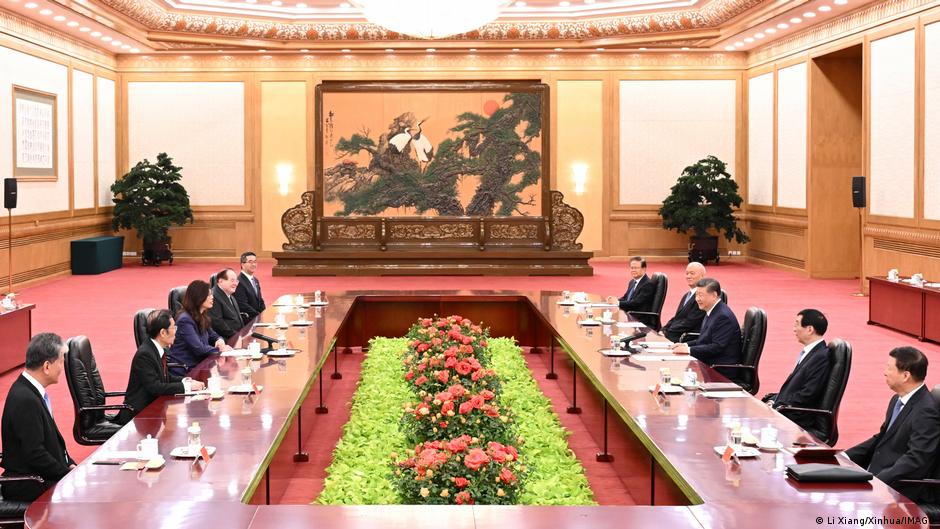
China's leader Xi Jinping promoted "peaceful development" in talks with Taiwan's opposition chief, a move analysts say could be aimed at US President Trump to soften Washington's stance on the self-ruled island.
https://p.dw.com/p/5BzH0The Xi-Cheng meeting marked a rare high-level cross-strait exchange since Beijing suspended dialogue in 2016Image: Li Xiang/Xinhua/IMAGOAdvertisement"The world today is far from peaceful, making peace more precious," China's President Xi Jinping emphasized in opening remarks at a meeting with Cheng Li-wun, the chair of Taiwan's Kuomintang (KMT) party.
"The leaders of the two parties are meeting today to safeguard the peace of our shared home," Xi added, speaking as head of the Chinese Communist Party, "and to promote the peaceful development of cross-strait relations."
Cheng echoed Xi's remarks, saying the two parties should pursue institutional solutions to prevent war and "thereby make the Taiwan Strait a model for world peace and conflict resolution."
Both Xi and Cheng reiterated their opposition to Taiwan independence, though neither explicitly mentioned unification.
Michael Cunningham, a senior fellow at the Stimson Center, told DW that Xi's remarks were largely routine.
"There wasn't anything directly threatening to Taiwan, or that indicated any time pressure to unify," Cunningham said.
"It's basically how they [China] see it: Someday Taiwan will be governed by Beijing, and it's nothing that they seem to have any pressure to push because it's something they believe is going to happen," he added.
The KMT is Taiwan's main opposition party and has traditionally advocated closer ties with China while opposing formal Taiwan independence. After the 2024 elections, the KMT became the largest party in the Legislative Yuan, the island's main legislative body, giving it significant influence over lawmaking and the ability to constrain President Lai Ching-te's Democratic Progressive Party (DPP) government.
Cheng, long viewed as sympathetic to improved relations with Beijing, has become the first Kuomintang leader in ten years to visit China, at a moment of heightened strain with the ruling DPP, which Beijing refuses to acknowledge as legitimate.
China regards self-governed Taiwan as its territory destined for eventual incorporation into the mainland and responds sharply to political steps that suggest moving toward formal independence.
US riles China with $11 billion arms deal for TaiwanTo view this video please enable JavaScript, and consider upgrading to a web browser that supports HTML5 video
The Xi-Cheng meeting marked a rare high-level cross-strait exchange since Beijing suspended dialogue in 2016, when the DPP won the presidency.
With a US-China leaders' summit expected next month, analysts told DW that Xi could use Cheng's visit to press Trump to soften his language on Taiwan or even halt US arms sales to the island.
In a speech on Friday marking the anniversary of the Taiwan Relations Act, which authorizes Washington to provide arms to Taiwan, President Lai warned against false notions of peace.
"Compromising with authoritarians comes only at the expense of sovereignty and democracy. It will not bring freedom, let alone peace," Lai said.
In Taipei, the KMT-led majority in the Legislative Yuan has blocked President Lai's proposed supplementary defense budget of NT$1.25 trillion (€34.33 billion, $40.2 billion), which includes potential arms purchases from the US.
Days before Xi met Cheng, China's Foreign Ministry reiterated its opposition to US arms sales to Taiwan, even as the island remains heavily dependent on American weapons.
Taiwan pushes to develop military capacities with sea dronesTo view this video please enable JavaScript, and consider upgrading to a web browser that supports HTML5 video
William Yang, a senior analyst at the International Crisis Group, said Xi could ask Trump to scale back or halt arms sales. And if he doesn't get the response he is seeking, the Chinese president "might decline to visit Mar-a-Lago later this year," Yang said.
Ja Ian Chong, an associate professor of political science at the National University of Singapore, told DW that Xi's emphasis on peace could be used as leverage in talks with Washington.
"If Xi can ask Taiwan to stop advocating for arms purchases from the US, he can tell Trump to halt the sales," Chong said.
Chong added that Cheng's visit could weaken pro-Washington voices within the KMT by mobilizing pro-Beijing voters ahead of Taiwan's legislative midterm elections in November.
Yang said the talks could resonate with the Taiwanese public at a time when Trump's ongoing involvement in the Middle East has heightened fears of conflict elsewhere.
"The Taiwanese people's trust in the US is declining, while skepticism is rising," Yang said.
With Trump having branded himself a world peacekeeper in 2024, Cunningham said the peace narrative emerging from the Beijing meeting could help Xi apply pressure on Washington.
While US policy calls for cross-strait disputes to be resolved through peaceful "means," Cunningham said Xi could push Trump to issue softer language endorsing a peaceful "resolution" of the Taiwan Strait issue.
"Xi can tell Trump in May: 'Taiwan wants a peaceful resolution. We want a peaceful resolution. Don't you want a peaceful resolution of the Taiwan issue as well?'" Cunningham said.
Why China is winning the Iran warTo play this audio please enable JavaScript, and consider upgrading to a web browser that supports HTML5 audio
Despite the peace rhetoric, Taiwan's Ministry of National Defense reported detecting 15 aircraft sorties and 24 naval vessels operating around Taiwan since Cheng departed for China on Wednesday.
"China's military coercion and threats of military actions weren't de-escalated because of Cheng's visit," Chong said.
While the meeting projected Beijing's willingness to engage in dialogue, Chong cautioned that the substance remained unclear.
"We still need to wait and see what China is willing to concede," he said.
Additional reporting by: Chia-Chun Yeh in Taipei