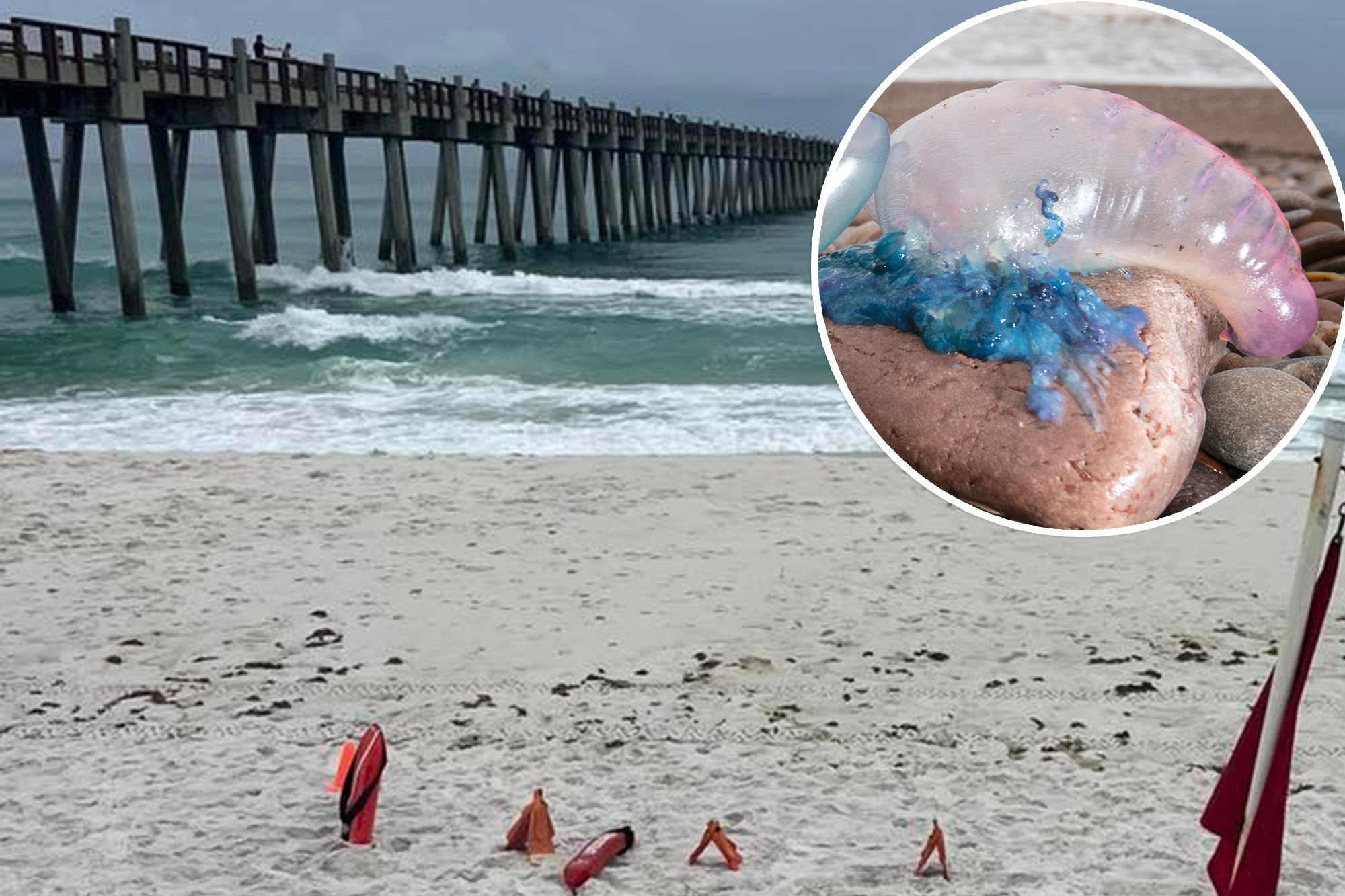
The Portuguese man o’ war has been making its presence known on beaches from Texas to Florida, as reported by Fox Weather.
The small but dangerous sea creature — which is known for its long tentacles and polyps that extend up to 100 feet, according to AL.com, and can deliver a painful sting even weeks after they’ve washed ashore — has also been seen on Fort Morgan, Alabama, beaches, where meteorologist Caroline Carithers took a photo of one.
Carithers has been seeing them wash up “all week,” according to News WKRG5.
The man o’war is typically found in subtropical seas and can end up on Gulf Coast shores — and even on the Southeast coast of the US.
On Pensacola Beach, lifeguards recently warned beachgoers of the nearby stinging marine life by flying both small red and purple flags, which were also meant to alert swimmers to dangerous conditions on the water.
“Please don’t touch or pick up these organisms — their sting is extremely painful!” the lifeguards wrote on nearby signage.
These nearly translucent blue, violet and pink-colored colored creatures are often confused with jellyfish due to their ethereal appearance and similar balloon-like float, which can rise six inches above the waterline. But they actually belong to a species of siphonophore, which is comprised of a colony of genetically identical individuals called zooids (clones) that work in uniform, each with different roles, per the National Oceanic and Atmospheric Administration.
Per NOAA, man o’ war has four specialized parts that cover the tasks of floating, taking prey, eating and reproducing.
While their sting uses tentacles to kill small fish and crustaceans with the nematocysts — microscopic capsules packed with venomous, coiled, barbed tubes — it is rarely fatal to humans. The welts it causes on exposed skin and the painful, burning sensation are not exactly what most would prefer while taking a relaxing stroll on the beach.
The sea creature gets its distinctive name for its aesthetic similarity to an 18th-century Portuguese warship.
In the event of an accidental sting, the afflicted should seek immediate medical attention. If planning to visit beaches along the Gulf Coast, keep an eye out for the creatures and admire them — just from a distance.