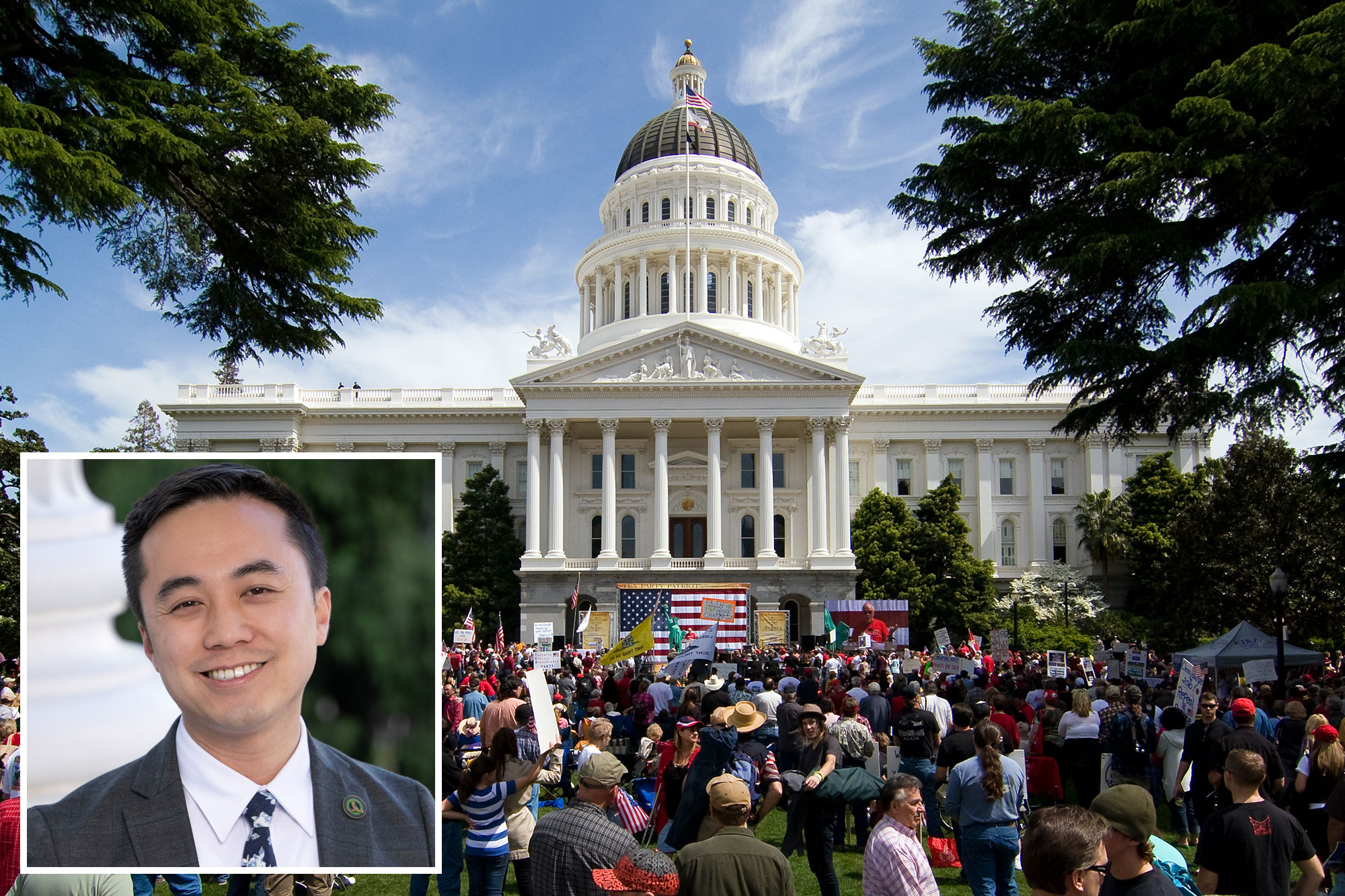
Clocking in from the couch could soon become the permanent way California does business.
On Wednesday, Assemblymember Alex Lee’s bill to allow state workers to continue teleworking sailed through the Committee on Public Employment and Retirement, clearing a key legislative hurdle.
AB 1729 would require each state agency to develop its own teleworking plan and assist in developing remote-work options — but a veto from Gov. Gavin Newsom could eventually be looming.
Lee, a Democratic socialist who represents Fremont and parts of San Jose, along supporters from the public employee union SEIU Local 1000 have been banging the drum on continuing pandemic-era work practices. They argue that remote work not only increases worker efficiency but also helps state workers who are struggling to pay bills.
They also cite state estimates that remote work would slash office space requirements and save the state as much as $225 million a year in office space.
“It is real health care money, it is real school money — money that could be spent more efficiently,” Lee said during Wednesday’s hearing, adding that it costs state workers roughly $6,000 a year to come into office four times a week.
Lee noted that the state had an online dashboard showing the benefits of telework from 2020 to 2024, and that AB 1729 would bring it back.
“Remote and hybrid workplaces are becoming the standard for a wide range of jobs,” he said.
The legislation stands in contrast to Newsom’s executive order last year, which will require all state workers to be back in the office four days a week starting in July.
“In-person work makes us all stronger — period,” Newsom said in a statement in March 2025.
“When we work together, collaboration improves, innovation thrives, and accountability increases. That means better service, better solutions, and better results for Californians, while still allowing flexibility.”
The governor’s order, which would increase the current two-day in-office requirement to four days, has faced resistance from unions and workers, delaying full implementation.
Newsom’s office does not usually comment on pending legislation and did not immediately respond to a request for comment on AB 1729.
Lee’s legislation would effectively suspend Newsom’s directive requiring most state employees to work in person four days a week and instead allow individual state agencies to set their own telework policies.
It also calls for the development of agency-specific telework plans and a statewide dashboard to track cost savings tied to remote work.
“Since we are, of course, in a deficit situation, $225 million is nothing to joke about,” Lee said during the hearing.
Dozens of state workers testified that telework reduces commuting expenses, improves work-life balance, and allows agencies to operate efficiently without requiring daily office presence, according to a Sacramento Bee report.
Some also pushed back on the idea that employees should return to offices to support downtown Sacramento businesses.
“I hate to sound harsh but that’s not the problem of our employees,” Anica Walls, president of SEIU Local 1000, said in a report. “It’s not our job to make sure the businesses in Downtown thrive.”
The area around the Capitol is often a ghost town most days due to a lack of workers in the area, and many businesses have closed down. Sacramento Mayor Kevin McCarty has previously supported Newsom’s call for a return to more in-office work.
“Having more people working downtown delivers tremendous economic and social benefits to Sacramento,” McCarty said in a statement to PBS KVIE.
In a town hall Tuesday, Rep. Eric Swalwell — one of the leading Democratic candidates for California governor — told the audience that he would support ongoing telework.
“I just want you to know I support your ability to telework,” Swalwell said. “It actually saves Californians a lot of money.”
The comments led one SEIU worker in the crowd to let out a primal scream in support.
AB 1729 now heads to the Assembly floor, where it is expected to face more scrutiny.
Even if it passes both chambers of the Legislature, the bill’s ultimate fate will likely hinge on Newsom’s signature.