—Daredevil: Born Again Season 2, Episode 1, “The Northern Star”
It isn’t easy for the staff of the Pitt to give up. The doctors, nurses, and other workers who keep the fictional Pittsburgh Trauma Medical Center’s eponymous emergency room are accustomed to attacking every problem that comes through their doors like it can be solved, from sunburns to severed legs. What happens when there’s nothing they can do about a new health care risk, because it’s walked in the door fully armed — and with the full backing of the United States government?
The air leaves the room the moment ICE agents show up in the emergency room on The Pitt. The series depicts these men — one of whom wears a gaiter to conceal his face, both of whom are carrying guns, and neither of whom appear to care all that much about the injured, terrified restaurant worker, Pranita (Ramona DuBerry) they’ve brought to the hospital — as truly menacing figures. The two men tower over their tiny prisoner, whom they’ve zip-tied in an outrageous case of overkill. They say she was shoved down a flight of stairs during their raid on her workplace but pointedly neglect to say by who.
Patients, staff, and people in the waiting room flee the hospital in fear rather than risk being detained themselves. Doctors and nurses are forbidden to contact any family members on the injured woman’s behalf. Eventually they yank her away before her wounded arm is properly treated. When nurse Jesse Van Horn (Ned Brower) steps in, they deck and detain him, too.
In moments like these, we tend to look to the leader of the Pitt, Dr. Michael Robinavitch (Noah Wyle), to do and say the right things, as both a medical professional and a thoroughly decent person. Even before Jesse is assaulted and arrested — a moment written and filmed months ago that eerily anticipated the murder of nurse Alex Pretti by ICE agents in Minneapolis — Robby recognizes that ICE is a threat to his hospital. Their very presence is preventing patients from seeking care and staff from giving it.
But Robby does nothing to fight these men, nothing to try to save Pranita from detention and deportation, because in this case there’s nothing he can do. A chief attending can’t stop a masked man with a gun from doing what he wants, especially not with the President of the United States endorsing his mission. All Robby can do is make the problem go away by treating and clearing Pranita as quickly as possible, so that the secret police guarding her will leave the hospital and things can go back to business as usual. The message, of course, is that as long as this terror reigns unchecked, there is no business as usual.
Like those ICE agents, Matt Murdock puts on a mask and does violent work, pursuing his own brand of justice. That’s where those similarities end. When it’s safe for him to have a day job, Matt is a lawyer who takes on innocent clients and impossible odds. He onlly wears his mask when he moonlights as the blind ninja superhero of Hell’s Kitchen, the title character of Daredevil: Born Again. (The character was created by Bill Everett, Jack Kirby, and Stan Lee; this season is heavily drawn from the Devil’s Reign comics storyline by Marco Checcetto and Chip Zdarsky.) Daredevil has more in common with Dr. Robby than with ICE’s Temu gestapo. Both characters exemplify a species of person identified on The Lowdown: “a white man who cares.”
In the season of Daredevil: Born Again that premiered last month, Murdock’s costumed alter ego has gone underground in a New York City ruled as an authoritarian state by its gangster mayor, Wilson Fisk (Vincent D’Onofrio). A murderous criminal with long-standing ties to the real estate industry, Fisk hangs giant banners with his name and face on them off government buildings. His supporters fly red banners with his name in block letters surrounded by a rectangle offset with stars. He’s promised that under his rule, New York has been “born again.” You don’t need to have Daredevil’s super-senses to see Fisk’s analogous relationship to President Donald J. Trump.
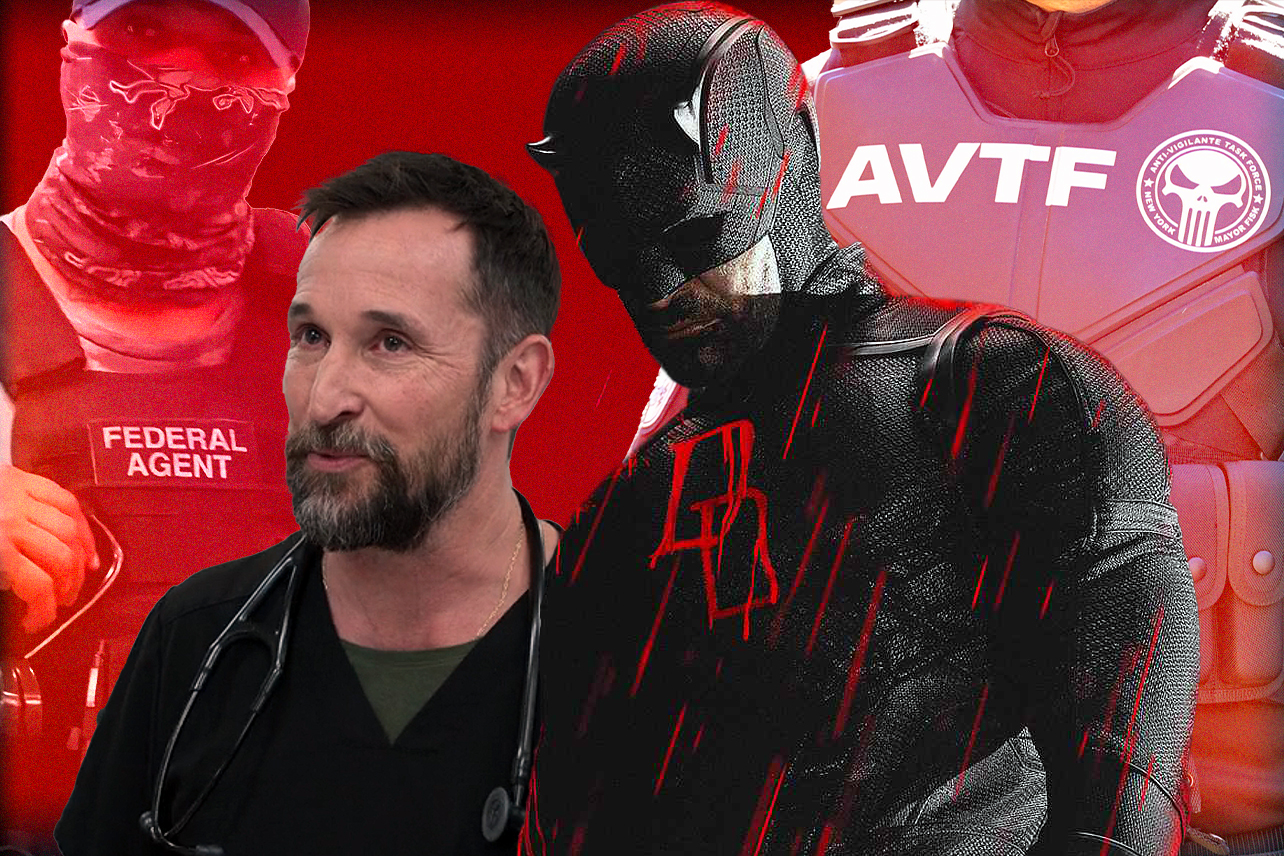
This season, Fisk directly commands a paramilitary offshoot of existing law enforcement called the Anti-Vigilante Task Force, originally formed exclusively of NYPD officers with police brutality complaints. Their uniforms feature Punisher skulls of the sort favored by real-world right-wing law-enforcement types like FBI Director Kash Patel.
In addition to tracking down superheroic vigilantes of the sort Marvel’s New York is famous for, the AVTF are also wielded against the immigrant communities upon whose cheap labor Fisk’s economy relies, and on protesters and activists combatting Fisk’s regime. People they arrest are disappeared to a warehouse where they are kept in cages and treated like animals. Fisk gives his goons free rein to pursue these goals: “no warrants, no due process, no body cameras.” One character calls them “fascist,” straight up, using a word that co-creator/writer Dario Scardapane’s Disney+ colleague Tony Gilroy says the company forbade him to employ while promoting the similarly themed Andor.
The show’s use of the MCU to mirror the second Trump administration, already impossible to miss in Season 1, has only grown more prismatic in its approach. Fisk is revealed to have ties to American intelligence. A close associate is directly implicated in war crimes. The city’s chief judges roll over. Lili Taylor plays a barely disguised Governor Kathy Hochul. There’s a disturbing premonition of the regime’s love of sinking boats full of people from other countries. The parallels to MAGA America are numerous, and not subtle.
But unlike Dr. Robby, Charlie Cox’s ripped-to-shreds Matt Murdock is an actual superhero, not just a metaphorical one. Living with superpowers in the Marvel Cinematic Universe gives him two distinct advantages over his world’s ICE equivalent, advantages that Robby lacks in his struggle with The Pitt’s realistic version.
First, he’s free to put on a cool costume and beat the living shit out of them. Is it cheap catharsis to watch Daredevil attack uniformed secret police — snapping their arms in half, beating their faces in, cracking their skulls with his cool ninja weaponry? Perhaps. But you need to be pretty angry to find watching this cathartic, and as many reports from this past weekend’s latest No Kings protests have indicated, millions of people are very, very angry at ICE and the people who unleashed it right now.
Second, Daredevil free to commit all this violence without Disney having to pay a bribe its way out of regulatory trouble because he’s not doing any of it to actual, literal ICE — just their extremely obvious fictional stand-ins. What are you gonna do, get angry because a superhero beat up a supervillain’s minions? Did you cry when Adam West and Burt Ward beat up the Joker’s henchmen too?
This season of Daredevil: Born Again feels like it plays out in the mind of The Pitt’s ferocious charge nurse Dana Evans (Katherin LaNasa) after watching Jesse get dragged away in zip-ties. The Pitt depicts the frustrating reality; Daredevil: Born Again is the dreamworld version, and as such it’s where dreams of justice can come true. No one here — certainly not me, and I don’t think anyone making either show — is under the impression that television is enough. Nor does the fact that Daredevil can kick the secret police in the teeth while Dr. Robby can’t make Born Again a more radical or more important work. But Daredevil demonstrates that with sufficient talent and courage behind the camera, even corporate superheroes can use their larger-than-life spectacle to express emotions we otherwise can’t. It’s amazing what you can get away with when you wear a mask.
Sean T. Collins (@seantcollins.com on Bluesky and theseantcollins on Patreon) has written about television for The New York Times, Vulture, Rolling Stone, and elsewhere. He is the author of Pain Don’t Hurt: Meditations on Road House. He lives with his family on Long Island.