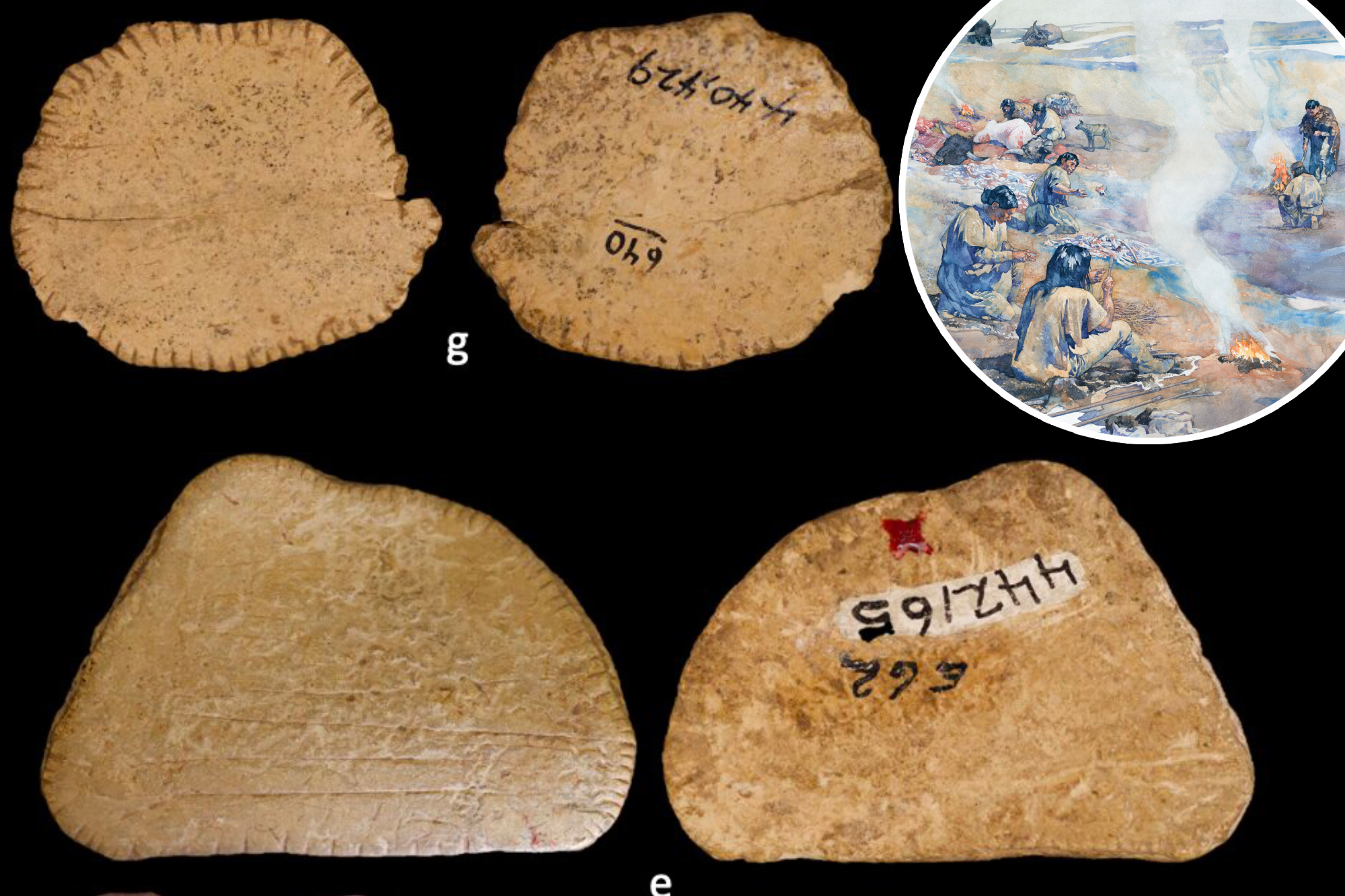
Sets of 12,000-year-old dice found in North America suggests that humans have been gambling since the last Ice Age. Robert Madden It was the Dice Age.
An analysis of 12,000-year-old Native American dice could potentially provide the first-ever proof of humans gambling, per a groundbreaking study published in the journal American Antiquity.
“This is the first evidence we have of structured human engagement with the concepts of chance and randomness,” study author Robert Madden, an anthropologist and PhD student at Colorado State University, told Livescience.
He noted that the game pieces preceded “evidence we have of dice in the Old World by 6,000 years,” indicating that indigenous North Americans were making these multi-sided randomness generators and using them in a game of chance as early as the last Ice Age.
Interestingly, the probability cubes themselves weren’t new, but their designation as dice was.
To confirm these artifacts’ function, Madden inspected over 600 sets of Native American dice from various prehistoric archaeological sites spanning the Western U.S — including both sides of the Rocky Mountains — and dating back between 13,000 and 450 years ago.
The researcher then vetted the potential game pieces using anthropologist Stewart Culin’s 100-year-old Native American games compendium, “Games of the North American Indians.”
To be classified as dice, the objects needed to meet four criteria: they needed to be at least two-sided and comprised of wood or bone; each side had to be differentiated, generally with paints or other markings; have sides that were either flat or curve; and boast the right size and shape for players to hold several simultaneously and cast them at a flat surface, Science Alert reported.
“In most cases, these objects had already been excavated and published,” said Madden. “What was missing wasn’t the evidence, it was a clear, continent-wide standard for recognizing what we were looking at.”
Using this method, Madden was able to definitely identify 565 examples of “diagnostic” dice — those that boasted all four features — and 94 “probable” dice that fit only two of the criteria.
Coincidentally, these dice weren’t the polka-dotted cubes seen on craps tales, but rather binary lots, defined by Culin as two-sided objects with different markings on each side.
However, just like their casino counterparts, these could be rolled and tossed to generate a random 50/50 option in a game of chance, much like a coin toss.
These dice reportedly spanned 58 archaeological sites in the Great Plains and the Rockies, with the oldest examples — including more than a dozen diagnostic dice — harking back to the Folsom culture, between around 12,200 and 12,800 years ago.
However, they claimed that one probable die, traced back to the Clovis people, could be as old as 13,000 years.
In either case, these artifacts are much older than the next-oldest examples of dice — 5,500-year-old items found in Asia and the Middle East. This doesn’t just wind back the clock on complex gambling, but on a specific type of arithmetic-based thinking.
“This finding is all the more significant because historians of mathematics frequently identify the invention of dice and games of chance as a crucial early step in humanity’s evolving discovery and understanding of randomness and the probabilistic nature of the Universe,” said Madden.
However, whereas the modern casino pits the individual against the house, researchers postulated that these ancient probability pursuits were more likely used as a networking device or “dice-breaker” between strangers who wanted to trade goods or information.
Ultimately, Madden said their findings illustrate that dice and gambling in general have been a “persistent feature” in native North American culture, helping facilitate social integration in their societies for thousands of years and into the present.