play Live Sign upShow navigation menuplay Live Click here to searchsearchSign upEXPLAINERNewsHow are NATO allies pushing back against Trump’s Iran war demands?Trump says he is considering a NATO exit as allies resist cooperation in US-Israel war on Iran. Here are the fractures emerging within the alliance.
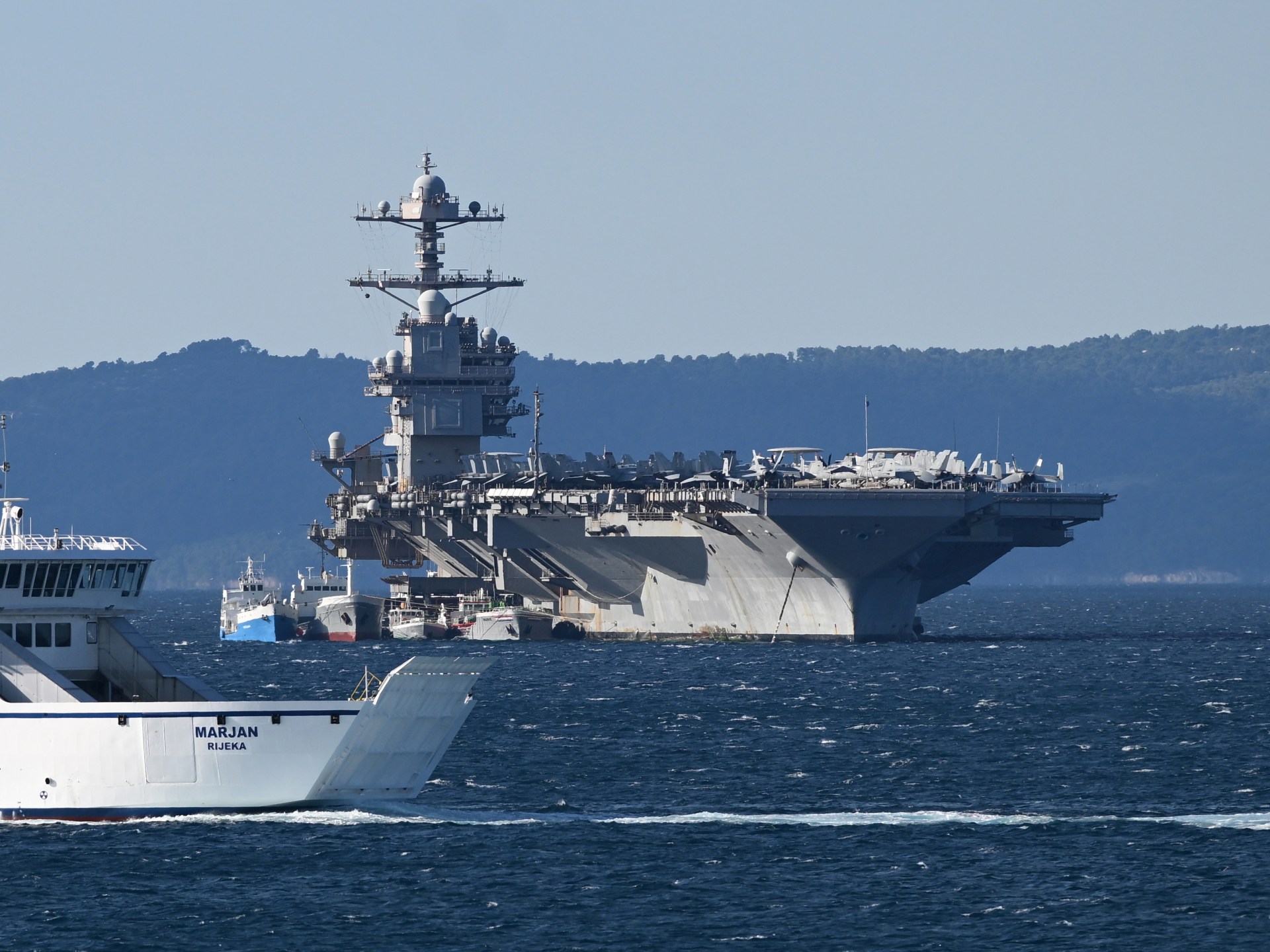
twitterwhatsappcopylinkgoogleAdd Al Jazeera on GoogleinfoThe USS Gerald R Ford was one of two US aircraft carriers deployed in the Middle East as part of the US-Israel war on Iran, but it is now anchored off Split, Croatia, for repairs after a noncombat fire on board [EPA]By Al Jazeera StaffPublished On 1 Apr 20261 Apr 2026United States President Donald Trump’s already fraught relationship with NATO allies is fraying further as the US-Israel war on Iran is in its second month. A growing number of partners are resisting Washington’s requests for support in the conflict, deepening a transatlantic rift.
From the deployment of naval forces to the Strait of Hormuz to the use of military bases in Europe, Trump wants more support from US allies. But their responses remain lukewarm and so does the Trump administration’s enthusiasm for them.
“I always knew they were a paper tiger,” Trump lashed out in an interview published on Wednesday in The Telegraph newspaper, saying he was strongly considering pulling out of NATO.
The same sense of disdain towards the allies was echoed a day earlier by Secretary of State Marco Rubio, who told Al Jazeera that if the transatlantic alliance was “just about defending Europe” but not the other way around, that’s “not a very good arrangement”. That, Rubio said, is going “to have to be re-examined”.
Reluctance in joining the war efforts among US allies was also evident after Trump’s repeated requests to help Washington in securing the opening of the Strait of Hormuz, a key waterway through which about a fifth of global oil and gas exports pass. Thanks to its geography, Iran has been able to bring traffic through the narrow chokepoint to a near-total halt by carrying out relatively few attacks on vessels there.
Italy, the UK, France, Greece and other countries have all responded with a flat no to the request of joining a naval coalition to open the strait. German Defence Minister Boris Pistorius gave his country’s reasoning behind such a position: “This is not our war. We have not started it.”
“Does … Trump expect a handful or two handfuls of European frigates to do in the Strait of Hormuz what the powerful US Navy cannot do?”
Still, some countries do have the capacity to help, such as support in minesweeping. Starmer said London was discussing with other allies the possibility of using its mine-hunting drones already in the region.
“All of those countries that can’t get jet fuel because of the Strait of Hormuz, like the United Kingdom, which refused to get involved in the decapitation of Iran, I have a suggestion for you: Number 1, buy from the U.S., we have plenty, and Number 2, build up some delayed courage, go to the Strait, and just TAKE IT,” Trump wrote on his Truth Social account this week.
Experts warned that comments from Trump and his cabinet members suggest mounting anger that could also take hold of the followers of the president’s Make America Great Again, or MAGA, movement.
“These things can accumulate momentum in Trump’s mind within the MAGA community,” Samir Puri, a visiting lecturer on war studies at King’s College London, told Al Jazeera, referring to what he described as “visceral anger voiced by Trump towards the UK and other European allies but also by [Defense Secretary] Pete Hegseth.”
As a result of the tensions over the war on Iran, he said, “The bond of NATO weakens further.”
Trump’s suggestion that allies should solve the de facto blockade in the Strait of Hormuz has added to concerns that he might be willing to end the war with Iran in control of the waterway. “What happens in the strait, we’re going to have nothing to do with,” Trump said.
Should that happen, NATO allies along with the rest of the world would face even greater economic repercussions.
Already, the slowdown in marine traffic through the waterway has caused major disruptions to the global economy with shipping companies afraid of attacks if they send their vessels through.
Oil and gas prices have gone up by up to 60 percent in some places, and some countries are facing serious shortages. Even if the waterway reopens tomorrow, the disruptions to global supply chains will be felt long after ships have been cleared to pass through the strait en masse, according to shipping and trade experts.
Highlighting those concerns, France’s Ministry of the Armed Forces said in a statement last week that Paris was in talks with about 35 countries for a mission to reopen the waterway once the war is over. The countries involved in the discussions were not named.