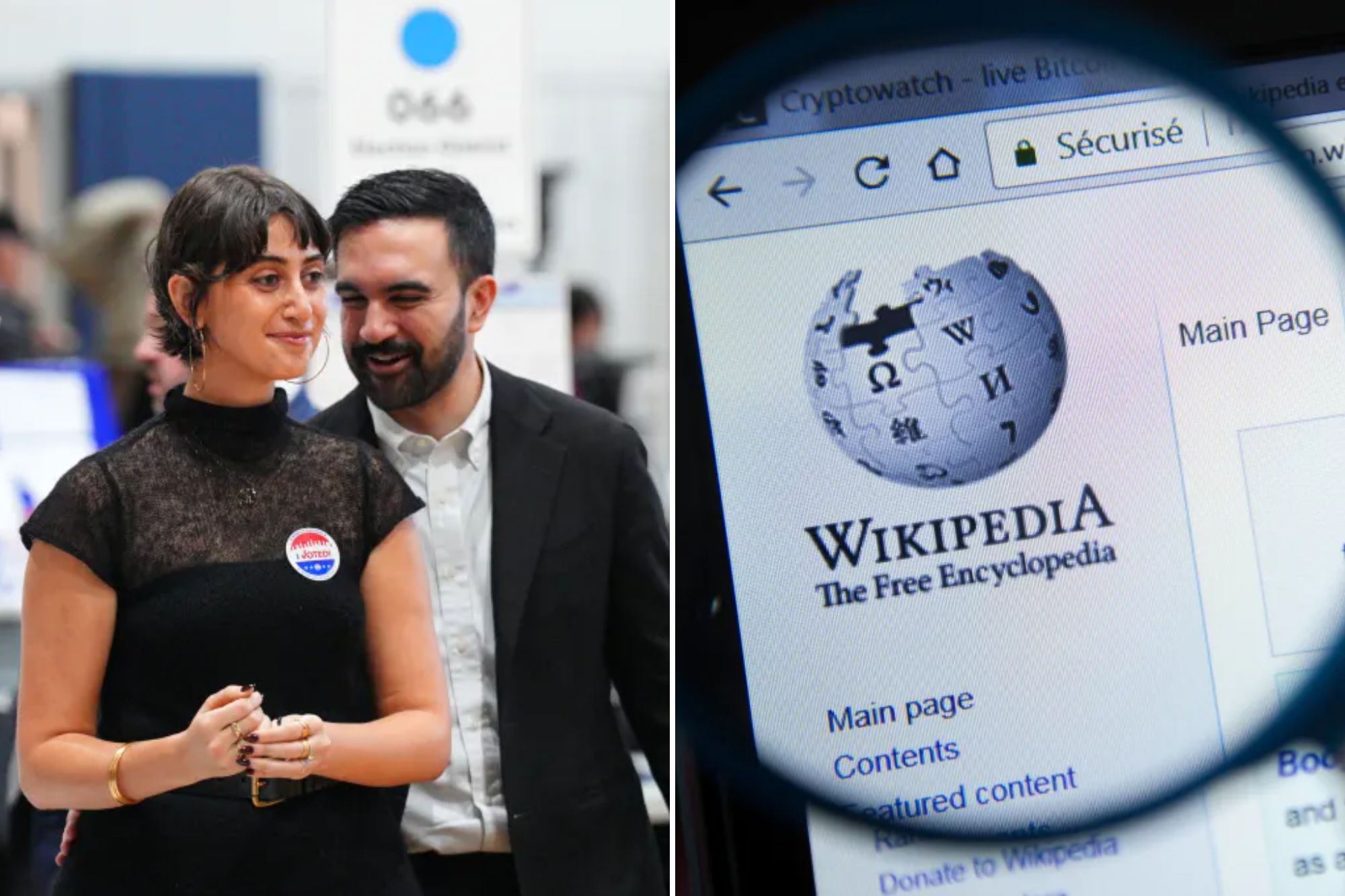
Wikipedia editors are helping politicians like Zohran Mamdani — and censoring outlets like The New York Post — by editing scandals out of entries.
For years, Mamdani has built relationships with the most radical groups in America. Before being elected mayor of New York City, he even went so far as to give a shout-out in one of the rap videos he recorded to five men convicted of financing Hamas — men who were held liable in federal court for the murder of a boy from New York City.
But Mamdani also has a solution, one afforded to far-left politicians: the media.
When The Post first broke the news of his infamous rap, mainstream media outlets ignored his pro-terror shoutout and instead focused on the cringe-inducing music, which Rolling Stone gushed over and Washington Post analyzed as part of his millennial bona fides.
What few realize is that this ideological Iron Dome doesn’t stop with the press. It extends into the infrastructure of information itself: Wikipedia.
In the early 2000s, Wikipedia was a novelty website that quickly evolved into the internet’s public square for shared knowledge. Today, it’s far more than that. Its data is training the AI systems that will determine our collective future. The thousands of seemingly insignificant editorial decisions by a small group of volunteer editors add up to a cohesive worldview — one that is shaping how our most advanced AI systems see the world.
A look at some key pages on the site reveals the lengths to which Wikipedia editors are willing to go to shape Mamdani’s public image — and, critically, that of his wife, Rama Duwaji. Over the past weeks, disturbing revelations have surfaced that the now first lady of New York City liked pro-Hamas social media posts in the wake of October 7.
A report by the Washington Free Beacon found that Duwaji created a post on blogging site Tumblr with the photo of PFLP terrorist Leila Khaled, with a caption echoing Khaled’s own words: “If it does good for my cause, I’ll be happy to accept death.” Duwaji also liked posts claiming that mass rapes committed by Hamas during the group’s genocidal rampage through Israel were “fabrications.”
She was also found to have used the n-word as well as a noxious slur against gay people. In the moral milieu of the left from which Mamdani and Duwaji hail, statements like these are disqualifying.
But on Wikipedia — and in the AI systems that increasingly rely on it — these details don’t disappear. They’re filtered, softened or reframed.
A look at Duwaji’s Wikipedia page shows how that works. The first line of the “Controversies” section states that she liked posts “supportive of the Palestinian cause” after October 7.
To be clear, Duwaji liked dozens of pro-Hamas posts tied to October 7 — some of the most extreme messaging circulating online at the time. But Wikipedia editors strip out that context and replace it with something safer, blander and far less accurate.
It gets worse. A single Wikipedia editor, IvanScrooge98, used a series of bureaucratic maneuvers in an attempt to keep these claims off Duwaji’s article altogether. The editor argued that, because The Post reported on these events, they weren’t worthy of inclusion.
Referring to The Post, IvanScrooge wrote: “If we need to cherrypick specific information … we shouldn’t even be using [that source].”
That’s because Wikipedia classifies The Post as “generally unreliable” — effectively sidelining it as a source.
While this seems targeted, the reality is that it’s part of a broader structural bias against conservative sources on the site, which blacklists outlets like Fox News, Breitbart, Newsmax, Epoch Times and the the DailyWire. Outlets on the left — no matter how far — like the Guardian, the Nation and the New Republic are blessed with a “Generally reliable” rating.
Even Chinese state media, like the CCP’s own China Daily, gets a high ranking (“somewhat reliable”). Al Jazeera, controlled by Qatar, an autocratic state ruled by the Al Thani royal family, is blessed with a “generally reliable rating.”
This is how Wikipedia — the site millions trust for quick facts — is quietly shaping what you’re allowed to see.
On the page of Rama Duwaji, IvanScrooge98 repeatedly stepped in to shape the narrative. At one point, he waved off sourced reporting as a smear. In another, he dismissed edits as “Zionist vandalism” and claimed the information was only controversial “if you support persecuting Palestinians.”
The Post has reached out to the Wikimedia Foundation, the nonprofit behind Wikipedia, for comment.
This isn’t just about New York City politics. In January, my reporting uncovered thousands of images and videos created by Iranian state media sources linked to the IRGC and uploaded to Wikipedia. I’ve found over 20,000 citations on the site using IRGC-linked state media as sources, and over 8,000 citations using sources linked to Hamas, Hezbollah and Palestinian Islamic Jihad — as well as around 100 citations of Al-Qaeda-linked media.
Behind the IvanScrooge account might be a real person. Or there might be something more coordinated, along the lines of an anti-Israel Wikipedia influence operation I exposed that is run by a well-resourced activism group called Tech For Palestine.
What’s clear is that this is not a good-faith attempt at achieving balance.
Instead, the account is part of a group of highly ideological editors working to push a far-left, anti-US, anti-Israel agenda. One small but representative example: IvanScrooge scrubbed the terms “murderer” and “terrorist” from an image of Che Guevara, a revolutionary icon linked to executions and political violence.
His praise for the Holy Land Five — men convicted in a major terrorism financing case — is softened into a bland line about people who were merely “arrested and connected” to a certain foundation. Far from “arrested and connected,” these men, all senior operatives in Hamas’ far-reaching network, were convicted for channeling charity funds to Hamas in what remains the largest terror financing criminal trial in US history. The “arrested” men received sentences ranging from 15 to 65 years in federal prison.
If a story comes from a conservative outlet, it gets treated as guilty until proven innocent by Wikipedia editors. A familiar protocol is activated. Editors demand extra sourcing, with the assumption that a right-of-center source is simply invalid. The inclusion of the information gets delayed. There is debate and discussion. Information coming from the other side of the ideological spectrum sails through.
It’s similar to how, when The Post broke the Hunter Biden laptop story in 2020, Big Tech didn’t debate it. They simply buried the story, blocked links, locked accounts and killed off any chances this piece of major breaking news had to inform voters looking to make their decision in the presidential election that was just days away.
In the aftermath of this censorship debacle, we were told that this was a one-off affair — a kind of lapse, a one-time case of overreach that wouldn’t happen again. In reality, the censoring of The Post’s Hunter Biden reporting became a template that is put to use on Wikipedia every single day.
What gets reported by the Post and a range of important conservative-leaning outlets is instantly memory-holed by a system that’s been designed to do just that. It’s the equivalent of sending unwanted email straight to spam, regardless of whether the reporting is accurate, relevant or — let’s not forget — newsworthy.
If the inputs into what is quickly shaping up to be humanity’s most powerful information architecture are skewed — if they are deliberately curated on sites like Wikipedia to boost one side of the political aisle and redact to erase another — the output will be too. And we’ve already seen where that leads and who it protects: politicians like Zohran Mamdani whose records are being quietly rewritten in ways that even the most expensive Manhattan PR firms could have once only imagined.