play Live Sign upShow navigation menuplay Live Click here to searchsearchSign upFeatures|Politics‘Gerrymandering’ in India’s Assam cuts Muslim representation before voteMuslims formed the majority in about 35 of the state’s 126 constituencies. Now that is down to about 20 seats. Assam votes on April 9.
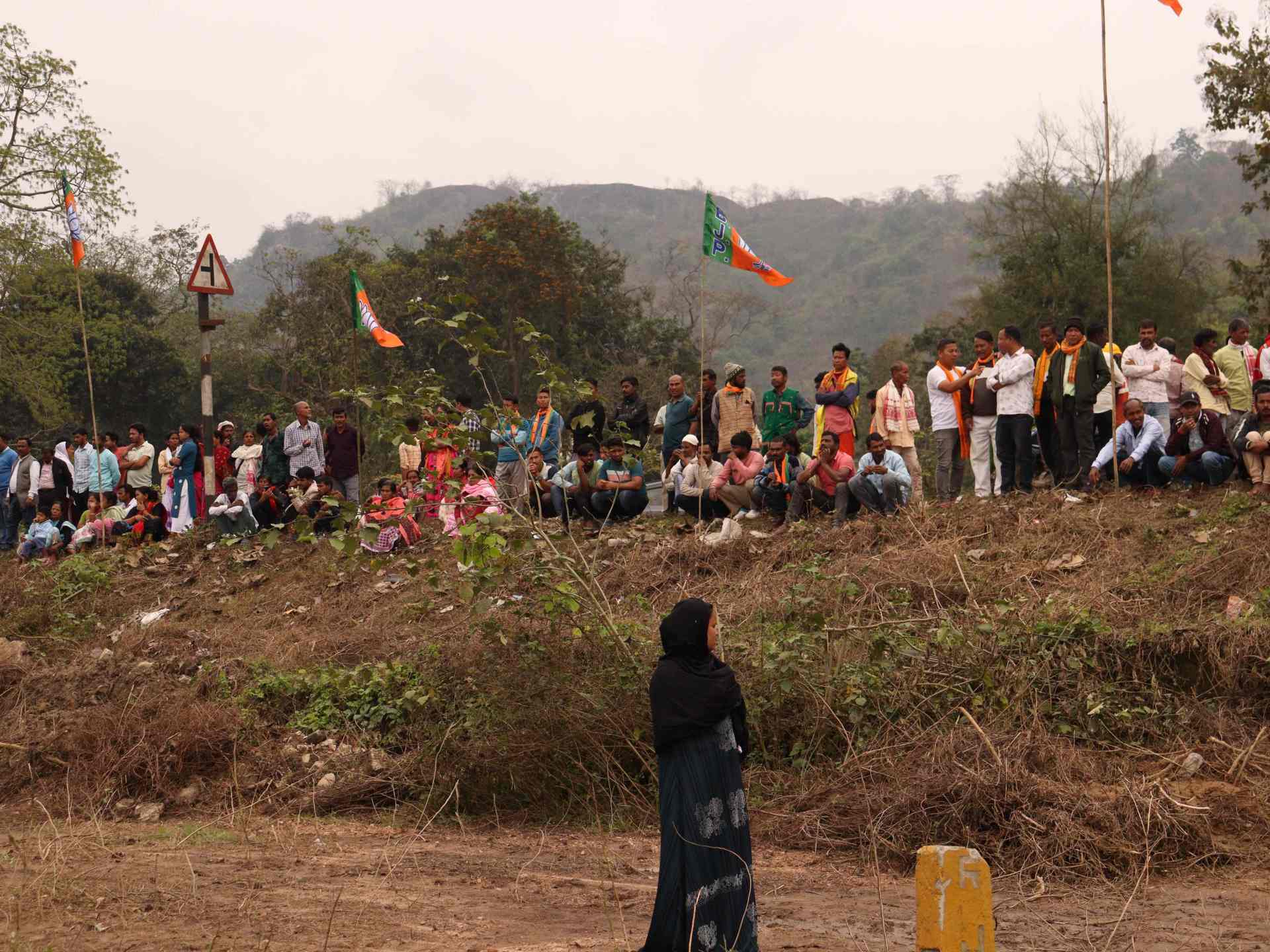
twitterwhatsappcopylinkgoogleAdd Al Jazeera on GoogleinfoA Muslim woman stands before an election rally of the ruling BJP in Assam, India [Arshad Ahmed/ Al Jazeera]By Arshad AhmedPublished On 1 Apr 20261 Apr 2026Assam, India – When elections are around, Islam Uddin takes it upon himself to raise awareness about the importance of casting votes. The 55-year-old retired teacher from Katigorah, an electoral constituency in India’s northeastern state of Assam that lies on the border with Bangladesh, goes door-to-door to urge other Muslims to vote.
“It’s about sending our representative to speak for us,” Uddin told Al Jazeera, his smile widening.
But as Assam goes to the polls on April 9 to choose a new government after five years, Uddin’s excitement is clouded by a constant worry: Will his efforts even matter?
Following a 2023 order from the Election Commission of India to redraw the boundaries of parliamentary and state legislature constituencies in Assam, the electoral math of Katigorah – bordered by the ancient Borail hills to the north and the Barak River to the south – has dramatically changed.
The constituency’s population was previously split almost equally between Hindus and Muslims. Of the state’s main parties, Prime Minister Narendra Modi’s Bharatiya Janata Party – which also rules Assam state – would pick a Hindu candidate. The opposition Congress would often choose a Muslim candidate, as would the All India United Democratic Front, the state’s third largest party, which counts Bengali-speaking Muslims among its key voters.
Before delimitation – the process of redrawing constituency boundaries is called – Katigorah had about 1,74,000 voters. “But about 40,000 Hindu voters from the neighbouring legislative constituencies have now been merged with Katigorah, making it a predominantly Hindu majority constituency,” Khalil Uddin Mazumder, former Katigorah legislator from the Congress party, told Al Jazeera. “The chances of electing a Muslim candidate from here have suffered significantly.”
Indeed, major parties have chosen Hindu candidates for Katigorah. But the constituency is not alone. Across the state’s 126 legislative constituencies, borders have been redrawn in a way that – activists like Uddin fear – could politically marginalise Assam’s 11 million Muslims further at a time when the ruling BJP has already targeted them through eviction drives, expulsion policies and vitriolic rhetoric.
Muslims constitute more than 34 percent of Assam’s population – only Jammu and Kashmir, and the island of Lakshadweep have higher proportions of Muslims, and neither is a full-fledged state, unlike Assam.
To many political analysts, Assam is the latest laboratory of the BJP’s Hindu majoritarian policies. What works in the state could offer a template for the rest of India.
Prominent poll analyst Yogendra Yadav, writing in The Indian Express newspaper, referred to the Assam model of delimitation as “communal gerrymandering”, likening it to 18th-century United States racial gerrymandering, where electoral boundaries were manipulated or redrawn to favour a dominant group or diminish marginalised groups’ electoral influence.
In Assam’s context, gerrymandering weakens the electoral influence of Muslims, Yadav argued, by deploying techniques borrowed from the US: Cracking, packing, and stacking. “Cracking” refers to the fragmentation of Muslim voters across multiple Hindu majority constituencies, therefore minimising their chance to form a majority in constituencies. In the case of “packing”, multiple Muslim-dominated pockets – which could have dominated several constituencies – were clubbed into a single seat to reduce the number of constituencies that Muslim candidates can viably win.
In parallel, Hindu population centres that were not each capable of forming a majority in a constituency were merged under a single constituency to give the community that majority. That is what Yadav described as “stacking”. The net result: Muslims formed the majority in about 35 of the state’s 126 constituencies before delimitation. That number is now down to about 20, say opposition leaders and experts.
Speaking to Al Jazeera, Suprakash Talukdar, the state’s secretary of the Communist Party of India (Marxist), said: “Hindu areas from far-flung Muslim-dominated seats were merged into constituencies with mixed populations, while Muslims from majority seats were dispersed into Hindu-majority areas.”
The Election Commission’s manual for delimitation states that boundaries should be redrawn in a way that no area of one constituency is cut off from the rest of that constituency by being surrounded by another constituency. “Apart from contiguity, geographical features,” the manual noted, “better connectivity, means of communication … [are to be] kept in view and areas divided by rivers…forests or ravines … will not be put in the same constituency.”
But Mazumdar, the former Katigorah legislator, said this policy had been violated in Assam’s delimitation exercise.
“Hindu areas from Badarpur, from far across the Barak river, were merged with Katigorah to make it a majority stronghold,” Mazumder said.
Legislative constituencies in the Muslim-majority Barak Valley’s Hailakandi district serve as examples, say experts and political leaders, of how the delimitation exercise has reshaped Assam’s landscape. In total, the legislative seats tally in Barak Valley, home to more than 1.7 million Bengali-speaking Muslims, went from 15 to 13 after delimitation.
Before the 2023 delimitation, three of the region’s seats – Algapur, Hailakandi, and Katlicherra – were represented mostly by Muslim candidates from the Congress party or the AIUDF.
But now Hindu pockets were carved out from Algapur and Katlicherra and merged with Hailakandi, making it a Hindu seat,” Ahmed Tohidus Jaman, a Barak Valley-based political researcher, told Al Jazeera.
The Naoboicha seat in the state assembly has previously elected Muslim legislators thrice. But under the delimitation, its Muslim-dominated pockets have been “split into four neighbouring Hindu majority constituency seats”, Azizur Rahman, who contested for the constituency on an AIUDF ticket in 2021, told Al Jazeera.
Now, the Naoboicha seat has been reserved for a Hindu candidate from a less privileged caste – several seats in India’s parliament and state assemblies are reserved for members of traditionally disadvantaged castes and tribes.
Rahman is now contesting the 2026 assembly election from a Muslim-majority seat in northern Assam. “They [the BJP] have crippled Muslim representation,” Rahman said, speaking at a rally.
Rebutting these criticisms, BJP spokesperson from Assam, Kishore Kr Upadhya, said on Facebook that the remapping exercise was not communal and that the Election Commission was responsible for it.
Al Jazeera sent a detailed questionnaire to Gyanesh Kumar, chief election commissioner of India, asking about the allegations of redrawn boundary manipulation, but has not received any response.
In Barpeta constituency, Nabab Mezbahul Alam, a Muslim voter, says the BJP is not even hiding attempts to reduce the political power of Muslims.
He referred to a recent remark by Assam cabinet minister Jayanta Mallah Baruah.“We delimitated the constituency on such lines that there’s no point for miyas [a derogatory slur for Bengali-speaking Muslims] to try and win it this time,” Baruah said, while campaigning in Barpeta.
Barpeta assembly seat has previously elected Muslims on four occasions. Now with redrawn boundaries, it is a Hindu-majority constituency, reserved for a Hindu lower-caste candidate. Explaining how Barpeta was turned into a Hindu-majority seat, former Barpeta legislator Abdur Rahim Ahmed told Al Jazeera that Hindu voters from Muslim-majority constituencies were added. “Muslims voters have now lost their voice in Barpeta,” Alam, also a lawyer, said. “Now no Muslim can represent us.”
The delimitation exercise had been a poll promise for the BJP to “protect the political rights” of “Indigenous people” -a reference to Assamese-speaking people – since the last assembly election in 2021.
In Assam, Bengali-speaking Muslims are often labelled “foreigners” — the state even has special tribunals to try cases involving those identified in this manner.
For decades, Assam’s politics has been shaped by agitation against alleged undocumented immigrants from Bangladesh. These anxieties stem from historical migration waves during British rule, when Bengali-speaking Hindu and Muslim communities moved from East Bengal to work in Assam’s tea estates and rice fields.
However, with Hindu majoritarianism making inroads under the BJP government, religion – rather than language or origin – has become the fundamental political faultline. “We have been politically emasculated,” Uddin, the retired teacher from Katigorah, said.
Alam, the lawyer from Barpeta, was more philosophical – and metaphorical. “It feels like you’ve given us hands, feet and head to move and see,” he said, “but you muted our voice.”