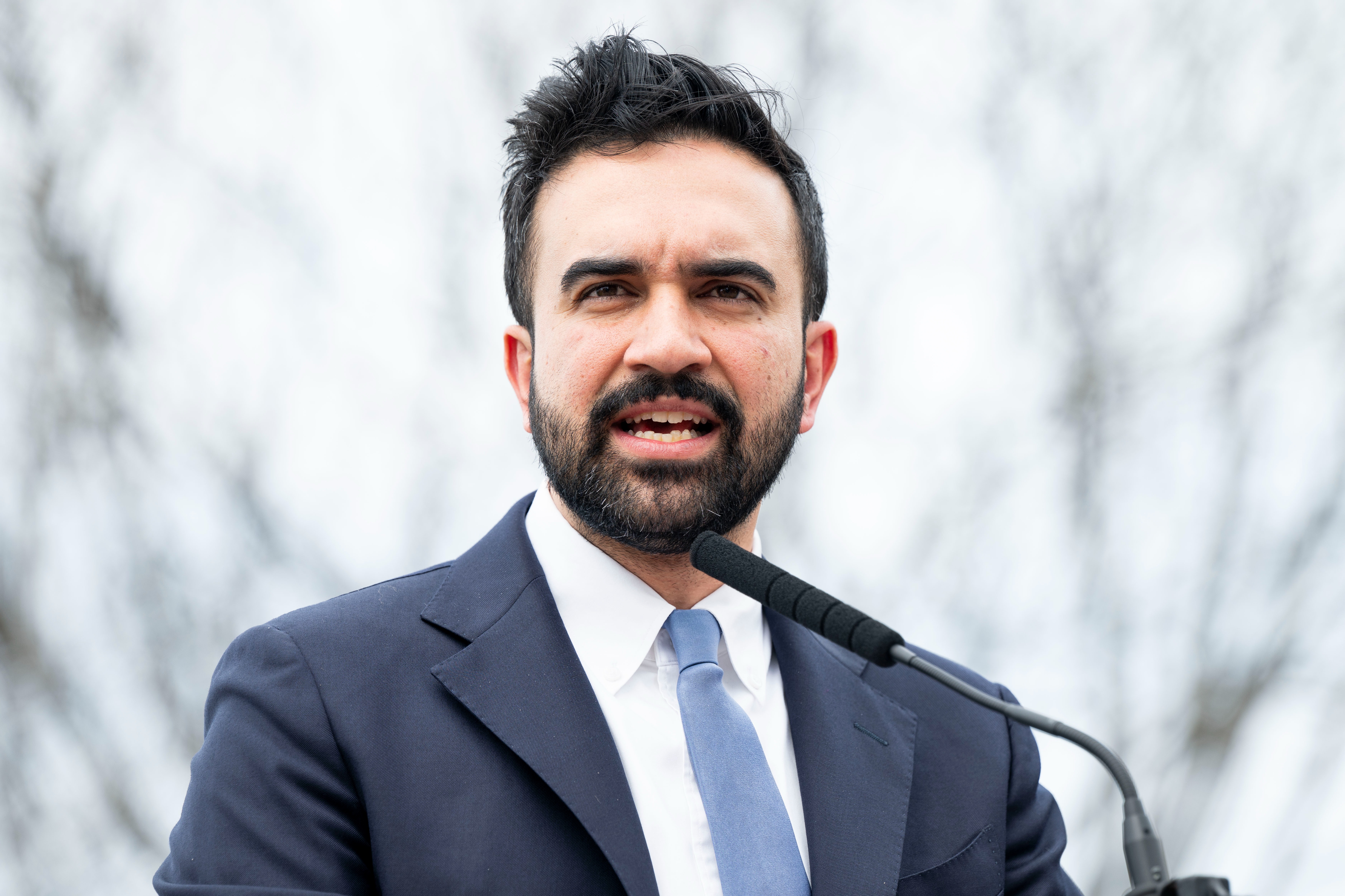
New York City Mayor Zohran Mamdani speaking at a press conference about catch basins, at Sunset Park in Brooklyn, New York City. Michael Brochstein/ZUMA / SplashNews.com Zohran Mamdani has a problem with the black political establishment, as well as the black middle class.
And he knows it, hence his pilgrimage to Greater Allen AME Cathedral in Queens on Palm Sunday.
It was no accident that he was seated next to Rep. Gregory Meeks, the boss of the Queens Democratic machine, and Queens Borough President Donovan Richards.
But proximity to establishment leadership does not make up for the lack of a working political relationship — or bad ideas.
Greater Allen AME, and in particular that section of Queens, is home to New York’s greatest concentration of the black middle class — professionals, civil servants, corporate workers, Democratic operatives and, most importantly, homeowners.
These are the people Mamdani addressed on Palm Sunday about the evil of . . . city tax liens sales and how those sales force black New Yorkers out of the city.
Surprisingly, the mayor didn’t attempt to quell concerns about his own two tax proposals, which directly threaten their ability to own their homes or to pass on the wealth generated by those properties to their heirs.
Mamdani didn’t dare speak about his threatened 9.5% property tax hike or his push to lower the “death” tax threshold, the state’s estate-tax exemption, from $7 million to $750,000, and tripling the top rate to 50%.
The median sale price for a home in Southeast Queens is fast approaching $750,000.
Not only are Mamdani’s politics and policies far to the left of middle-class black Democrats, his policies would rob them of the generational wealth they’ve spent a lifetime building.
For Mamdani, who grew up in a Marxist household and inside the Democratic Socialists of America, the political debate is about class warfare, poor vs. rich, without thinking of the implications for the black middle class.
Our privileged socialist mayor would understand this if he had real relationships with black Democrats.
But there are hardly any in Mamdani’s inner circle.
Mamdani took three months to hire a black deputy mayor — Renita Francois as deputy mayor for community safety — which was seen by many critics as a slap to the black community.
“For 50 years, every administration saw the value of representation that a black deputy mayor conveys,” thundered one angry Democratic operative.
Another grumbled that not only did it take Mamdani too long to appoint a black deputy mayor, “he gave her the hardest job with the least resources and no damn blueprint.
“Deputy Mayor Francois is managing offices, not even full agencies.”
More than one black political operative has grumbled that, for all his faults, former Mayor Eric Adams had “black people in his administration holding real power.”
Policing is another policy area where Mamdani is out of step with this segment of black New Yorkers.
If Mamdani took the time to speak with black homeowners, he’d learn that they oppose defunding the NYPD, instead wanting lawbreakers arrested and taken off city streets.
Many African Americans are frustrated that Mamdani has ignored the plight of NYCHA residents, while giving significant attention to improving conditions for cyclists and illegal immigrants.
Mamdani is catering to his younger, white, college-educated base, which leans far more left than to the city’s more pragmatic black political establishment.
But black Democrats are not only more moderate in general, they’re a still-potent constituency in city politics.
If Mamdani continues to regard the black political class as unimportant, it will come back to bite him. They won’t be inclined to back his socialist policies. And they will be looking to defeat him in 2029.
Michael Benjamin is a former state assemblyman and a member of The Post’s editorial board.