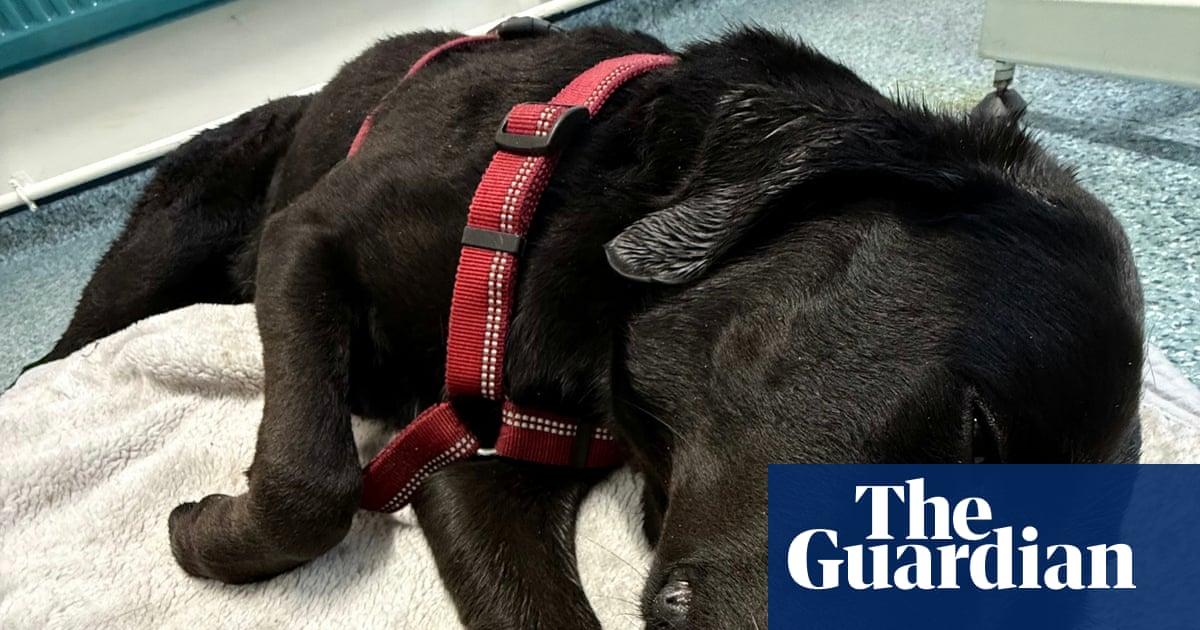
Tokyo, a Labrador retriever, recovering in Fort William, Scotland, after digesting a neurotoxin.View image in fullscreenTokyo, a Labrador retriever, recovering in Fort William, Scotland, after digesting a neurotoxin.‘She was swaying, zoning out’: UK pets poisoned in record numbers by illicit drugsToxicology helplines report 42% increase in calls involving animals poisoned by drugs and nicotine
A record number of pets are ingesting recreational drugs and requiring veterinary care in the UK, figures shared with the Guardian reveal.
Last year, the UK’s only emergency poison centre for animals received its highest ever number of calls involving animals poisoned by cannabis, cocaine, magic mushrooms and nicotine, and it is on course to do so again this year.
The centre runs two emergency phone lines, the Veterinary Poisons Information Service (VPIS) for vets and the Animal PoisonLine (APL) for owners.
Pet owners are reporting that dogs in particular have poisoned themselves by finding and eating the vomit or faeces of a drug user, or abandoned food laced with drugs. Others have been poisoned after swallowing discarded nicotine gum, vaping fluid or other recreational drug products.
Dr Nicola Robinson, the VPIS head of service, said: “It’s quite remarkable what dogs decide to eat. Cats think before they eat, so there are far fewer cases of cats [being poisoned] than dogs.”
In 2025, there was a 42% increase in calls to toxicology specialist helplines involving recreational drugs and nicotine, from 445 calls in 2024 to 633. This exceeded a 26% increase in total calls to the VPIS and APL over the same period.
“We’re very busy at the moment, so I expect we’ll have a record year again this year,” Robinson said.
On average, the poison centre receives a call a day about an animal that has ingested recreational drugs, and it is dealing with 87% more cases than it did in 2021. The greatest numbers of calls concern nicotine products and cannabis.
Robinson said cannabis was a growing problem. “It’s amazing how many pets get it in a public place – in an alleyway, a public park or even in quite rural places like the woods.”
The dog insurer Waggel has seen a rise in the number of cannabis claims owners have made over the past five years. “Highly food-motivated breeds like labradors, golden retrievers and beagles are most at risk,” said Aimee Warner, a Waggel vet.
Pamela Wesson, 72, no longer lets her dog Lola off the lead in Mill Road cemetery in central Cambridge, a Victorian burial ground that is now a wildlife haven.
View image in fullscreenPamela Wesson and her dog, Lola, who was poisoned in a Cambridge cemetery. Photograph: Pamela WessonLola, a jack russell crossed with a pug, used to run into bushes and come out licking her lips having eaten something she shouldn’t have. “I’d have a little yucky laugh with the other dog owners nearby: ‘Oh no, there she goes again,’” said Wesson. “I certainly wouldn’t say that any more with a light heart.”
On Christmas Eve 2023, Lola darted into some bushes and emerged “looking guilty”, said Wesson. “Very soon after that, at home, her legs started sliding out from under her and then she collapsed. I thought she was going to die.”
She rushed Lola to the emergency vet, who diagnosed toxin ingestion. Police have seized class A and B drugs during patrols of the cemetery, and Wesson suspects Lola – who made a full recovery after an expensive overnight stay – was poisoned by eating residues of drugs in human waste.
“The cemetery is a beautiful place to walk – it’s soul-enhancing, if you ignore the drawbacks,” Wesson said. “But it’s incredibly dangerous, what some of these people do. If Lola had died I would have been heartbroken.”
Robinson recommends that any animal poisoned by a recreational drug is immediately taken to see a vet. “I would not recommend owners waste time calling us on the Animal PoisonLine. Go to the vets and let the vet ring and get treatment advice if they need it,” Robinson said.
Christina Bluhme and her son Magnus were nearly at the top of Ben Nevis when they noticed their six-year-old labrador, Tokyo, was behaving oddly. “She started losing her weight bearance on her hind legs – her legs kind of went [from] under her,” she says. “She was swaying, zoning in and out.”
View image in fullscreenChristina Bluhme and Tokyo, who was stretchered off Ben Nevis by a mountain rescue team. Photograph: noneThey decided to turn back, fearing the normally agile dog had suffered a stroke while climbing Britain’s tallest peak. But Tokyo refused to move. “She just lay down and was completely lifeless.”
Bluhme, a 50-year-old dog trainer from Surrey, tried to carry the 24kg dog down the mountain but was unable to get very far.
Read moreIn desperation, she called the emergency services and discovered a team from Lochaber mountain rescue were already descending the 1,345-metre (4,413ft) summit after rescuing a hiker. Alerted to the dog’s plight, they rushed Tokyo down the mountain on a stretcher.
A senior emergency vet who was waiting in a nearby clinic saw that the dog was exhibiting signs of having digested a neurotoxin and a call to the VPIS confirmed this. “She had every symptom,” Bluhme says. “She couldn’t control her bladder, she was drifting in and out of consciousness, her body temperature was really low, and when the vet took her temperature, we could actually smell the cannabis she was digesting, coming from her behind.”
After being treated with activated coal to absorb the cannabis in her gut, Tokyo made a full recovery. The vet’s bill, which included an overnight stay, came to £1,121, which was settled by Bluhme’s insurer, Petplan.
After appearing on ITV’s This Morning to talk about what happened, Bluhme was inundated with hundreds of messages from people with similar experiences, she says. “It’s opened my eyes to a problem that’s just crazy.”
On social media, people have made jokes about Tokyo experiencing a high on a high or getting munchies on the mountain, which Bluhme has tried not to read. “It’s really not funny. It’s a real problem.”