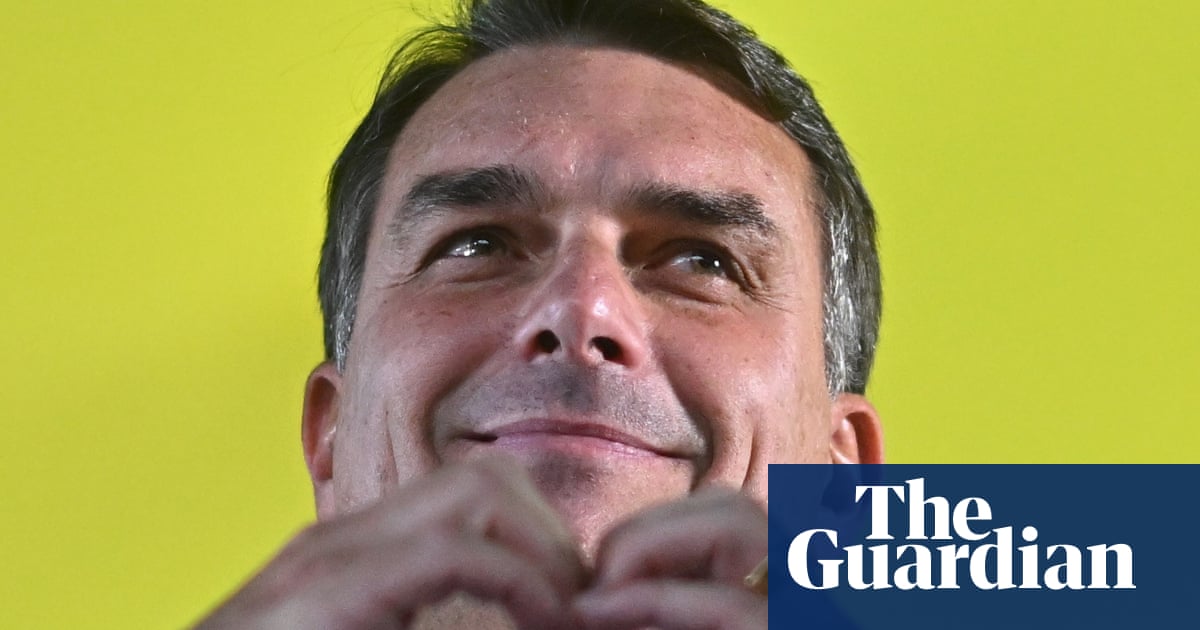
Flavio Bolsonaro, 45, goes into the 25 October run-off as favourite after a first-round win against Luiz Inácio Lula da Silva in Sunday’s presidential election. Photograph: André Borges/EPAView image in fullscreenFlavio Bolsonaro, 45, goes into the 25 October run-off as favourite after a first-round win against Luiz Inácio Lula da Silva in Sunday’s presidential election. Photograph: André Borges/EPA‘Another coup d’état’: fears grow as Flávio Bolsonaro vows to ‘re-democratise’ BrazilAfter a surprise first-round victory, critics suggest son of disgraced ex-president could seek to continue his father’s authoritarian rule
Flávio’s surprise first-round win highlights rapid rise of Brazil’s House of Bolsonaro
Flávio Bolsonaro, the far-right frontrunner to become Brazil’s next president, has vowed to “re-democratise” the South American country, fuelling fears over a move into authoritarian rule if he wins power.
Brazil was re-democratised in the 1980s after a brutal 21-year dictatorship that Flávio’s father, the disgraced ex-president, Jair Bolsonaro, has long praised.
Read moreLast year, Jair Bolsonaro, a former soldier who served under that military regime, was jailed for 27 years for trying to engineer a coup after he lost the 2022 election to the current leftwing president, Luiz Inácio Lula da Silva.
But Flávio, 45, beat Lula, 80, in Sunday’s presidential election first round and goes into the 25 October run-off as favourite. On Tuesday, the rightwinger vowed to capitalise on the hugely increased far-right presence in congress after the election to change the constitution and “re-democratise this country”.
“The only thing standing in the way of Brazil becoming a barbarity is called Flávio Bolsonaro as president,” he claimed at a campaign event in Goiânia, a city near the capital, Brasília.
The incendiary comments caused outrage among historians and opponents of Bolsonaro’s radical populist movement, who have accused him of co-opting the language of democracy to disguise an illiberal shift.
View image in fullscreenFlavio Bolsonaro raises hands with former presidential candidate Ronaldo Caiado (left) and Sao Paulo governor Tarcisio de Freitas during a rally in Goiania, Goias state, Brazil. Photograph: Sérgio Lima/AFP/Getty ImagesTalíria Petrone, the leftwing congresswoman, wrote on X: “This is the announcement of a coup.”
Marcelo Freixo, a newly elected congressman from Lula’s Workers’ party (PT), said: “Brazil was re-democratised in 1988. The person who tried to undo this was his father, who was convicted of an attempted coup. What they want, once again, is a coup.”
Bolsonaro did not spell out what he meant by “re-democratising” Brazil, a vibrant if polarised multi-party democracy which the Sweden based V-Dem institute ranks 28th on its liberal democracy index, two places ahead of the UK and 23 ahead of the US.
But Jair Bolsonaro, who has praised authoritarian leaders including Chile’s former dictator Augusto Pinochet, has long hankered for a return to military rule.
Last September, the supreme court found Jair Bolsonaro guilty of trying to convince military chiefs to help him cling to power at the end of his 2018-2022 presidency. The conspiracy culminated in the 8 January 2023 riots in Brasília, a far-right insurrection seemingly inspired by the January 6 storming of the US Capitol.
Writing in the O Globo newspaper, Míriam Leitão, a prominent political and economic journalist, warned that, if Bolsonaro won, Brazil faced “the extreme and concrete danger of … another coup d’état attempt”.
“Flávio follows the same ideas as his father and has already said that an intervention in the institutions is necessary,” Leitão wrote.
“If Flávio Bolsonaro is elected, he will have more tools at his disposal to carry out his father’s authoritarian project: robust caucuses in the lower house and senate, a weakened supreme court, and the support of the Donald Trump administration. Political science shows that it’s in the second term that an autocrat doubles down on their plan. Look at the case of Donald Trump. The risk isn’t of the son repeating the father, it’s that he surpasses him,” Leitão said.
View image in fullscreenSupporters of Brazilian presidential candidate Flavio Bolsonaro flash victory signs during a rally ahead of the presidential election runoff. Photograph: Adriano Machado/ReutersPolitical scientist Miguel Lago said Sunday’s far-right election triumph – in which Bolsonaro’s Liberal party (PL) secured the senate’s largest caucus, with 28 of its 81 seats – would permit radical changes, including the impeachment of supreme court ministers considered enemies of the Bolsonarismo movement.
Jair Bolsonaro and his jailed co-conspirators are also likely to be freed if his son wins, with the former president expected to become an influential minister able to select the new heads of the armed forces.
“It’s better than a coup d’état … it’s almost like a coup d’état with the support of the majority of the population,” Lago said.
Nayib Bukele, El Salvador’s authoritarian president, has been accused of “killing” democracy by using control over the country’s congress and institutions to approve sweeping constitutional changes, including scrapping presidential term limits so he can seek indefinite re-election.
Flávio Bolsonaro recently met Bukele’s security minister, Gustavo Villatoro, in São Paulo, hailing the Central American country’s hardline security policies, which have seen thousands jailed during a state of exception that has lasted nearly five years. Bolsonaro told reporters that during their conversation, Villatoro “stressed the importance” of using control of congress to make the “necessary legal changes”.
On Tuesday, the president of Bolsonaro’s party, Valdemar Costa Neto, said that if Flávio Bolsonaro became president, he would release his father, who would then be “a strong candidate” in the 2030 presidential election.