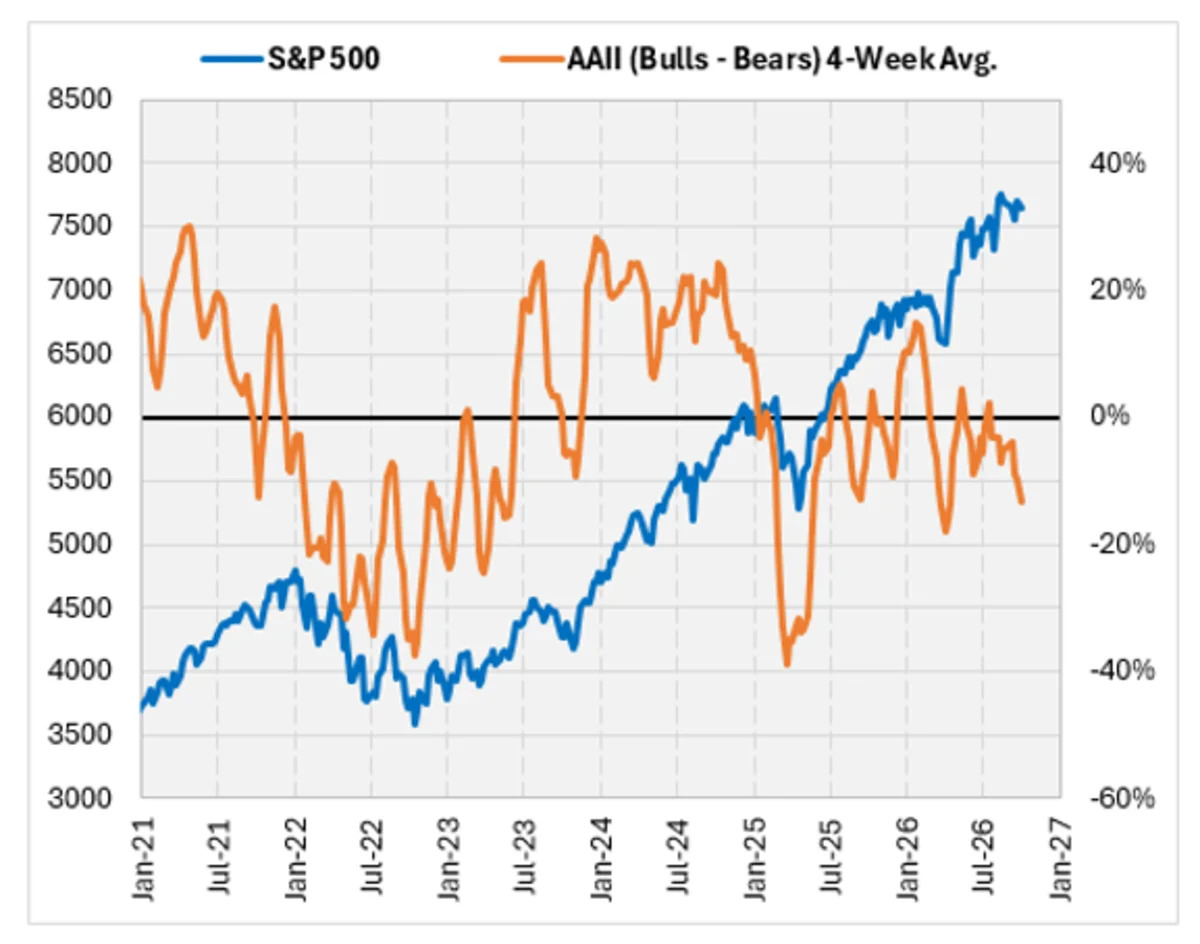
^GSPC +0.58% The S&P 500 Index (SPX) is at all-time highs, but individual investors aren't buying it. That's according to recent survey results from the American Association of Individual Investors (AAII). Each week, the AAII asks their members whether they are bullish, bearish, or neutral on the stock market over the next six months. The chart below shows the SPX along with the four-week average of the bullish investors minus the bearish investors.
The SPX hit a new all-time high yesterday, even as this poll shows bearish investors outnumbering bullish ones by over 10 percentage points. Individual investors have a reputation for being poor market timers, which is why polls like this are considered contrarian indicators. This week, I'll look at the historical data to see whether that reputation is justified and whether their bearish sentiment gives us any insight into where stocks go from here.
I looked at the AAII weekly sentiment survey results going back to 1990. The table below shows the SPX forward returns based on the four-week average of the bulls minus bears line.
The SPX has been especially strong going forward when bears have been 10 percentage points more than the bulls, as they are now. For every time frame below, from two weeks to 12 months, the SPX shows the best average return when the sentiment is at this level based on this poll.
When the AAII poll shows the most optimism, we see the lowest forward returns for the index at two weeks, six months, and a year. The one and three-month returns aren't the lowest but still underperform their typical return.
In short, the historical data shows the AAII sentiment survey to be a reliable contrarian indicator, so it's good news their members are especially bearish now.
This next table gives more context to the six month returns in the table above. When the bears outpaced the bulls by at least 10 percentage points, the SPX averaged a return of 7.86% with 78% of the returns positive. Both figures are the best in the table. However, this setup has also led to the most volatility. When the index has gone higher, it has averaged a return of 13% and when it has declined, it's been by an average of 11.7%. Both of those are highest in magnitude among the sentiment buckets. In other words, we might expect the market to pick a direction and go.
The bearishness in the AAII poll is especially notable because of how well stocks have performed. The latest survey, in which the four-week average of the bulls minus bears fell below -10%, the SPX closed within 2% of its all-time high. The index has been near its high for some time now.
The table above shows 299 readings in which the four-week average of bears was at least 10% above the bulls. I separated those reports by whether the SPX was within 5% of its all-time high or not. The SPX averaged a better return when it was more than 5% off the high compared to within 5% (8.18% vs. 6.47%). However, the smaller average return, which was still better than its typical six-month return, had an impressive percent positive of 88% and based on the average positive and negative, there tended to be less volatility.
In the analysis above, I showed the AAII sentiment survey has been a reliable contrarian indicator. So, it bodes well for the stock market that the bears in the survey have significantly outnumbered the bulls. This sentiment level is more interesting with the bears sitting near an all-time high.
Historically when bears outnumbered the bulls by at least 10 percentage points and the SPX was at least 5% off its high, the index averaged a return of 8.2% over the next six months with 76% of the returns positive. With the bearish sentiment and within 5% of the all-time high (our current situation), there was a slightly smaller average return of 6.5%, but that came with a higher percent positive of 88% and less volatility.