1:05Unseen footage of the first Battle of Hastings re-enactment in 1966 – video‘A God-almighty punch-up’: rare footage shows Battle of Hastings (the 1966 one)English Heritage acquires film of first re-enactment, ‘a lot of pushing and shoving’ between Kent and Sussex students
At the top of a hill in a field near Hastings, a group of defiant English combatants awaited the invading army of William the Conqueror, brandishing their spears and shouting “Harold! Harold!”.
Unfortunately, the Norman army had been held up in traffic on the A27 from Brighton, meaning the most significant battle in English history had to be delayed by 20 minutes while the French got into their costumes.
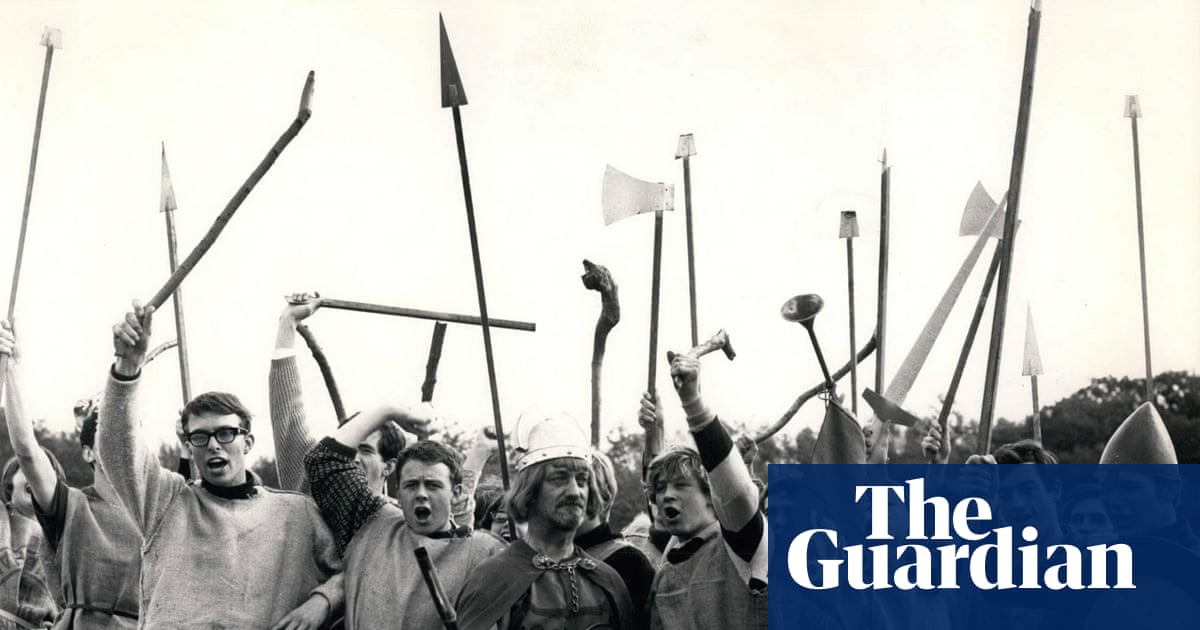
On 14 October 1966, when a group of 500 students from Kent and Sussex universities met to re-enact the Battle of Hastings to mark its 900th anniversary, not every aspect was strictly historically accurate. Yes, the event was being staged on the same fields outside Battle in East Sussex where the original clash happened, but the English were wearing belted sacks and their swords and axes were made of wood and hardboard that had been painted silver.
View image in fullscreen‘A pleasingly Monty Pythonesque record’: university students in combat at the first Battle of Hastings re-enactment in October 1966. Photograph: Keystone Press/AlamyThe rivalry between Kent and Sussex universities was real enough, however, according to Peter Sampson, a Sussex fresher who had been persuaded to sign up by the prospect of “a grand day out” and the promise of free beer. Once the two sides met, he says, it turned into “a God-almighty punch-up”.
“There was actually a lot of real pushing and shoving, a lot of fighting going on in there … My friend John got a big whack around the head with the end of a [fake] spear, which hurt his face quite a lot.”
Sixty years after that first re-enactment spawned an annual event which still attracts thousands of visitors each year, English Heritage has acquired rare colour footage of the inaugural event, at which a bemused French foreign minister attended, Queen Matilda was played by Miss World and health and safety was a far-off dream.
View image in fullscreenChaps in fake chainmail bonking each other on the heads with fake weapons: Battle of Hastings re-enactors in 1966. Photograph: Keystone Press/AlamyIt was filmed by Alan Wootton, an innovative manufacturer of electronics who lived in Hastings and had been invited to capture a film record of the celebrations by Hastings town council. The film came to light when Alan’s son Cliff, who had helped out on the day as a 12-year-old, recently visited Battle Abbey, the medieval foundation that was built on the site of the skirmish and is today overseen by English Heritage. He mentioned to a volunteer that he had 300 reels of film of the event, and would the charity be interested in seeing them?
The result – condensed into a 12-minute film – is a pleasingly Monty Pythonesque record of chaps in fake chainmail bonking each other on the heads with fake weapons while others ride around a bit on horses and 30,000 highly partisan (ie anti-French) spectators look on. (Though the era-defining British comedy, pedants will note, did not air until three years later.)
“When Cliff showed me the footage, I was blown away by it, it was really, really impressive,” says James Witcombe, the site manager of Battle Abbey.
View image in fullscreenRe-enactors marking the 950th anniversary of the Battle of Hastings in October 2016. Photograph: Jack Taylor/Getty ImagesThe film is, he says, very much of its time – and very different from the event which the charity has continued to stage every year since. “Looking at it from a modern perspective – yeah, it is a little bit of an interesting watch. I think the thing that’s very obvious is that it’s a load of amateurs getting together and really having fun … From our point of view, that’s the atmosphere that we want to preserve, just making sure we’ve got a few more sort of boundaries in place and nobody actually gets hurt.”
Present-day crowds still tend to back “the home side”, he says, though “it’s a bit less partisan than it used to be”. This year’s event will be staged on 10 and 11 October, with a full battle run-through each day (though the result, sadly for England fans, does not change).
View image in fullscreen‘It’s a bit less partisan than it used to be: thousands of visitors now attend the annual event (October 2018 pictured). Photograph: Jonny Weeks/The GuardianToday’s re-enactors – 1,000 combatants are expected this year – pay rather more attention to historical details, says Witcombe. “Whereas in 1966, there were knitted outfits and all that sort of stuff, the re-enactors today take it very seriously. It’s all about authenticity and, actually, experimental archaeology – [the idea that] living the experience gives you a much greater insight.” With the Bayeux tapestry’s presence in London having driven up interest in all things Norman, English Heritage is expecting bumper crowds – and is inviting any of those involved in the original 1966 event to come along.
As Sampson recalls, while the battlefield itself was certainly “edgy”, once hostilities ended after 25 minutes of fisticuffs, things became much more convivial. After the promised free beer did not materialise, “we took matters somewhat into our own hands and, shall we say, liberated a couple of beer kegs from the back of the refreshment tent.
“We cracked them open and then sat down with the Kent lads and lasses, and in the warm afternoon sunshine, just discussed the events of the day. So it became very friendly at the end of the day.”